
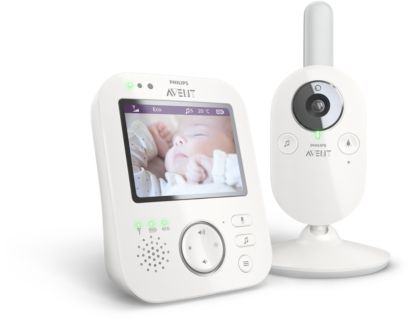
Your needs, this model
Does it fit your priorities?
For an existing SCD630/37 owner who wants one local camera picture on a dedicated receiver, what is documented—and does the model code clear the safety action?
The exact U.S. listing and manual describe one local Baby Unit-to-Parent Unit video path with a 3.5-inch color screen. But Philips and CPSC include SCD630 in a date-scoped battery action; the label/date code on the individual Parent Unit must be checked. Philips marks SCD630/37 discontinued, so it is not a purchase recommendation.
Explore this need in the finder →If the Parent Unit is charged, will SCD630/37 keep its camera picture running when household power fails?
No. Philips says the rechargeable battery is in the Parent Unit, while the Baby Unit has no charging function and only operates from mains power. Receiver battery does not power the camera. Choose a separately documented Baby Unit backup arrangement if this is essential; unknown battery backup cannot meet the requirement.
Explore this need in the finder →Does the SCD630/37 camera mechanically turn to follow a child when its Parent Unit is used to pan the picture?
No. The SCD630 manual describes turning the Baby Unit by hand and the product page describes 2× digital zoom/pan on the Parent Unit. That reframes the displayed image; it is not a confirmed motorized remote pan/tilt camera. The discontinued, recall-affected model is not a purchase recommendation in either case.
Explore this need in the finder →Philips Avent SCD630/37 is a discontinued local video system built around a 3.5-inch Parent Unit, infrared night vision, sound-triggered receiver modes and camera-side lullabies. The most consequential operating limit is easy to miss: its rechargeable Parent Unit does not keep the camera running in a power cut. This is an owner-reference review, not a reason to buy a used set; Philips and the U.S. CPSC include SCD630 in a battery safety action covering specified production dates.
A dedicated screen, not a phone camera
The exact U.S. listing identifies SCD630/37, marks it discontinued and describes a color 3.5-inch screen, adaptive FHSS pairing, automatic infrared night vision, 2× digital zoom/pan, talk-back, vibration and room-temperature functions. The manual describes one Baby Unit and a paired Parent Unit with receiver controls. It is a local one-room setup; the reviewed U.S. sources do not document a phone feed, simultaneous multiroom view or add-on camera limit. Do not infer those features from “pan” wording or a used listing.
The screen is larger than the SCD600/10’s 2.4-inch display. SCD630 also adds talk-back, vibration, temperature information, a Baby Unit nightlight and five lullabies. It is not a current choice: Philips marks it discontinued, and its safety notice changes the purchasing answer.
Four modes trade constant viewing for quiet intervals
The manual documents Video, Audio, VOX and Eco modes. Video keeps the display on, while Audio turns the screen off and leaves sound available. VOX turns off the receiver’s screen and sound after 20 seconds below the selected sound threshold, then restores them when the Baby Unit detects sound. Eco also pauses screen and sound transmission after a quiet interval; Philips says this reduces power use while the Parent Unit checks the connection periodically. Sensitivity has four settings, so a lower threshold can make quiet sounds more likely to wake the receiver, while a higher threshold filters more background activity.
These settings change how often the receiver wakes; they do not identify a cry or explain a sound. The sound-level lights indicate how much sound reached the Baby Unit, not a medical alert. A temperature reading is likewise a household indicator. Vibration follows the selected sound or temperature settings, not a separate clinical sensor.
Parent-unit battery does not equal camera backup
The Parent Unit has a built-in rechargeable lithium-ion battery that Philips says cannot be removed. The user manual gives an approximate ten hours of cordless Parent Unit use after a three-hour charge, but it does not tie that estimate to continuous-screen video. Brightness, volume, mode, battery age and the condition of an old set matter, so this is not a promise that a used receiver will last a full night in Video mode.
More important, the same manual says the Baby Unit does not have a charging function and works only while connected to mains power. If household power fails, the Parent Unit’s battery cannot keep the camera transmitting. An owner who needs the camera side to continue through an outage should choose a monitor with explicitly documented Baby Unit backup or a properly supported backup-power arrangement; an unknown capability should not satisfy that requirement. This differs from the later SCD843/37 support answer, which calls for charged batteries in its Baby Unit as well as a charged Parent Unit. Neither model is a recommendation here, and their accessories should not be assumed interchangeable.
Manual positioning, digital reframing and local nursery controls
On SCD630/37, pan is a digital adjustment after enabling zoom, not a motor turning the camera toward a moving child. The manual says the Baby Unit can be rotated by hand, placed on a stable surface or wall-mounted with screws. If remote mechanical pan or tilt is essential, this model does not meet it. The nightlight is controlled at the Baby Unit; lullabies can be started from either unit, with one selected song repeating about 15 minutes.
Philips lists up to 300 m (985 ft) outdoors and 50 m (165 ft) indoors. These are maxima, not furnished-home measurements. The manual describes range loss from walls, metal and other 2.4 GHz devices. Check reception where the Parent Unit will be used; follow its cord and mounting instructions. The monitor remains an aid, not a substitute for adult supervision.
Check the exact unit before operating or considering a used set
Philips marks the SCD630 product and support routes discontinued. Its 2023 voluntary replacement notice names SCD630 and SCD843 parent units produced from January 2016 through January 2020 and describes possible battery overheating while plugged in. Philips instructs owners to identify the model and production-date code on the Parent Unit and use the official replacement instructions; the notice also describes an exception for serial numbers beginning “SM.” The CPSC notice gives a narrower manufacture window of March 2016 through December 2019 for its U.S. recall description. Those are the sources’ stated date scopes, not a claim that every code is affected or that an unlisted unit has been safety-certified.
If this exact model is already in your home, inspect the label and follow the Philips replacement action and CPSC instructions before use. Do not buy a secondhand SCD630/37 based on appearance, claimed battery life or a seller’s conclusion that a date code is safe. For a current one-room dedicated-screen arrangement, compare the VTech VM819; for away-from-home phone viewing, compare a separately documented app system such as the VTech VM901HD. Use the Philips Avent local-video owner guide to distinguish the SCD630/37 from other Avent codes, not to infer camera compatibility. This review remains useful for understanding an exact unit, while its discontinued status and date-specific safety action keep it out of shopping recommendations.
Key details at a glance
| Parent-unit screen | 3.5 in |
|---|---|
| Camera-to-parent-unit connection | Direct local adaptive FHSS Baby Unit-to-Parent Unit link; exact product/support documents do not provide a router/app operating path. |
| Manufacturer-stated open-space range | 985 ft |
| Advertised maximum range claim | 985 ft |
| Cameras in the reviewed kit | 1 |
| Video rooms visible at once | 1 |
| Phone viewing away from home | No |
| User-replaceable parent-unit battery | No |
| Supplied camera lens setup | The Baby Unit can be rotated manually for placement. Philips documents 2× digital zoom and pan on the Parent Unit; the pan reframes the displayed picture and is not a motorized camera pan/tilt. The exact material reviewed does not confirm additional cameras or their simultaneous display. |
| Recommended stable operation uses home Wi-Fi | No |
| Audio-only system | No |
| Parent talk-back | Yes |
| Room-temperature readout | Yes |
| Preloaded lullaby count | 5 |
| Included crib-mount option | No |
| Supplied camera mount | The Baby Unit can stand on a stable, level surface or be wall-mounted with screws; it is positioned/rotated by hand. |
| Parent-unit vibration prompt | Yes |
| Parent receivers included | 1 |
Use the exact model’s instructions for operating limits, supplied equipment and version differences.
Sources for this assessment
- Philips U.S. Avent Digital Video Baby Monitor SCD630/37 product page
- Philips U.S. exact SCD630/37 support route
- Philips support documentation list for exact SCD630/37
- Philips Avent SCD843/SCD630 multilingual User Manual, English section
- Philips SCD630 English Quick Start Guide
- Philips SCD630 Important Information Manual
- Philips FAQ: SCD630/37 Video, Audio, VOX and Eco modes
- Philips voluntary replacement action for SCD630 and SCD843
- U.S. CPSC Philips Avent digital video baby monitor recall notice
- Philips page-linked SCD630/37 Parent Unit and camera rendering
Check the room and the receiving setup.
Read the exact model's constraints, camera count and supervision limits before choosing a package.