
Your needs, this model
Does it fit your priorities?
Does the DXR-6 use a dedicated screen instead of a phone app?
Yes. Its exact manual describes a local camera and handheld parent unit, with no phone or internet-viewing pathway.
Explore this need in the finder →Is a 2.4-inch display large enough for the requirement?
The manual specifies a 2.4-inch 320×240 display; it cannot meet a 3-inch minimum.
Explore this need in the finder →Can the DXR-6 keep two rooms visible and audible at once?
No. Its manual describes scanning paired cameras sequentially, one picture at a time, not simultaneous split-screen or dual-audio operation.
Explore this need in the finder →A historical local monitor, still useful to identify
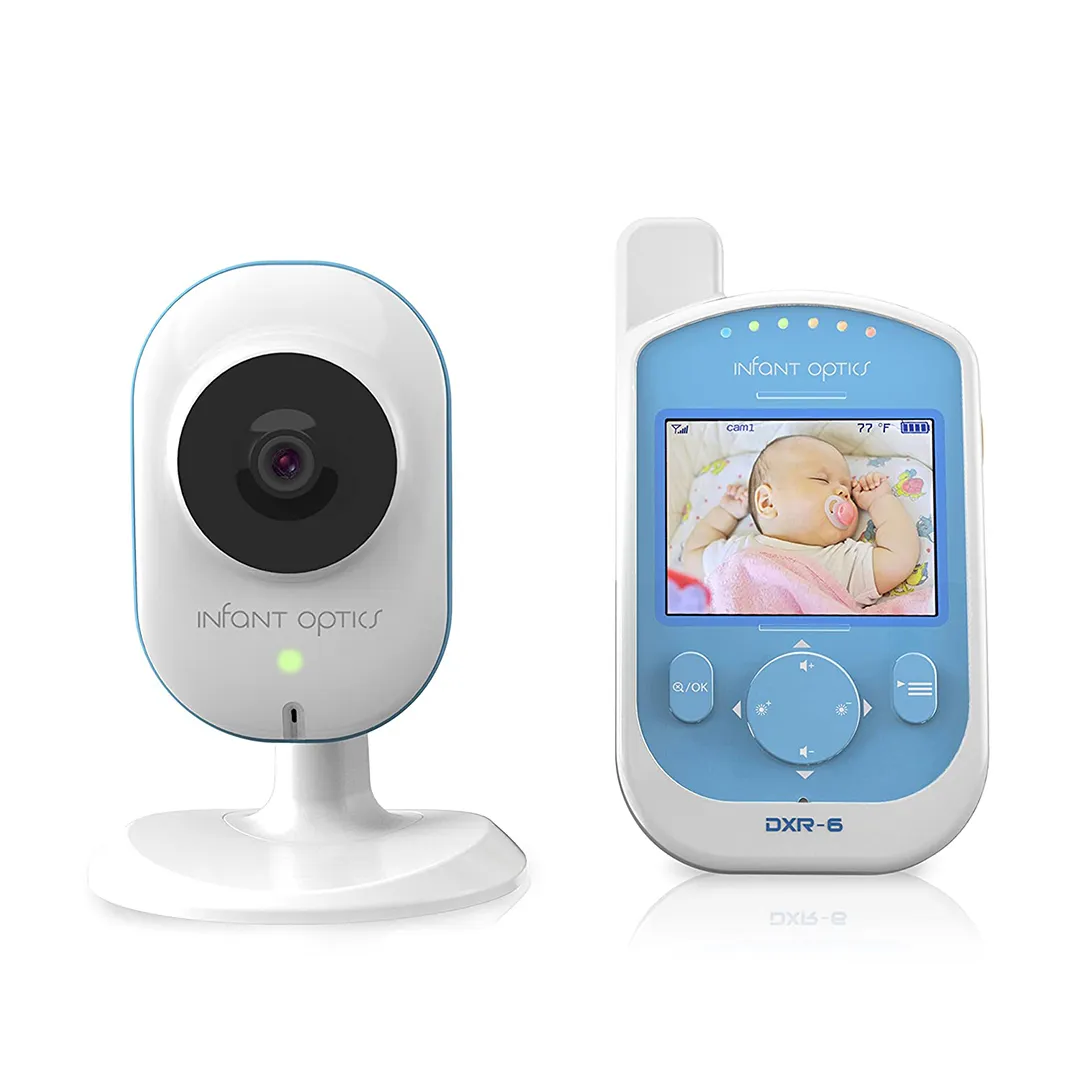
The Infant Optics DXR-6 is an earlier dedicated video monitor with a matching handheld parent unit and one camera in the original kit. Its exact manual remains available through the manufacturer's support page, which groups it under “DXR-6 and Earlier.” That is useful if you already own this monitor, are identifying a receiver or camera, or need to understand an old kit's documented operation. The current US shop lists the later DXR-8, DXR-8 PRO and PRO SS full kits, not the DXR-6. This assessment is therefore an ownership reference, not a current buying recommendation.
The display is a 2.4-inch 320-by-240 color screen. It presents a clear difference from the later original DXR-8's 3.5-inch display even though the listed pixel resolution is also 320 by 240. If a caregiver needs the camera image to occupy a larger portion of a dedicated receiver, the DXR-6's smaller display is the principal limitation. It is not an app camera: the manual describes a separate monitor unit paired with a camera, with no phone, router or internet viewing pathway.
How it handles more than one camera
The manual lists four selectable camera channels, but the original package contains one camera and the unit shows one camera at a time. Adding and pairing another compatible camera is a separate configuration. The scan mode cycles through paired channels, changing the picture about every twelve seconds; it does not make a split-screen view or keep both rooms audible simultaneously. The scan function is only useful when more than one camera is paired, and the manual says the monitor stops scanning and alerts if a camera is out of range or switched off.
That distinction matters if you are comparing old equipment for a two-room routine. Four channels are expansion capacity, not four included cameras or four simultaneous rooms. The DXR-6 cannot meet a requirement for two live pictures at once. For an existing owner, check every camera in the actual scan mode and heed the loss-of-signal warning instead of assuming an unselected room is continuously visible.
Useful basics, with an older and smaller receiver
The manual documents automatic infrared night vision, digital zoom, a talk-back function, a camera temperature display, an audio-level LED bar, and a sleep mode that turns off the LCD while leaving audio active. The parent-unit lithium-ion battery is replaceable; the manual lists 1200 mAh capacity, up to six hours with the screen on, up to ten hours in standby, and about seven hours for a full charge. Those are manufacturer specifications, not a measurement of this particular battery today. Age and condition matter on a used unit, so an old runtime figure should not be mistaken for current battery health.
In the manual's specifications, the radio link is FHSS in the 2.4 GHz band and its maximum stated range is up to 700 feet line of sight with no obstruction. That is an open-space maximum, not a promise through floors and walls. The DXR-6 can sound a warning if the link is lost, and the manual advises checking reception after changing a camera location. Move and test both units only within safe, manual-approved positions.
What changes in the later family
The later DXR-8 keeps the local handheld style but moves to a 3.5-inch screen and adds interchangeable camera lenses. The PRO models use a five-inch 1280-by-720 receiver; the PRO adds documented active noise reduction, while the PRO SS kit adds two cameras, split-screen operation and a selectable simultaneous dual-audio mode. Those are real functional differences, not just a suffix change. They may matter more than the DXR-6's expandable camera count to a new buyer.
The DXR-6 manual does not establish the later PRO models' noise-reduction feature, and its single-view scan mode is different from the PRO SS's simultaneous arrangement. There is no basis to assume a DXR-8-series replacement camera, battery, lens or power adapter will work with a DXR-6 unless the manufacturer confirms that exact combination. Check the part label and official compatibility information before replacing anything.
Placement and supervision remain essential
The DXR-6 manual says to keep the camera and cord out of reach, never place them in or near a crib or playpen, and secure the cord at least three feet away. It also says to test the monitor before use and after moving the camera, because obstacles can shorten the wireless range. Follow the complete manual, use only its specified adapters, and inspect an older battery or enclosure before continued use.
Like any consumer monitor, the DXR-6 is not a medical device and does not replace an adult checking on a child or following safe-sleep practice. A silent activity may not trigger a warning. For present-day choices, read the DXR-8, DXR-8 PRO, and DXR-8 PRO SS assessments; they describe distinct later kits and are not interchangeable with the DXR-6.
Key details at a glance
| Parent-unit screen | 2.4 in |
|---|---|
| Published display resolution | 320 × 240 |
| Camera-to-parent-unit connection | Local 2.4 GHz FHSS camera-to-parent-unit link; dedicated receiver, no app or internet viewing. |
| Manufacturer-stated open-space range | 700 ft |
| Cameras in the reviewed kit | 1 |
| Maximum camera units supported | 4 |
| Video rooms visible at once | 1 |
| Phone viewing away from home | No |
| Manual-stated screen-on runtime | 6 h |
| User-replaceable parent-unit battery | Yes |
| Supplied camera lens setup | Fixed built-in f/2.8 camera lens (2.5 mm focal length); interchangeable lenses are not listed in the manual. |
| Recommended stable operation uses home Wi-Fi | No |
| Audio-only system | No |
| Parent talk-back | Yes |
| Room-temperature readout | Yes |
Use the exact model’s instructions for operating limits, supplied equipment and version differences.
Sources for this assessment
Check the room and the receiving setup.
Read the exact model's constraints, camera count and supervision limits before choosing a package.