
Your needs, this model
Does it fit your priorities?
Does the full SS kit include two cameras for the two-room arrangement?
Yes. The exact manual lists two camera units; the manual documents split-screen and a selectable dual-audio mode.
Explore this need in the finder →Can I use an independent parent screen without Wi-Fi and require noise reduction?
Yes. The model has a local receiver, a five-inch HD display and documented active noise reduction.
Explore this need in the finder →Can the feed be checked from a phone away from home?
No. This is a closed local system without app or internet viewing.
Explore this need in the finder →A two-room system that actually carries two audio feeds
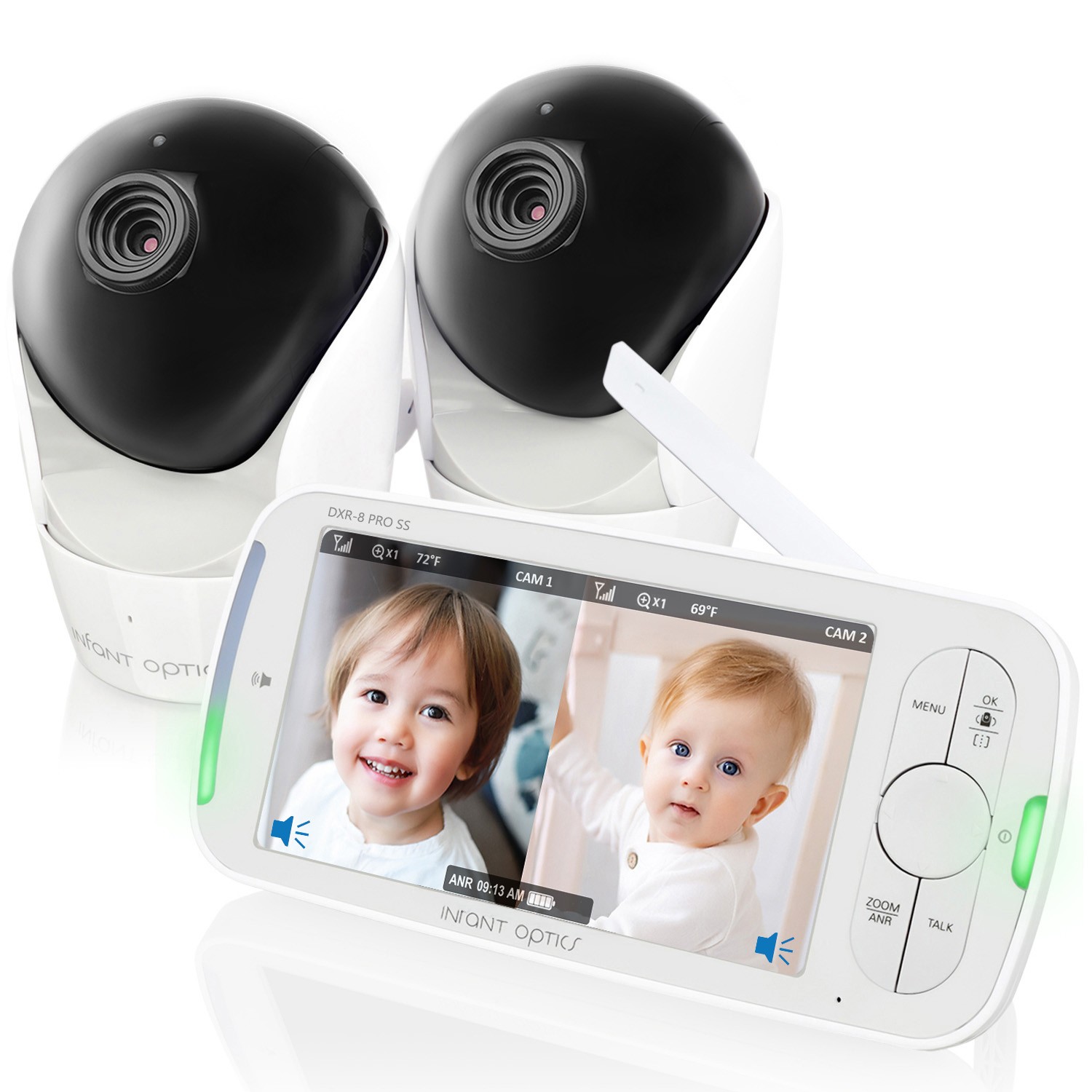
The Infant Optics DXR-8 PRO SS addresses a narrower need than a typical multi-camera monitor: it can show two rooms on one five-inch handheld display and, in the dual-audio setting, carry both rooms' sound at once. The full kit's exact manual lists two camera units, so the core two-room setup is included rather than dependent on buying a second camera separately. This differs materially from the DXR-8 PRO, whose full kit includes one camera and whose specified viewing mode is a single view.
In split-screen mode, the SS can display both camera feeds together or expand one to a full-screen view. The manual also includes an audio-mode choice for split screen: select one camera's audio or choose the simultaneous two-room audio mode. That setting matters. A split picture alone does not guarantee that both rooms are audible, and families who need continuous sound from both rooms should confirm that dual-audio mode is selected during setup. The SS supports up to four camera units in total, but that capacity is not the same as four simultaneous video panes or four included cameras.
Same local foundation, with the newer screen and filtering
The parent unit has a five-inch 1280-by-720 color display, remote camera pan and tilt, digital zoom, infrared night vision, two-way talk, a remote temperature reading and a sound-activated LED bar. The cameras connect to the supplied parent unit over a dedicated FHSS radio system, not through home Wi-Fi. There is no phone app, cloud stream or subscription for outside-the-home viewing. That avoids routing the picture through the household router, while leaving the system dependent on its own radio range and still subject to signal loss or interference from walls and other electronics.
Active Noise Reduction is also included. The manual describes it as a way to reduce repetitive steady background sounds, including the droning from fans, air purifiers, air conditioners, humidifiers and heaters. It cautions that some digital sound machines with non-repeating patterns can cause distortion. That is a targeted feature, not a guarantee that every nursery noise will disappear or that every cry will be separated perfectly from a sound machine.
What the kit gives you—and what it does not
The SS manual lists two camera units with lens hoods, a monitor unit with a rechargeable lithium-ion battery, power adapters, USB-C power cables, mounting hardware and documentation. It does not list a separate optical zoom lens in the box. The manufacturer's camera-accessory pages sell optional zoom and wide-angle optics; do not assume that an interchangeable-lens system means every lens is supplied. This is a practical difference from the current DXR-8 PRO kit, whose product page states that the package includes an optical zoom lens.
The parent-unit battery is user-replaceable, and Infant Optics lists a 3,000 mAh replacement battery for both the PRO and PRO SS. Capacity is not the same as a screen-on runtime. The exact SS manual and current product page do not state a duration, so the runtime field remains unknown rather than borrowing the PRO's six-hour figure. If you need a guaranteed use period between charges, compare the current manual and test the actual setup before relying on a number that the maker has not published for this exact system.
When the SS is worth choosing
Choose the PRO SS when the need is specifically to look at two rooms together and hear both rooms continuously without changing the selected camera. The included second camera and dual-audio mode answer that need directly. Split-screen halves the available display area for each room; a parent who wants to inspect detail can expand one feed, and can return to both rooms. A five-inch panel is not the same as two full-sized displays, so expect the two views to be smaller while split.
The standard DXR-8 PRO is a better match for a single nursery when the larger HD screen and ANR matter but concurrent two-room sound does not. It is also less dependent on setting up two camera units at the start. The original DXR-8 is a smaller-screen local alternative with a 700-foot stated line-of-sight range, but it lacks the PRO-family HD screen and ANR. Both older systems can work with multiple camera channels, yet their documentation does not establish simultaneous two-room video and audio in the way the SS manual does.
Placement and supervision remain the parent's responsibility
The manufacturer states up to 1,000 feet in line of sight. That is an open-space maximum, not a promise for every floor plan; test the feed where it will be used and recheck it after moving a camera. The manual warns that camera cords must stay at least three feet from a crib or playpen and that the camera and cord must never be placed in or near one. It also says the system is for indoor use, is not a medical monitor and does not replace adult supervision. Keep small lens parts out of reach, use the exact supplied adapters and follow the manual's battery-care instructions.
The SS is a focused choice for a two-room household rather than a remote-access camera. If a caregiver needs to check from outside the home, choose a system specifically documented for phone access and consider the network, account and update routine that entails. If the household is nearby and simultaneous two-room audio is the deciding requirement, the SS's real distinction is not a slogan—it is the combination of two cameras in the kit, split-screen viewing and a selectable dual-audio mode.
Key details at a glance
| Parent-unit screen | 5 in |
|---|---|
| Published display resolution | 1280 × 720 |
| Camera-to-parent-unit connection | Local FHSS camera-to-parent-unit radio; no home Wi-Fi, app or internet viewing. |
| Manufacturer-stated open-space range | 1000 ft |
| Cameras in the reviewed kit | 2 |
| Maximum camera units supported | 4 |
| Video rooms visible at once | 2 |
| Active noise reduction | Yes |
| Phone viewing away from home | No |
| User-replaceable parent-unit battery | Yes |
| Supplied camera lens setup | Two camera units with lens hoods; separate zoom and wide-angle lenses are sold separately. |
| Recommended stable operation uses home Wi-Fi | No |
| Audio-only system | No |
| Parent talk-back | Yes |
| Room-temperature readout | Yes |
Use the exact model’s instructions for operating limits, supplied equipment and version differences.
Sources for this assessment
Check the room and the receiving setup.
Read the exact model's constraints, camera count and supervision limits before choosing a package.