
Your needs, this model
Does it fit your priorities?
Is the smaller 3.5-inch display enough for a dedicated one-room check-in?
The exact manual specifies a 3.5-inch 320×240 screen. It meets a 3.5-inch minimum, but not a 4-inch minimum.
Explore this need in the finder →Does the original kit keep a camera picture available without home Wi-Fi?
Yes. The system uses a local camera-to-parent-unit FHSS link; it does not stream to a phone away from the home.
Explore this need in the finder →Can it keep both room audio feeds open at once?
No simultaneous two-room audio is documented. Its manual describes a sequential camera scan with one camera view at a time.
Explore this need in the finder →What the DXR-8 is for
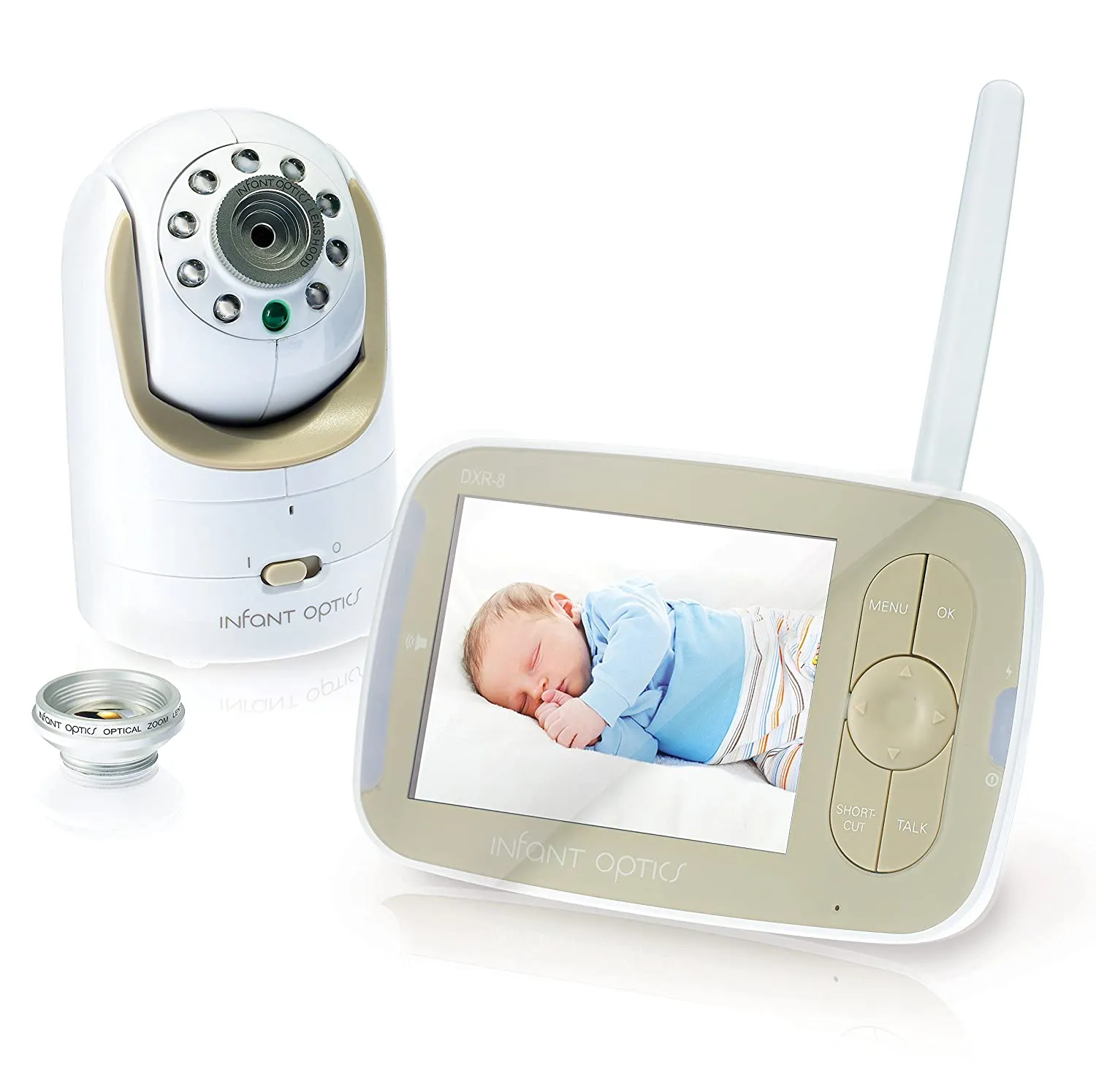
The Infant Optics DXR-8 is a dedicated-camera video monitor with a separate handheld parent unit. It does not rely on home Wi-Fi, a phone app or an internet account. That makes the everyday routine straightforward: power the camera, carry the receiver, and check the picture or sound in the rooms where its radio link reaches. The trade-off is equally direct. A parent away from home cannot check the feed on a phone, and no cloud recording or remote family access is part of this system.
Its place in the current Infant Optics range is the compact, simpler-screen option. The exact manual lists a 3.5-inch color display with 320 by 240 pixels, rather than the five-inch HD screens used by the PRO models. That is a real difference if you expect to make out fine detail on the handheld display. It can still show whether the camera is pointed at the intended area and whether there is movement, but it is not the larger, higher-resolution view in the newer family.
Camera movement and lens changes
The supplied camera can be panned and tilted remotely from the parent unit. Digital zoom offers 1× and 2× settings; that enlarges the image electronically and should not be confused with an optical zoom lens. The DXR-8 kit also includes an interchangeable optical zoom lens along with the default aluminum lens hood. The manual describes the zoom lens as useful when the camera is farther from the crib, and an optional wide-angle lens as a way to see more of a room, with some distortion and reduced clarity. Each change affects the view, so a parent should recheck the framing after changing lenses or camera position.
One camera is included in the reviewed full kit. The parent unit can pair with up to four camera units, and the manual describes a scan mode that cycles through paired cameras rather than showing all of them together. That is useful for checking different spaces on one receiver, but it is not a split-screen system: the DXR-8 does not document simultaneous two-room pictures or dual audio. If hearing both rooms continuously is essential, move up to the DXR-8 PRO SS rather than assuming that adding cameras changes the viewing mode.
Range, power and nightly use
Infant Optics states a maximum range of up to 700 feet in line of sight. Treat that as an open-space figure, not a promise that the signal will cover 700 feet through a house. Walls, reinforced materials, other electronics and the actual placement can change reception. The manual recommends checking reception before use and after moving the camera; it also lists Wi-Fi routers, Bluetooth products and microwave ovens among possible interference sources. A drop in signal is not proof that the camera or receiver is defective, but it is a reason to move the units or test the room again.
The monitor unit uses a rechargeable, replaceable 1,200 mAh lithium-ion battery. Infant Optics' manual gives approximately six hours with the screen on, ten hours in standby and about seven hours to recharge fully. These are manufacturer figures, not runtime measurements from our own test, and screen brightness, mode and battery condition matter in practice. The receiver can keep audio on while its display is asleep, which can conserve power when a continuous picture is not necessary. The system also has two-way talk, infrared night vision, a remote temperature reading, a sound-level indicator and alarms; the temperature display is not a medical or safety monitor.
Where it fits—and where it does not
The DXR-8 is a sensible fit for a household that wants one local video feed, camera movement, interchangeable optics and a receiver that works independently of the home router. It may also make sense for an existing DXR-8 owner who wants a compatible camera or lens accessory; the manufacturer's accessory pages distinguish the original 3.5-inch system from the 5-inch PRO equipment, so model labels matter.
Choose the DXR-8 PRO if a five-inch HD screen, active noise reduction and a longer published line-of-sight figure matter more. The PRO still displays one camera view at a time, so it does not solve the two-room simultaneous-audio need. Choose the DXR-8 PRO SS if you want a split-screen view and simultaneous sound from two rooms; its full kit includes two cameras, whereas the standard DXR-8 kit includes one. These are meaningful differences, not finish variants.
Safety and limits to keep in view
The DXR-8 manual says the camera and cord must not be placed in or near a crib or playpen and instructs users to keep cords at least three feet away. It also says the system is for indoor use, is not intended as a medical monitor and does not replace adult supervision. Follow the exact manual's mounting, power-adapter and battery instructions. A local monitor may reduce dependence on a router, but it cannot guarantee a secure or uninterrupted signal in every environment, nor can any monitor replace an adult checking on a child.
Key details at a glance
| Parent-unit screen | 3.5 in |
|---|---|
| Published display resolution | 320 × 240 |
| Camera-to-parent-unit connection | Local FHSS camera-to-parent-unit radio; no home Wi-Fi, app or internet viewing. |
| Manufacturer-stated open-space range | 700 ft |
| Cameras in the reviewed kit | 1 |
| Maximum camera units supported | 4 |
| Video rooms visible at once | 1 |
| Active noise reduction | No |
| Phone viewing away from home | No |
| Manual-stated screen-on runtime | 6 h |
| User-replaceable parent-unit battery | Yes |
| Supplied camera lens setup | One camera with the default aluminum lens hood and included optical zoom lens; optional wide-angle optics are separate. |
| Recommended stable operation uses home Wi-Fi | No |
| Audio-only system | No |
| Parent talk-back | Yes |
| Room-temperature readout | Yes |
Use the exact model’s instructions for operating limits, supplied equipment and version differences.
Sources for this assessment
Check the room and the receiving setup.
Read the exact model's constraints, camera count and supervision limits before choosing a package.