
Your needs, this model
Does it fit your priorities?
I already own the exact SCD843/37 and want a one-camera local picture on the dedicated screen. Which instructions fit, and does the model code alone confirm recall status?
The exact Philips page and family guide document one local camera/Parent Unit path, but the code alone does not clear an individual unit. Philips and CPSC list SCD843 among units subject to a parent-battery safety action for specified date codes; check the Parent Unit label and use the official replacement instructions before operating it. The model is discontinued and excluded from recommendations.
Explore this need in the finder →Can an owner count on the SCD843/37 to show two room pictures or hear both rooms simultaneously?
No. The reviewed exact setup is one camera with one Parent Unit. The exact U.S. page, support-linked family guide and troubleshooting material do not establish a two-room simultaneous view or the maximum paired-camera count. An unknown camera expansion path cannot meet an essential multiroom requirement.
Explore this need in the finder →Does the SCD843/37 create an away-from-home phone feed if a caregiver cannot stay within its local receiver link?
No phone/app plan appears in the exact product/support/guide material reviewed; the documented setup uses the paired Parent Unit. For away-from-home access, choose a separately documented app system rather than assuming this local monitor will relay remotely.
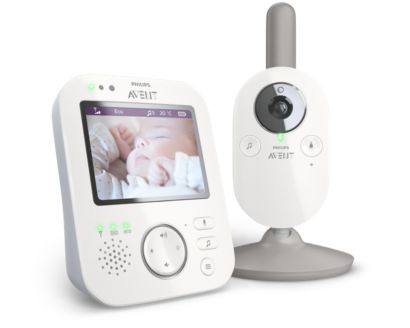
Explore this need in the finder →Philips Avent SCD843/37 is a discontinued local video monitor with a dedicated 3.5-inch Parent Unit, infrared night vision, zoom, room-temperature display, talk-back and several sound-triggered modes. It is useful as an owner reference only: Philips and the U.S. CPSC identify SCD843 as part of a battery-replacement safety action affecting specific production dates. Do not treat this review as a reason to buy a used set; check the exact parent-unit code and date against the official notice before using one.
A richer local-screen setup than the oldest Avent video models
The SCD843/37 sends a camera view and sound to a separate Parent Unit over Philips’ paired adaptive FHSS connection. Its U.S. product page describes the screen as a 3.5-inch color LCD, with automatic infrared night vision and 2× digital zoom with pan. The “pan” is a digital framing control on the parent display, not evidence that the camera physically turns itself to follow motion. This is a one-room camera view in the documented package; the exact materials inspected here do not establish a two-room split view or the maximum number of add-on cameras.
Against an older 2.4-inch local Avent set such as SCD600/10, the SCD843 adds more screen area and documented talk-back, vibration and temperature features. Both use a separate receiver, not away-from-home phone viewing. The comparison guide explains why similar-looking Avent cameras should not be assumed compatible.
Modes let you choose how much stays on the receiver
Philips documents four parent-unit modes. Video keeps sound and picture on; Audio turns the display off but keeps sound available; VOX turns off the Parent Unit’s picture and sound after a quiet interval, then restores them when the Baby Unit detects sound; Eco likewise suspends display and sound transmission while quiet to conserve power. The sensitivity control changes the sound threshold, so the amount of background activity that wakes the receiver depends on setup. These modes are not cry recognition and cannot explain what caused a sound.
Two-way talk can be useful for a brief familiar voice from the Parent Unit, and the feature list also includes a vibration mode for quieter alerts. The camera-side night light and five lullaby selections add nursery controls, while the room thermometer can display a reading and provide a configured temperature alert. A consumer room reading is not medical monitoring, and none of these prompts replaces checking the child directly or following safe-sleep guidance.
Check charging, battery backup and signal in the rooms you use
The Philips Quick Start Guide shows a three-hour charge followed by up to ten hours of parent-unit use. It does not give that runtime a precise screen-on test condition, so it should not be translated into a guaranteed ten hours of continuous video, especially for an older unit. Philips also notes that rechargeable capacity declines with age and that higher sound sensitivity consumes more parent-unit power. The Parent Unit contains a rechargeable lithium-ion battery; the short Important Information booklet says only that the parent unit has the battery and recommends professional removal at disposal.
Philips’ power-outage support answer says operation depends on charged batteries in the Baby Unit and enough charge in the Parent Unit, and that the Baby Unit may need restarting after power returns. The exact material inspected here does not clearly establish the Baby Unit backup-battery type or its runtime. Do not assume it will stay on through a long outage just because the Parent Unit has a battery. Test the kit’s current condition and adapter connections, and keep cords well outside a child’s reach.
The Quick Start diagram gives up to 300 m (985 ft) in open space and up to 50 m (165 ft) indoors. Those are manufacturer limits, not room-to-room performance tests. Floors, walls, layout and local radio interference can change reception, so check the actual picture and sound at the places a caregiver will be rather than relying on the larger number. A lost-link indicator is a connection prompt, not evidence that the camera or child is in a particular state.
Recall status changes the practical answer
The exact SCD843/37 U.S. product and support pages now mark the model discontinued. Separately, Philips’ voluntary replacement notice names SCD630 and SCD843 parent units produced from January 2016 through January 2020, with a possible battery-overheating hazard while plugged in; its notice says to check the production-date code and explains that serial numbers beginning “SM” are not affected. The CPSC notice describes the U.S. action for SCD630 and SCD843 units manufactured March 2016 through December 2019. These date descriptions are the manufacturers’ and regulator’s stated scopes, not a claim that every SCD843/37 unit is affected or that an unlisted unit is safe.
If you already have an SCD843, read the code and date on the bottom of the Parent Unit and follow the linked Philips replacement instructions and CPSC notice. Philips tells owners with an affected unit to stop using it and unplug it, then contact Philips for replacement guidance. An “SM” serial exception is part of Philips’ own screen; for uncertainty, use the official checker/contact route rather than guessing from appearance or a listing title. Because the model is discontinued and exact used-unit status and battery condition are unknown, it is excluded from buying recommendations even though unaffected serials may remain in owners’ possession.
For a current choice, start with the monitor finder and require a currently eligible model that matches the room and connection needs you actually have. If the priorities are a dedicated local display and one camera, compare an in-scope local model such as the VTech VM819; if away-from-home viewing matters, a current app model is a different operating plan. No listing-level resemblance establishes cross-model camera pairing. The Philips Avent local-video owner guide helps distinguish the SCD843/37 from older model codes, but it is not a compatibility chart. A monitor remains an aid to adult supervision, not a medical device or substitute for safe-sleep practice.
Key details at a glance
| Parent-unit screen | 3.5 in |
|---|---|
| Camera-to-parent-unit connection | Direct local Baby Unit-to-Parent Unit radio link using Philips-described unique pairing and adaptive FHSS; exact sources do not establish a phone-app or router mode. |
| Manufacturer-stated open-space range | 985 ft |
| Advertised maximum range claim | 985 ft |
| Cameras in the reviewed kit | 1 |
| Video rooms visible at once | 1 |
| Active noise reduction | No |
| Phone viewing away from home | No |
| User-replaceable parent-unit battery | No |
| Supplied camera lens setup | The pictured one-camera unit is placed by hand. Philips describes 2× digital zoom and pan on the Parent Unit; no exact source reviewed documents motorized remote camera movement or the maximum/add-on camera count. |
| Recommended stable operation uses home Wi-Fi | No |
| Audio-only system | No |
| Parent talk-back | Yes |
| Room-temperature readout | Yes |
| Preloaded lullaby count | 5 |
| Supplied camera mount | Camera is manually positioned; the exact source set does not establish an included crib/wall mount. |
| Parent-unit vibration prompt | Yes |
| Parent receivers included | 1 |
Use the exact model’s instructions for operating limits, supplied equipment and version differences.
Sources for this assessment
- Philips U.S. All Series catalogue listing, SCD843/37 exact row
- Philips U.S. exact SCD843/37 product page
- Philips U.S. exact SCD843/37 support page
- Philips-linked SCD841/SCD843/SCD845 Quick Start Guide
- Philips-linked SCD843 Important Information manual
- Philips support FAQ: SCD843/37 operating modes
- Philips support FAQ: power outage behavior, SCD843/37
- Philips support FAQ: parent runtime and battery aging, SCD843/37
- Philips voluntary replacement action for SCD630 and SCD843
- U.S. CPSC Philips Avent digital video monitor recall notice
- Philips page-linked SCD843/37 product image
Check the room and the receiving setup.
Read the exact model's constraints, camera count and supervision limits before choosing a package.