
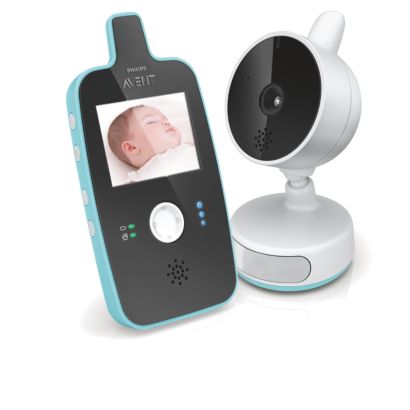
Your needs, this model
Does it fit your priorities?
Does the SCD603/10 show video on its own dedicated parent screen without home Wi-Fi?
Yes. The exact SCD603 guide describes direct local operation between a Baby Unit and handheld Parent Unit, not an app connection.
Explore this need in the finder →Is a 2.4-inch color screen enough for the minimum display size?
It meets a 2.4-inch threshold but not a 3-inch minimum. Philips does not publish a resolution in the exact U.S. product material reviewed here.
Explore this need in the finder →Does its manual state a 5.5-hour screen-on runtime?
Yes, about 5.5 hours at the default setting with the screen continuously on after full charge; the separate roughly seven-hour voice-activation figure is not continuous-screen runtime.
Explore this need in the finder →The Philips Avent SCD603/10 is an older, local video baby monitor with a small dedicated parent screen and a separately placed camera. Philips now classifies this exact U.S. product as phased out and its latest listing shows no stock, so this is an owner and model-identification reference—not a current buying recommendation.
A compact screen and a simple local link
The reviewed system pairs a handheld Parent Unit with one Baby Unit. The parent display is a 2.4-inch color screen; the manufacturer does not state a resolution in the exact product material reviewed here. Its radio works in the 2.4 GHz band and the manual describes direct operation between the two units, not a Wi-Fi or phone-app setup. That makes the old system easy to understand if you already have its matched camera and receiver, but it does not offer remote phone viewing from another location.
Screen size is the most immediate trade-off. A 2.4-inch picture can help confirm what is in the camera’s field of view, but it will not look as large as newer receivers. The SCD603/10 also has a sound-level light bar, volume and brightness controls, automatic channel selection, and a parent-unit belt clip that doubles as a stand. Those are straightforward controls rather than a modern app dashboard. If you want a larger dedicated display, compare the VTech VM819, with its 2.8-inch screen, or the newer Philips Avent SCD971/26, which has a five-inch screen and a different hybrid local/app setup.
Range is a best-case figure, not a room promise
Philips specifies up to 150 metres (490 feet) in open air and line of sight, with an indoor maximum of 30 metres (98 feet). The indoor figure is the more relevant comparison for most homes, and even that is an upper claim: the manual warns that interference and building materials can reduce reach. It gives especially large possible losses for reinforced concrete and metal. Before relying on a new camera position, test the link from the actual rooms and watch for the receiver’s out-of-range alert. A number printed for open air cannot predict a signal through a floor or around a stairwell.
Voice activation and power-outage planning
Voice activation turns the parent screen off while the room is quiet and switches it back on when the Baby Unit detects sound; after about 20 seconds without new sound, the picture turns off again. This can save battery, but it is not a smart cry classifier and it is not an always-on picture. The manual separately describes an auto-mute behavior for low sound levels, with audio restored when it detects a louder sound such as crying. If you need continuous sound or a permanently visible image, use the settings and routine that provide that for you rather than assuming voice activation is the same as uninterrupted viewing.
The 1,100 mAh rechargeable battery in the Parent Unit is specified for about 5.5 hours with its screen continuously on, or about seven hours in voice-activation mode; Philips says charging normally takes about 2.5 hours. These are the maker’s figures for a fully charged battery, not a present-day measurement of an aging unit. The Baby Unit normally uses mains power, but it can switch to four non-rechargeable AAA alkaline batteries during an outage. Those backup cells are not included and the unit does not charge them. Philips recommends mains operation; Philips gives one qualified backup figure: the Baby Unit is listed for about three hours on alkaline backup cells with its nightlight on. That is not a guarantee for old cells or an aging unit, and the manual does not state a separate duration for other operating conditions.
Small useful extras, with known limits
Automatic infrared night vision changes the picture to black and white in low light. A small base nightlight and three lullabies can be switched from the parent unit. The parent display has voice activation, a battery indicator and a signal-strength indicator; the manual also explains how to reset the Parent Unit. The feature list does not establish remote camera pan or tilt, a temperature readout, two-way talk, multiple simultaneous room views or remote phone notifications. Treat those as unconfirmed for this exact model rather than borrowing features from another Avent monitor.
Setup matters more than the attractive product rendering. Philips instructs caregivers to place the Baby Unit one to 1.5 metres from the child for sound pickup, keep it out of the bed or playpen and beyond the child’s reach, and route cords more than one metre (3.5 feet) away. The camera can sit on a stable, level surface or be wall mounted with the supplied hardware; the manual does not describe a crib clamp. Check the microphone direction, test the link before use and after moving a unit, and use the manufacturer’s specified adapters and battery type. Do not put rechargeable cells in the Baby Unit.
Who should keep this reference
The SCD603/10 is most useful to a family identifying a set already in the home, checking its expected button and battery behavior, or planning whether its small local screen fits a simple one-room routine. Its direct receiver, sound-activated display, camera-side battery backup and modest indoor range claim are the defining trade-offs. Its age means battery condition, missing adapters and second-hand camera compatibility cannot be inferred from this review; compare the exact model numbers and check the manufacturer’s instructions before pairing parts. The Philips Avent local-video owner comparison sets it beside the SCD600/10 without assuming shared accessories. For a new monitor, choose among currently eligible models using screen size, phone access, camera count and placement needs instead. Like any consumer baby monitor, this one is an aid, not a medical device or a substitute for responsible adult supervision and safe-sleep practice.
Key details at a glance
| Parent-unit screen | 2.4 in |
|---|---|
| Camera-to-parent-unit connection | Direct local 2.4 GHz Baby Unit-to-Parent Unit radio link; no phone app or internet viewing path is documented in the exact manual. |
| Manufacturer-stated open-space range | 490 ft |
| Advertised maximum range claim | 490 ft |
| Cameras in the reviewed kit | 1 |
| Video rooms visible at once | 1 |
| Phone viewing away from home | No |
| Manual-stated screen-on runtime | 5.5 h |
| User-replaceable parent-unit battery | Yes |
| Supplied camera lens setup | One fixed-position Baby Unit camera is documented. No remote camera movement is described in the exact manual. |
| Recommended stable operation uses home Wi-Fi | No |
| Audio-only system | No |
| Camera-side mood light | Yes |
| Preloaded lullaby count | 3 |
| Supplied camera mount | Stable tabletop surface or wall-mounted with the supplied screws and template, according to the manual; no crib clamp is documented. |
| Parent receivers included | 1 |
Use the exact model’s instructions for operating limits, supplied equipment and version differences.
Sources for this assessment
- Philips U.S. exact SCD603/10 Digital Video Baby Monitor product page
- Philips U.S. All Series baby-monitor listing showing the exact model row
- Philips U.S. latest baby-monitor list with SCD603/10 lifecycle and stock fields
- Philips U.S. support page for the exact SCD603/10
- Philips U.S. alternate support catalogue for SCD603/10, showing the English (US) manual entry
- Philips Avent SCD603 User Manual, English (US) entry from the exact SCD603/10 support catalogue
- Philips Avent SCD603 quick start guide from the SCD603/10 U.S. support page
- Philips Avent SCD603/10 Important Information Manual, English
- Philips-hosted SCD603/10 product-page single-product rendering
Check the room and the receiving setup.
Read the exact model's constraints, camera count and supervision limits before choosing a package.