
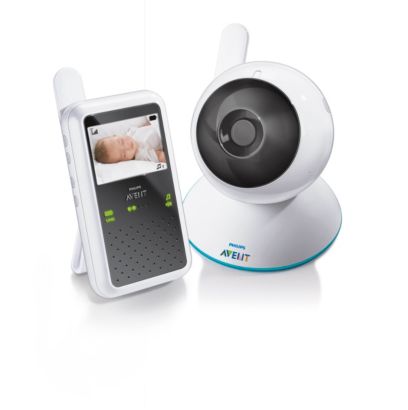
Your needs, this model
Does it fit your priorities?
I already own the SCD600/10 and want one local camera picture on a separate screen without home Wi-Fi. Is that the documented setup?
Yes. The exact model’s manual describes one Baby Unit and one Parent Unit connected locally, and the product page identifies a camera picture. It is discontinued, so it is an owner reference, not a current buying result.
Explore this need in the finder →Can I rely on this exact set to show two rooms at once, or assume a second Avent camera will pair?
No. One local camera view is documented for this set; the exact sources do not establish a maximum paired-camera count or second-camera compatibility. Do not treat an unknown expansion path as meeting a must-have two-room view.
Explore this need in the finder →Is the SCD600/10 screen at least three inches if screen size is essential?
No. Philips’ exact SCD600/10 product literature identifies a 2.4-inch color screen. The brochure is linked in this dossier as a remote-only source because its byte retrieval returned 404; do not confuse this with the separate current product image, which is archived.
Explore this need in the finder →The Philips Avent SCD600/10 is a discontinued U.S. video monitor for an owner who already has the correctly labelled set: one camera sends a local picture and sound to its handheld Parent Unit. It does not need home Wi-Fi, and Philips no longer lists it as a current product, so this is an owner reference rather than a new-purchase recommendation.
A small local video system, not a phone camera
The SCD600/10 is built around one Baby Unit camera and one separate Parent Unit. The manufacturer’s exact U.S. page describes a digital video monitor, infrared night vision and automatic channel selection; the linked manual describes the direct unit-to-unit link and the Parent Unit’s picture, link light and sound-level lights. There is no router setup or phone app in the documented SCD600 operation. That makes the old arrangement understandable for a caregiver who wants a dedicated receiver and one room view, not a feed while away from home.
Philips’ SCD600/10 product literature describes the Parent Unit display as a 2.4-inch color screen. It is a compact check-in view rather than a large, detailed picture. The camera’s infrared illumination activates automatically when the room is dark. The Parent Unit also offers automatic screen activation: it keeps listening, turns the picture on when the Baby Unit detects sound, then switches the display off after a quiet interval. Sound-level lights remain useful when the screen is dark or its volume is low. These are simple prompts, not a way to identify why the room is noisy or to classify a particular cry.
Position the camera and test the actual link
The camera is adjusted by placing its stand; the manual does not describe motorized remote pan or tilt. Philips instructs caregivers to keep the Baby Unit at least three feet from the child, no farther than five feet for its intended view, and at least three feet from the Parent Unit to avoid acoustic feedback. Put it on a stable surface, keep its fixed cord out of reach, and never place or attach it inside the crib or play yard. The connection indicator turns red and the Parent Unit beeps when the link is lost; its “out of range” message can also appear if the camera is switched off, so check power as well as distance.
The manual’s 150-metre (490-foot) figure is for open air, not a promise for a house. Walls, floors, metal, placement and other 2.4 GHz equipment can reduce the signal or cause interruptions. There is no indoor distance figure in the exact manual. Test the picture and sound from the places a caregiver will actually use the receiver, and retest after moving either unit. A range headline cannot tell you whether a particular bedroom, stairwell or patio will stay connected.
Battery flexibility comes with an old-system caveat
The Parent Unit has a rechargeable 1,050 mAh lithium-ion battery and can also be used with its adapter. Philips’ manual estimates at least eight cordless hours with automatic screen activation, or about six hours with video continuously on, after the battery has reached full capacity. It says normal charging takes about three and a half hours and calls for at least four hours for the first charge or after long storage. These are the maker’s conditions, not a promise for an old set: the current capacity of a used battery is unknown, and replacement must be the specified SCD600 type.
The Baby Unit normally uses its adapter but can operate from four non-rechargeable AAA alkaline batteries, which are not included; that offers a backup option in a power interruption. Nightlights and lullabies are available, but Philips warns that they consume more power when the camera is on batteries. For a long lullaby or nightlight session, use the adapter. The exact manual says a sufficiently charged Parent Unit and a Baby Unit with batteries continue during a power failure; neither battery claim substitutes for checking the used pack and correct adapter before relying on a second-hand set.
Know what this code does not establish
The SCD600/10 does not document simultaneous views from two rooms, remote phone viewing, a temperature readout or alert, or parent talk-back. Its manual gives no camera-expansion limit, so a second camera’s compatibility is unknown; do not buy a loose camera just because another Avent system looks similar. If two rooms must appear together, require a model and exact kit whose manual confirms two live pictures in one supported setup. If temperature sensing, voice from the Parent Unit, or away-from-home access is essential, this set does not establish those needs.
Philips marks the exact U.S. product page and support page discontinued; the support page links the SCD600 manual and Quick Start Guide. The SCD600/10 is therefore retained for identifying the correct buttons, batteries and setup for an existing owner, not as a current shopping result. A 2023 CPSC recall notice for Avent digital video monitors names SCD630 and SCD843 only, not SCD600; that specific notice does not resolve the condition or safety of an individual used unit. The Philips Avent local-video owner comparison distinguishes this model from the phased-out SCD603/10. If you need a current dedicated-screen option, compare a currently eligible model such as the VTech VM819 on its own terms, or use the finder to decide whether you need video, phone access, multiple rooms or a temperature feature. Any monitor is only an aid to adult supervision and safe-sleep practice.
Key details at a glance
| Parent-unit screen | 2.4 in |
|---|---|
| Camera-to-parent-unit connection | Direct local 2.4 GHz digital Baby Unit-to-Parent Unit video/audio link; Philips lists automatic channel selection. The exact manual does not describe Wi-Fi, app or remote phone viewing. |
| Manufacturer-stated open-space range | 490 ft |
| Advertised maximum range claim | 490 ft |
| Cameras in the reviewed kit | 1 |
| Video rooms visible at once | 1 |
| Phone viewing away from home | No |
| Manual-stated screen-on runtime | 6 h |
| User-replaceable parent-unit battery | Yes |
| Supplied camera lens setup | One page-linked camera with an adjustable tabletop stand. The exact manual directs the caregiver to position the unit by hand; no remote pan/tilt operation or second-camera compatibility is documented. |
| Recommended stable operation uses home Wi-Fi | No |
| Motion alert | No |
| Audio-only system | No |
| Parent talk-back | No |
| Camera-side mood light | No |
| Preloaded lullaby count | 3 |
| Included crib-mount option | No |
| Supplied camera mount | Stable tabletop stand with manual camera repositioning; follow the model-specific placement and cord guidance. No crib mount is documented. |
| Parent-unit vibration prompt | No |
| Parent receivers included | 1 |
Use the exact model’s instructions for operating limits, supplied equipment and version differences.
Sources for this assessment
- Philips U.S. All Series catalogue, exact SCD600/10 row
- Philips U.S. exact SCD600/10 product page
- Philips U.S. support page for SCD600/10
- Philips-linked SCD600 English user manual
- Philips-linked SCD600 English quick-start guide
- Philips SCD600/10 official product literature
- Philips-hosted SCD600/10 page-linked single product rendering
- U.S. CPSC Philips Avent digital video monitor recall notice
Check the room and the receiving setup.
Read the exact model's constraints, camera count and supervision limits before choosing a package.