
Your needs, this model
Does it fit your priorities?
Is one local sound-only DECT link enough, without a camera picture or remote-phone path?
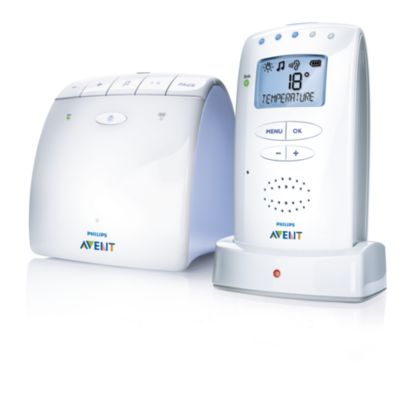
The exact SCD520/00 is a one-room audio reference with a parent information/temperature LCD, not a video or connected system. Philips marks it discontinued; a used set's battery and completeness need individual checks.
Explore this need in the finder →Would one local audio setup with room-temperature information and parent talk-back meet the need?
Yes, the SCD520/00 manual documents temperature reading/alert and talk-back in its local DECT plan. It does not provide a camera picture or phone access, and its sound alert is a loudness threshold rather than cry recognition.
Explore this need in the finder →Does Philips' stated range clear a 900-foot open-air minimum but fail 1,100 feet?
Philips states up to 1,000 feet outdoors and up to 150 feet indoors. That clears only the lower manufacturer-claim threshold; it is not an indoor promise, and the exact SCD520/00 remains a discontinued owner reference.
Explore this need in the finder →The Philips Avent SCD520/00 is a discontinued U.S. DECT audio monitor. Its parent receiver displays status and room temperature, but it has no camera picture, phone app or away-from-home viewing. Keep this assessment for owners identifying a set, not as a current purchase recommendation.
A local sound link, not a small video monitor
The exact U.S. product and support pages identify the SCD520/00 and mark it discontinued. Philips describes one Baby Unit and one Parent Unit linked by DECT. The Parent Unit's LCD shows status, settings and a temperature reading; it does not show a camera image. There is no documented Wi-Fi, internet or smartphone plan. That makes the set straightforward for an owner who wants room sound and a receiver they can carry around the home, but a poor fit if seeing the crib or checking in from somewhere else is essential.
Sound sensitivity and receiver volume are adjustable. Sound-level lights give a visual cue even if the Parent Unit's speaker is muted. The optional sound alert can beep and illuminate the display when sound reaches the fourth level light while volume is off. That is a configurable loudness threshold, not smart cry recognition: other noise can trigger it, and quieter sounds may not. The manual also describes parent talk-back. Treat it as a simple one-room voice link rather than a substitute for going to the room when needed.
Temperature display and small-room extras
The linked Parent Unit displays the Baby Unit's room-temperature reading, and its optional alert beeps when the chosen range is exceeded. If you do not set a range, Philips gives 57°F and 86°F as the default lower and upper alert points. The manual says the sensor measures the room only; it cannot adjust room temperature or assess a child's health. A displayed number is useful household context, not a medical measurement.
The Baby Unit has a nightlight and plays a selection of five lullabies. Pay attention to the U.S. limitation in Philips' own product material: remote activation of the nightlight is unavailable in the U.S., and remote lullaby control is unavailable in the U.S. and Canada. The manual's operating steps use the buttons on the Baby Unit. A parent who expects to switch these features on from across the house should not assume that the U.S. version behaves like another market's description.
Battery claims need the age of the set in mind
Philips states up to 24 hours of cordless Parent Unit use after charging. Its manual says normal charging takes about eight hours, while first use or a long period out of service calls for at least ten hours; the pack reaches full capacity only after several charge-and-discharge cycles. Those are manufacturer instructions and a published maximum, not a promise about an old battery. The Parent Unit uses the SCD520 NiMH rechargeable pack identified in the manual. For an existing set, check whether the original pack, charger and adapters are present, then judge runtime with the actual battery rather than the model name.
The Baby Unit normally runs from its supplied-type mains adapter. Philips also permits four 1.5-volt AA alkaline cells, not included, so the Baby Unit can continue during a power failure. Rechargeable AA cells are not allowed in that unit, and Philips does not give a backup runtime. If backup matters, fit the specified type, check its condition and remember that the nightlight and high sensitivity use more power. Do not count the Parent Unit's battery as proof that the nursery unit itself has backup power.
Range, placement and real limits
Philips lists up to 1,000 feet outdoors in open air and up to 150 feet indoors. The manual's material table shows why these figures are not a house-wide guarantee: reinforced concrete, metal and wet materials can sharply reduce or completely block the link. Test the matched units in the rooms where they will be used and respond to a lost-link warning. The product does not send an alert to a phone when you leave its radio range.
Follow the placement instructions: keep the Baby Unit and cord at least three feet (one metre) from the child, never inside a bed or playpen, and keep cords out of reach. Keep Parent and Baby Units at least a metre apart as well to avoid acoustic feedback. Philips says a baby monitor is an aid, not a substitute for adult supervision; this model is not a medical monitor.
Who should keep the SCD520/00?
It is useful to an owner who already has this exact pair and wants to interpret its DECT link, temperature alert, sensitivity, muted-volume sound alert, talk-back or power-failure setup. Philips' official specifications claim up to 24 hours cordless Parent Unit use, longer than the 18-hour claims on the SCD560/10 and SCD570/10 owner references; battery age and setup make the difference unsuitable as a promise for a used unit. The two later references add their own model-specific distinctions, so do not assume a shared badge means shared features or interchangeable parts. Read the SCD520/00, SCD560/10 and SCD570/10 comparison for the family tradeoffs.
If you are replacing a discontinued set, choose a complete current system rather than trying to pair one Philips component with an unrelated transmitter. The Motorola PIP11 is one separately assessed current audio-only option; it is not a compatible SCD520 accessory. Start with the finder if you need a camera, multiple-room view or phone access instead. Whatever the model, keep its exact manual and test the operating plan before relying on it.
Key details at a glance
| Camera-to-parent-unit connection | Local DECT audio between the matched Baby Unit and Parent Unit; no app or away-from-home phone path is documented. |
|---|---|
| Manufacturer-stated open-space range | 1000 ft |
| Advertised maximum range claim | 1000 ft |
| Cameras in the reviewed kit | 0 |
| Maximum camera units supported | 0 |
| Video rooms visible at once | 0 |
| Phone viewing away from home | No |
| Recommended stable operation uses home Wi-Fi | No |
| Motion alert | No |
| Audio-only system | Yes |
| Parent talk-back | Yes |
| Room-temperature readout | Yes |
| Parent-unit batteries included | Yes |
| Camera-side mood light | No |
| Preloaded lullaby count | 5 |
| Parent-unit vibration prompt | No |
| Parent receivers included | 1 |
Use the exact model’s instructions for operating limits, supplied equipment and version differences.
Sources for this assessment
- Philips U.S. exact SCD520/00 Avent DECT baby monitor product page
- Philips U.S. exact SCD520/00 support page
- Philips Avent SCD520 User Manual, English instructions from the exact U.S. support route
- Philips SCD520 Quick Start Guide, English instructions
- Philips U.S. All Series baby-monitor directory row for SCD520/00
- Philips-hosted SCD520/00 exact product image
Check the room and the receiving setup.
Read the exact model's constraints, camera count and supervision limits before choosing a package.