
Your needs, this model
Does it fit your priorities?
Is a sound-only feed sufficient if a camera picture is not required?
For an existing SCD510/00 set, yes: Philips documents one Baby Unit sending local DECT audio to the Parent Unit. The discontinued product has no current buying recommendation, even if earlier models are allowed.
Explore this need in the finder →Can an SCD510/00 be counted on when a temperature display is essential?
No such capability is established for this exact model. A generic sentence in the manual mentions a sensor, but Philips does not document an SCD510 reading or alert control; treat the need as unknown and choose a model with exact, operational temperature documentation.
Explore this need in the finder →Does Philips’ maximum range support a 900-foot claim threshold, but not 1,100 feet?
The manual says up to 1,000 feet in open air and up to 150 feet indoors, so the open-air maximum clears 900 feet but not 1,100 feet. Neither figure is a promise through a home’s walls, and the discontinued set remains reference-only.
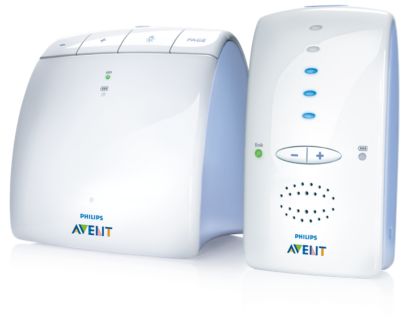
Explore this need in the finder →The Philips Avent SCD510/00 is a discontinued, local DECT audio monitor: one baby unit sends sound to one portable parent receiver, with no camera view or documented phone connection. Philips marks this exact U.S. model no longer available, so this is an owner reference for identifying and setting up a matching pair—not a current buying recommendation.
A simple listening link, not a video screen
The SCD510/00 suits the narrow need of hearing activity from one nearby room while carrying a separate receiver. The product page identifies DECT transmission, adjustable sound sensitivity and volume, sound-level lights, an out-of-range warning, a low-battery indicator, a belt clip and parent talk-back. There is no baby camera in the documented system, and the parent unit has indicator lights rather than a display for viewing the child. It does not give a Wi-Fi, app or away-from-home phone path. If checking a picture is essential, this model cannot provide it; choose a documented video system instead.
Sound sensitivity is adjustable at the parent unit after the pair is linked. That can help when ordinary room noise triggers the feed too often, but a higher setting makes the baby unit transmit more frequently and uses more power. The parent’s LED sound-level lights can signal activity even when its speaker is muted; they are a rough indication of sound, not a system that identifies a cry or explains what caused it. The receiver also beeps and shows a red link light when it loses connection, and signals low battery. Treat those as status prompts to check, not proof that every sound or interruption is detected.
Do not assume the SCD510 reads room temperature
Philips’ exact SCD510 product page lists audio, sound and status features, but does not list a temperature display or a temperature alert. Its manual contains a general paragraph about a temperature sensor, yet the model’s control description and operating instructions do not explain a temperature reading or alarm. The reviewed material therefore does not establish a usable SCD510 temperature function. If temperature information is an essential need, do not select an SCD510 on that assumption. The nearby SCD520/00 and SCD560/10 manuals explicitly describe temperature readout and alerts, but those exact U.S. models are also discontinued; the current Motorola PIP11 is a different, currently listed audio-only alternative with a documented temperature display. None should be confused as compatible replacement units.
The SCD510 does have a baby-unit nightlight with a physical control, a parent-unit paging button for finding the receiver, and a belt clip for carrying it. Philips does not list lullabies, a charging dock, a vibration alert or camera-side motion features for this exact model. Do not transfer features from the more equipped SCD520/00, SCD560/10 or SCD570/10 simply because all four are Avent audio products. The SCD570/10’s charging base and threshold vibration prompt, for example, belong to that different model.
Range is a maximum; battery condition is an owner question
Philips’ SCD510 manual gives up to 330 metres (1,000 feet) in open air and up to 50 metres (150 feet) indoors. These are maximum manufacturer figures, not a promise through a particular house. The manual’s table shows that walls, reinforced concrete, metal and wet materials can substantially reduce range. Test the connection at the locations where the parent unit will actually be used, and check the link indicator before relying on the monitor in another room. Philips also cautions that nearby DECT equipment can affect the connection.
The Parent Unit uses Philips’ SCD510 NiMH rechargeable pack. The manual says a normal charge takes about eight hours; for first use or after a long period unused, charge it switched off for at least ten hours. It claims at least 24 hours of cordless operation after a full charge, with full capacity reached only after four charge/discharge cycles. That is a manufacturer estimate for a suitable pack, not a test of an old unit. The manual identifies the replacement pack as 850 mAh. Check the pack, its polarity and condition, the adapter, and the actual battery indicator before taking a used receiver away from an outlet. The Baby Unit can use four 1.5-volt AA alkaline batteries, which Philips says are not included; no backup-runtime figure is specified. Sensitivity, volume and leaving the nightlight on can all affect how often the baby unit transmits or uses power.
Placement and choosing an alternative
Philips instructs caregivers to keep the Baby Unit at least one metre (3.5 feet) from the child and to keep the Parent Unit at least that distance from the Baby Unit during setup to avoid feedback. Do not put the baby unit in a crib or playpen or bring its cord into the sleep space. This monitor is an aid to supervision, not a medical device and not a substitute for an adult checking on a child or following safe-sleep guidance.
For an existing set, read the labels on both units and use the SCD510-specific instructions; a similar Avent shape or shared brand does not establish radio compatibility. If shopping now for the same basic local audio role, compare a currently eligible model such as the Motorola PIP11 through its own facts and manual, or use the monitor finder to decide whether a camera, phone access, temperature information or multiple rooms changes the choice. The SCD510’s appeal is its uncomplicated sound-only plan, belt clip and simple light/status feedback. Its limits—no picture, no documented remote connection, uncertain temperature capability, maximum-only range claims and unknown condition in a used set—are material, not small-print details.
Key details at a glance
| Camera-to-parent-unit connection | Local DECT audio between one baby unit and the parent receiver; no app or away-from-home phone path is documented. |
|---|---|
| Manufacturer-stated open-space range | 1000 ft |
| Advertised maximum range claim | 1000 ft |
| Cameras in the reviewed kit | 0 |
| Maximum camera units supported | 0 |
| Video rooms visible at once | 0 |
| Phone viewing away from home | No |
| User-replaceable parent-unit battery | Yes |
| Recommended stable operation uses home Wi-Fi | No |
| Motion alert | No |
| Audio-only system | Yes |
| Parent talk-back | Yes |
| Parent-unit batteries included | Yes |
| Camera-side mood light | No |
| Preloaded lullaby count | 0 |
| Parent-unit vibration prompt | No |
| Parent receivers included | 1 |
Use the exact model’s instructions for operating limits, supplied equipment and version differences.
Sources for this assessment
Check the room and the receiving setup.
Read the exact model's constraints, camera count and supervision limits before choosing a package.