
Your needs, this model
Does it fit your priorities?
If I already own a correctly labeled SCD502/10 pair, can it cover one room’s sound?
Yes, the exact local DECT audio arrangement is one Baby Unit to one Parent Unit, but Philips marks it discontinued, so it remains an owner reference and not a new buying result.
Explore this need in the finder →Does this exact set provide temperature information or let the caregiver talk back from the Parent Unit?
Neither operation is documented for this exact U.S. model; do not assume it from a nearby Avent product. If either feature is essential, choose a model with the exact function documented.
Explore this need in the finder →Can it be a battery-backed portable set during an outlet failure?
Only the Parent Unit can run from two AA cells; the Baby Unit is mains-only and the Parent Unit does not charge rechargeable cells. The monitor cannot keep sending nursery sound when the Baby Unit loses power.
Explore this need in the finder →Philips Avent SCD502/10 is a discontinued U.S. DECT audio monitor for existing owners who want to identify and operate that exact set. Its documented plan is one powered Baby Unit sending room sound to one Parent Unit; it does not provide a camera picture, phone access, temperature display or a charging cradle. This page preserves the exact model as a reference, not a current buying recommendation.
A separate receiver for one room’s sound
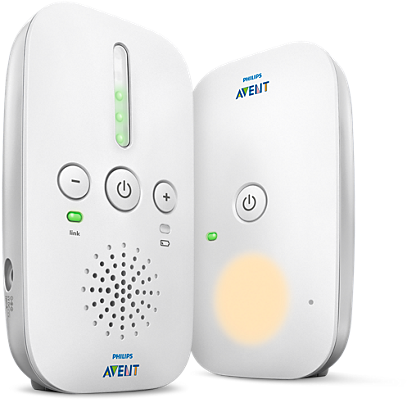
The exact Philips U.S. product and support pages identify the SCD502/10 and mark it discontinued. They describe a basic audio link with a Baby Unit nightlight, and the product page’s linked 2022 English manual names SCD501, SCD502 and SCD503. In that guide, the Parent Unit has volume buttons, a speaker, a connection light, a battery indicator and sound-level lights. There is no camera sensor or viewing screen in this arrangement; the light bar is a visual sound indicator rather than a picture. If a camera view or away-from-home phone feed is essential, do not try to stretch this audio system to fit it.
The lights are useful if you mute the speaker, because the manual says they continue to show detected sound and rise with louder sounds. That is a simple level indication, not a cry classifier, motion detector or medical warning. The Baby Unit’s nightlight is toggled with its own button. Philips does not document a Parent Unit control for speaking back, a temperature reading, songs or lullabies, or an app for this exact U.S. model. The simplicity can suit someone who already owns the complete SCD502/10 set and wants a direct local audio receiver; it is not a substitute for these additional features.
Do not mistake wall power for a battery charger
The Parent Unit works from the adapter or from two AA cells. The manual permits either 1.5-volt alkaline batteries or 1.2-volt rechargeable AA batteries, but it explicitly says the Parent Unit cannot charge them. Rechargeable cells require a separate charger. Philips’ SCD502/10 product page also carries the no-charging-function disclaimer, so a used set should not be assumed to include a charging cradle or an internal rechargeable pack. The manual says battery operation can last up to 24 hours, but this varies with the batteries and how much the receiver is used; it is not a measured result for a used monitor. Check for the exact SCD502/10 label, both original units, the adapter and a working battery compartment. If planning portable use, install known-good cells and verify the low-battery indicator before relying on them.
The Baby Unit is mains-powered only. Philips says it cannot run from batteries, and its power cord is fixed. That means a nursery power interruption also interrupts the monitor feed; there is no documented battery backup in the Baby Unit. Keep the unit and cable at least one metre from the child and outside the bed or playpen, following the manual’s cord-warning diagram. This is a placement constraint, not an optional feature trade-off.
Maximum range is not a room-to-room promise
The model-linked family manual states up to 300 metres (985 feet) outdoors in open air and up to 50 metres (150 feet) indoors. Its troubleshooting section says building materials, floors and ceilings reduce range; other DECT equipment can also interfere. The Parent Unit’s flashing red link light and beeping indicate that it is not connected, and the manual notes that a fresh connection may take about 30 seconds. Use the indicator at the places where you will actually carry the receiver, then move nearer if the link is lost. A product page’s “reliable” wording cannot establish coverage in a particular home.
Philips’ SCD502/10 U.S. product page includes a Smart ECO section but qualifies it as unavailable in the United States and Canada. The linked family manual separately describes Smart Eco as always active. The exact U.S. page and family manual therefore do not tell a single consistent story about this mode for this regional package. This assessment does not credit a U.S. SCD502/10 with a selectable Smart ECO power-saving feature, and no essential Eco Max-style requirement should match it. Its exact evidence supports local DECT audio and the functions described above, not every general statement in the family manual.
SCD502/10 versus SCD501/10
The exact SCD502/10 product image shows a white receiver and Baby Unit without the blue side band visible in Philips’ SCD501/10 rendering. The two product pages have separate model codes and separate support routes, while their linked family manuals name both codes (and SCD503). In the reviewed U.S. pages and manual instructions, no functional distinction is established that would justify claiming different range, battery life or sound processing. Treat the suffix and actual labels as important for identification, but do not invent a benefit for one code over the other. The SCD501/10 and SCD502/10 comparison guide summarizes this evidence boundary.
Because Philips marks SCD502/10 discontinued, compare a current model such as the separately assessed Motorola PIP11 if you need to buy an audio-only monitor now. It is not a compatible replacement unit; check the exact new model’s features and manual. For existing SCD502 owners, identify both pieces, verify the link, test the adapter and batteries, and keep the power lead safely outside the sleep space. An audio monitor is only an aid to adult supervision, never a medical device or a replacement for safe sleep and direct care.
Key details at a glance
| Camera-to-parent-unit connection | Local DECT audio between one Baby Unit and one Parent Unit; no U.S. app or away-from-home phone path is documented. |
|---|---|
| Manufacturer-stated open-space range | 985 ft |
| Advertised maximum range claim | 985 ft |
| Cameras in the reviewed kit | 0 |
| Maximum camera units supported | 0 |
| Video rooms visible at once | 0 |
| Phone viewing away from home | No |
| User-replaceable parent-unit battery | Yes |
| Recommended stable operation uses home Wi-Fi | No |
| Motion alert | No |
| Audio-only system | Yes |
| Parent talk-back | No |
| Room-temperature readout | No |
| Parent-unit batteries included | No |
| Camera-side mood light | No |
| Preloaded lullaby count | 0 |
| Parent-unit vibration prompt | No |
| Parent receivers included | 1 |
Use the exact model’s instructions for operating limits, supplied equipment and version differences.
Sources for this assessment
Check the room and the receiving setup.
Read the exact model's constraints, camera count and supervision limits before choosing a package.