
Your needs, this model
Does it fit your priorities?
If I already own a correctly labeled SCD501/10 pair, can it cover one room’s sound?
Yes, the exact local DECT audio arrangement is one Baby Unit to one Parent Unit, but Philips marks it discontinued, so it remains an owner reference and not a new buying result.
Explore this need in the finder →Does this exact set provide temperature information or let the caregiver talk back from the Parent Unit?
Neither operation is documented for this exact U.S. model; do not assume it from a nearby Avent product. If either feature is essential, choose a model with the exact function documented.
Explore this need in the finder →Can it be a battery-backed portable set during an outlet failure?
Only the Parent Unit can run from two AA cells; the Baby Unit is mains-only and the Parent Unit does not charge rechargeable cells. The monitor cannot keep sending nursery sound when the Baby Unit loses power.
Explore this need in the finder →The Philips Avent SCD501/10 is a discontinued, local DECT audio monitor for an owner who already has this exact set: a corded Baby Unit sends one room’s sound to a separate Parent Unit. It provides no camera picture or documented phone route. Philips marks the exact U.S. product discontinued, so this is an identification and operating reference, not a current purchase pick.
What the SCD501/10 does—and does not do
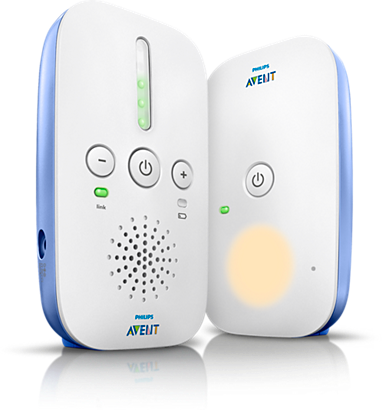
Use this model when the need is simply to hear one nearby room from its included receiver. The U.S. product page describes the SCD501/10 as a DECT audio monitor, and the manual linked from its exact support route names SCD501, SCD502 and SCD503. Its controls and illustrations show a Parent Unit with a speaker, volume buttons, connection and battery lights, and sound-level lights. There is no camera, image screen, temperature readout, talk-back control or mobile app in the documented SCD501 setup. The sound-level lights are helpful when the Parent Unit is muted: more lights illuminate with louder room sounds. They show sound level, not the source of the noise or whether a particular sound is a cry.
The Baby Unit has a small nightlight controlled on that unit itself. A corded Baby Unit and portable receiver make a straightforward local system, but Philips does not document a remote-phone path or a way to check the room while away from home. If you need an image, temperature information, a lullaby player or the ability to speak from the receiver, this exact configuration does not meet that need. Choose an assessed model with those exact functions instead of extending features from a related Avent monitor.
Battery operation is not the same as charging
The Parent Unit may run from wall power or two AA batteries. Philips’ manual allows 1.5-volt alkaline cells or 1.2-volt rechargeable cells, but says the Parent Unit does not charge them while plugged in; the rechargeable cells must be charged separately. Its exact U.S. product page repeats that the monitor has no charging function. The manual’s estimate of up to 24 hours on a full set of batteries depends on battery type and use. It is a manufacturer figure, not a promise for an old receiver with unknown cells. For a used SCD501/10, inspect the battery compartment and contacts, check the correct cell polarity, and test both the adapter-powered and battery-powered setup before relying on it away from an outlet. Do not leave empty cells in the Parent Unit during long storage.
The Baby Unit is different: the manual says it runs only on electrical power and cannot operate from batteries. Its cord is fixed to the unit. Keep it outside the crib or playpen and at least one metre (3.5 feet) from the child, with the cord out of reach. This product has no documented Baby Unit battery backup, so it cannot keep sending sound through a power failure at the nursery outlet. Put the baby unit where its supplied power lead reaches safely, not inside a sleep space.
Range and connection deserve a real-room check
Philips’ SCD501 family manual lists up to 300 metres (985 feet) outdoors in open air and up to 50 metres (150 feet) indoors. Those are stated maxima, not measured reach through your walls, floor, appliances or metal building materials. The same instructions explain that wall and ceiling materials attenuate the signal, that damp materials may eliminate the link, and that a connection can take about 30 seconds to establish. A red flashing link light and beeps indicate that the connection is lost; move the Parent Unit closer, confirm the Baby Unit is powered and allow the link to return. Test the intended rooms before depending on it, especially after moving either unit.
Philips promotes Smart ECO on the page, but the exact U.S. product page states that this mode is not available in the United States and Canada. The linked family manual has a generic section describing Smart Eco as standard and always active. Because these statements differ, do not treat a power-saving mode as a verified U.S. SCD501/10 buying requirement or rely on it for any promised battery benefit. It is safer to plan around the manual’s ordinary local link and its maximum range, not the broad marketing description.
Identifying a used set and choosing alternatives
The exact page-linked rendering shows a white Parent Unit and Baby Unit with blue side trim. Philips shows the SCD502/10 with a different exterior treatment, while linking both exact model routes to manuals that name the same SCD501/SCD502/SCD503 family. The reviewed U.S. material does not identify a decision-changing operating difference between the two codes. Keep the identities separate, read the label on each actual unit, and do not infer that a receiver from another code will pair or that an adapter from a similar-looking set is correct. A shared family manual alone is not a compatibility chart.
If you are replacing a discontinued SCD501/10, compare a currently eligible audio-only choice such as the Motorola PIP11 on its own terms, or use the finder to decide whether sound alone is enough. The PIP11 is a separate current configuration, not a drop-in SCD501 receiver. The practical SCD501/10 case is narrower: an existing owner with both correctly labeled units, a working adapter, safe cord placement and a battery plan that does not assume in-unit charging. The SCD501/10 and SCD502/10 guide explains why their shared manual does not prove that the unit codes are interchangeable. This monitor is an aid to adult supervision, not a medical monitor or a substitute for safe-sleep practices.
Key details at a glance
| Camera-to-parent-unit connection | Local DECT audio between one Baby Unit and one Parent Unit; no U.S. app or away-from-home phone path is documented. |
|---|---|
| Manufacturer-stated open-space range | 985 ft |
| Advertised maximum range claim | 985 ft |
| Cameras in the reviewed kit | 0 |
| Maximum camera units supported | 0 |
| Video rooms visible at once | 0 |
| Phone viewing away from home | No |
| User-replaceable parent-unit battery | Yes |
| Recommended stable operation uses home Wi-Fi | No |
| Motion alert | No |
| Audio-only system | Yes |
| Parent talk-back | No |
| Room-temperature readout | No |
| Parent-unit batteries included | No |
| Camera-side mood light | No |
| Preloaded lullaby count | 0 |
| Parent-unit vibration prompt | No |
| Parent receivers included | 1 |
Use the exact model’s instructions for operating limits, supplied equipment and version differences.
Sources for this assessment
Check the room and the receiving setup.
Read the exact model's constraints, camera count and supervision limits before choosing a package.