
Your needs, this model
Does it fit your priorities?
Does a 3.2-inch local receiver with one room at a time meet the need?
The exact HB32 page and manual identify a 3.2-inch receiver, one camera in the package and a local 2.4 GHz link. Additional cameras scan sequentially rather than showing simultaneously.
Explore this need in the finder →Is an ambient temperature display and alert essential?
Yes, the exact HB32 page and model guide document the temperature readout and adjustable high/low alerts. The guide does not establish a measurement-accuracy tolerance, so this cannot replace a calibrated thermometer or medical advice.
Explore this need in the finder →Does the HB32 meet a phone-away or simultaneous-two-room requirement?
No. The supported plan is a local receiver link; the manufacturer documents sequential camera scan, not two live feeds together or phone-away viewing.
Explore this need in the finder →The HB32 adds a larger screen and room-temperature alerts to a local kit
HelloBaby's HB32 is a dedicated-screen video monitor for families who do not need a phone feed away from home. Its U.S. product page names the model, a 3.2-inch LCD, a 2.4 GHz wireless link, automatic infrared night vision, two-way talk, VOX, temperature monitoring and eight lullabies. The manufacturer also offers a stand option. A model-specific manual identifies one parent unit, one camera, two power adapters, a user guide and a wall-mounting kit in its package description. The camera must be connected to its adapter; the receiver can also run from its internal battery.
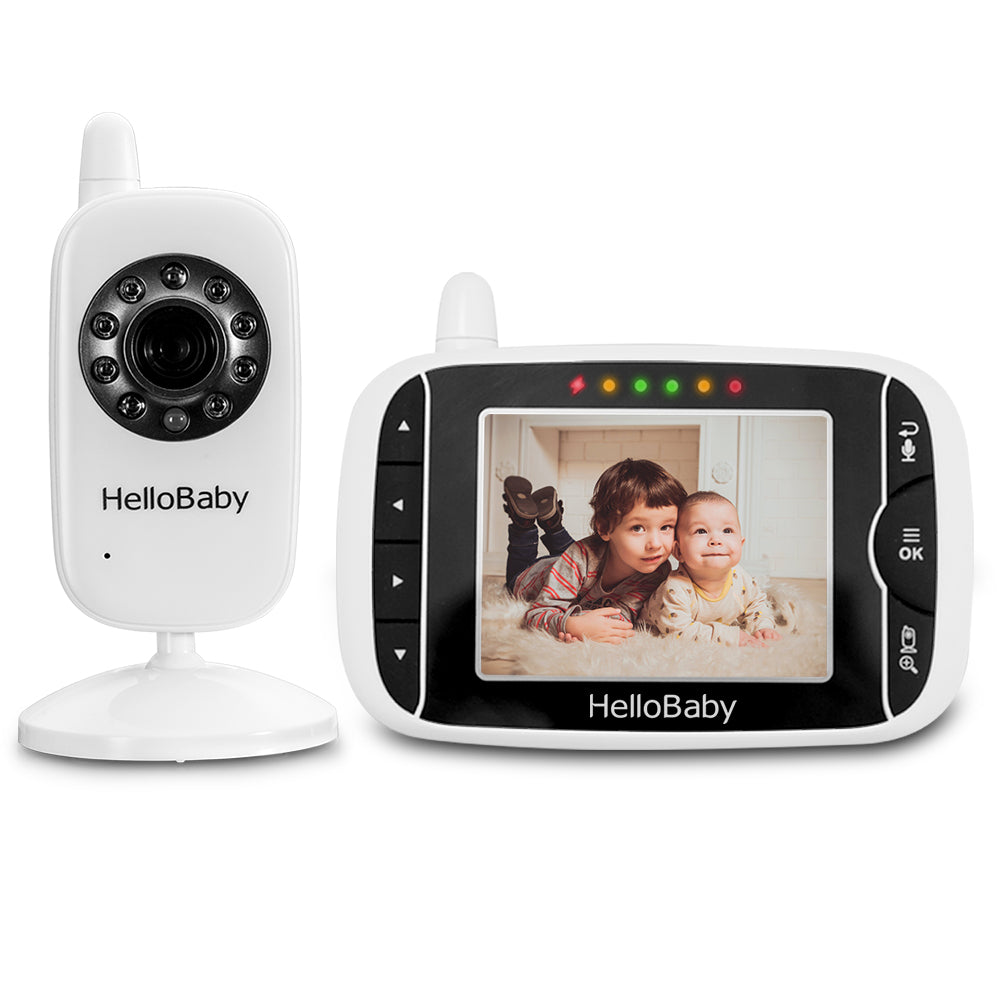
For a one-room setup, that combination is more informative than the smaller HB30 receiver: the HB32 gives you a 3.2-inch screen and a temperature readout without introducing app pairing or a household Wi-Fi dependency. It remains a single-view local monitor, not a large-screen multi-room control center. Its screen size is still modest compared with larger systems, and the maker does not publish a video-resolution figure on the exact listing.
Temperature and voice features are helpful cues, not safety guarantees
The HB32 displays a room-temperature value and lets the parent unit sound an alert when the set high or low limit is crossed. The manual describes editable limits, with different adjustment ranges for high and low thresholds, but it does not provide an accuracy tolerance. Use the number as a basic room cue, not as a calibrated thermometer or proof that a sleep environment is safe. It cannot replace appropriate safe-sleep practice, direct observation or professional advice.
VOX/ECO mode turns off the screen and audio transmission after a quiet interval, then wakes the receiver when the camera detects sound above the selected sensitivity. That can preserve receiver battery and make a dark room less distracting, but it does not recognize cries or promise a notification for every sound. The manual describes low and high sensitivity settings, so choose the threshold deliberately; if you want a continuously lit picture or constant room audio, switch out of the sound-activated plan. Talk-back is push-to-speak, and the manual says the receiver speaker is muted while you speak.
Eight lullabies and a recurring reminder alarm are controlled from the receiver. They can cover a routine need without a phone app, but the lullaby default is off and the reminder is a timer, not a feeding record. Do not expect the monitor to tell you whether a child is asleep or needs a particular care action.
One camera view at a time, with a practical camera-placement limit
The shipped package includes one camera. HelloBaby says the system can connect up to four, and the guide describes a scan that holds each camera's image on screen for about ten seconds before moving to the next. That is sequential checking, not simultaneous split-screen coverage. If two rooms must remain visible or audible together, this is not a fit. The exact model page does not prove that any nearby-numbered HelloBaby camera will pair; confirm an HB32-compatible expansion camera before adding one.
The word “pan/tilt” can be confusing here. The manual describes directional movement of the enlarged digital image while zoom is active; it does not document a motor that turns the camera from the parent screen. Set the camera's physical aim where it is needed before leaving the room. Digital zoom can enlarge a crop but does not improve sensor resolution. The guide recommends placing the camera within about six feet of the area for optimum image, and the wall-mount kit gives a fixed-placement option. Keep the cord out of the sleep space and route it beyond children's reach as the manual directs.
Battery and range claims vary by source
The model guide lists a 950 mAh parent-unit battery with up to six hours of battery life, but it does not specify a tested screen-on runtime or state that the camera has battery backup. HelloBaby's general FAQ describes around eight hours for its video monitors, so do not plan a long night or travel day around the larger, brand-wide estimate. The camera itself needs the supplied adapter and an outlet; the portable part is the parent receiver, not the whole monitoring system.
Range is also not a reliable differentiator on the available material. The exact product page says up to 960 feet, while the guide lists up to 1,000 feet line of sight and 165 feet indoors. Those are manufacturer claims with no matching test protocol, not a measured in-home guarantee. Walls, metal and nearby radios can reduce reception. Try the camera and receiver in the actual rooms and on the actual floors before relying on the link.
Who gets the most from the HB32
The HB32 suits someone who wants a local parent screen larger than the HB30's, a temperature readout with adjustable audible limits, two-way talk and simple camera scanning. It is a poor match for an essential away-from-home phone view, confirmed dual-room video at once, a motorized remote camera, or a specified runtime above what the manual claims. The exact product page's monitor-only and “+ stand” options are package choices; the page does not itemize what is added by the stand selection, so check the exact order configuration rather than assuming extra safety or hardware.
If the 2.4-inch display and simpler feature set are sufficient, compare the HelloBaby HB30. If you need remote phone access, look at a networked camera and verify its account, connection and outage behavior. The HB32 page showed Sold Out and its archived official product response marked both listed variants unavailable on the same check date; its exact product identity remains clear, but this does not establish present stock. Check the current model-specific listing before buying.
Key details at a glance
| Parent-unit screen | 3.2 in |
|---|---|
| Camera-to-parent-unit connection | 2.4 GHz local camera-to-parent-unit link documented in the exact product page and HB32 user guide; no router, account or away-from-home phone view is documented as part of this setup. |
| Manufacturer-stated open-space range | 1000 ft |
| Advertised maximum range claim | 960 ft |
| Cameras in the reviewed kit | 1 |
| Maximum camera units supported | 4 |
| Video rooms visible at once | 1 |
| Phone viewing away from home | No |
| Supplied camera lens setup | The model guide describes digital zoom with directional pan/tilt of the enlarged image; it does not document a motor that physically turns the camera from the receiver. |
| Recommended stable operation uses home Wi-Fi | No |
| Audio-only system | No |
| Parent talk-back | Yes |
| Room-temperature readout | Yes |
| Preloaded lullaby count | 8 |
| Parent receivers included | 1 |
Use the exact model’s instructions for operating limits, supplied equipment and version differences.
Sources for this assessment
Check the room and the receiving setup.
Read the exact model's constraints, camera count and supervision limits before choosing a package.