
Your needs, this model
Does it fit your priorities?
Is a one-camera local screen enough when away-from-home phone access is not required?
The exact HB30 monitor-only configuration is described with a dedicated receiver and one camera over a 2.4 GHz link; no remote phone path is documented.
Explore this need in the finder →Must the camera turn remotely from the parent unit?
No. The listing describes physical manual rotation/tilt and 2× digital zoom, not a motorized remote pan/tilt mechanism.
Explore this need in the finder →Does this satisfy a minimum screen or verified continuous-runtime requirement?
The manufacturer states a 2.4-inch display, but does not provide the video resolution or a verified continuous-screen runtime for the exact U.S. listing. The model fails a 3-inch essential screen minimum and any numeric runtime requirement.
Explore this need in the finder →A compact local monitor for a room where a small screen is enough
The HelloBaby HB30 is aimed at a household that wants a camera picture on its own parent unit rather than a phone app. Its U.S. product page identifies the HB30 monitor-only package, a 2.4-inch LCD and a 2.4 GHz wireless connection. The box description lists one parent unit, one camera, two power adapters, a wall-mount kit and a user manual. The camera and receiver form the system; the page does not document away-from-home phone viewing, an account or a home-router setup.
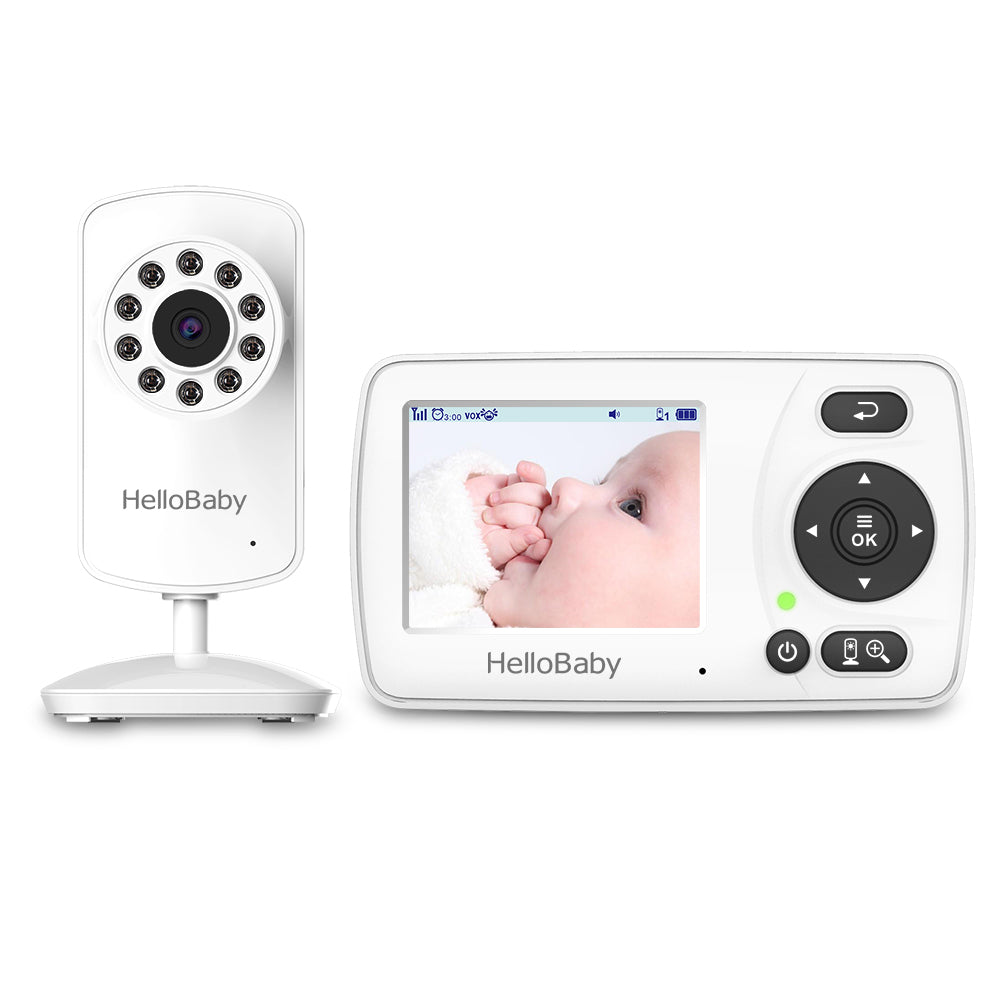
That arrangement works best when you expect to keep a receiver nearby and mainly need one room at a time. It avoids the phone-notification and Wi-Fi requirements of an app camera, but the smaller display is a real tradeoff. If you routinely want a larger picture, compare the HelloBaby HB32, whose maker lists a 3.2-inch screen. Neither model is a substitute for direct supervision, and neither should be treated as a medical monitor.
What changes when you use sound activation
The HB30 listing describes automatic infrared night vision, two-way talk and VOX: the parent screen can sleep while the room is quiet and wake when sound is detected. That can reduce the time the display is lit, but it is not a baby-cry classifier. The manufacturer does not publish a detection threshold or guarantee that every quiet sound will wake the screen. If you choose this mode, set the receiver where you can see its sound indicator and hear its output, then check the chosen sensitivity in the room you will actually use.
A model-specific manual copy describes adjustable sound-activation sensitivity and a feeding reminder. The exact product page describes eight timer settings from 30 minutes to four hours; the accessible manual copy describes a half-hour interval with a different upper limit and number of steps. Because those source versions disagree, rely on the presence of a reminder rather than a particular schedule range until you verify the manual supplied with your unit. The manual also describes two-way talk as a push-and-hold action; using it temporarily mutes the parent-unit speaker while you speak. That is useful for a quick reassurance, but it is not the same as hearing the room continuously during the talk-back press.
Camera positioning is a hands-on task
HelloBaby says the camera can be rotated manually and tilted by hand, and the receiver offers 2× digital zoom. These controls help you set a closer view or physically re-aim the camera, but they do not provide motorized remote pan and tilt from the parent unit. If the crib or bed position changes, expect to adjust the camera itself. A zoomed crop can make a small detail fill more of the screen; it does not add image detail that the sensor did not capture, and the maker does not state the video resolution.
The page says the system can add cameras up to a four-camera maximum, but this package includes only one. Additional cameras are not four simultaneous views: the maker's support description says the receiver scans cameras in sequence, roughly ten seconds per view. If two rooms must remain visible or audible together, the HB30 is the wrong operating plan. Confirm the exact model of any add-on camera before purchasing; close HelloBaby model numbers are not universally interchangeable.
Range and setup should be treated as household questions
The product page advertises up to 800 feet outdoors and 165 feet indoors. HelloBaby's general FAQ gives a different open-field figure, and the model manual copy also uses a different line-of-sight number. These are manufacturer claims, not independent range tests, and the discrepancy makes a numeric range threshold a poor reason to choose the HB30. Walls, metal, reinforced concrete and nearby 2.4 GHz equipment can change reception. Place and test both units from the locations you intend to use instead of treating an open-field claim as a through-walls guarantee.
The camera is not a wireless camera in the battery-powered sense: the exact package lists power adapters for the system, and the manual instructs the user to connect the camera to an adapter. Plan a safe outlet and cable route before selecting a wall or tabletop position. The manual warns to keep cords more than three feet from the crib or playpen and to use the supplied adapters rather than an extension cord. The separate “HB30 + stand” selection appears on the seller page, but its added contents are not itemized there; do not treat a stand as permission to place a camera or cord inside a sleep space.
Who should choose it—and who should look elsewhere
Choose the HB30 if your ordinary need is a straightforward local camera picture, a separate receiver, two-way talk and a 2.4-inch screen, and you are comfortable aiming the camera before use. Its sound-activated screen and timer can be useful extras, but the product page does not confirm temperature alerts, phone-away viewing, simultaneous multi-room video or a specific continuous screen-on runtime. Those unknowns should stay unknown rather than becoming assumptions in a must-have list.
Look at the HB32 if a 3.2-inch display and a documented temperature readout matter more than the HB30's smaller receiver. Consider a networked camera only if remote phone access is essential, and choose a system with a documented simultaneous-view mode if two rooms must stay on screen together. The official HB30 page showed Sold Out while the manufacturer's all-products response marked the monitor-only variant available, so stock signals conflict; this review identifies the model, not current inventory. Verify the exact HB30 listing and package option before ordering.
Key details at a glance
| Parent-unit screen | 2.4 in |
|---|---|
| Camera-to-parent-unit connection | 2.4 GHz camera-to-parent receiver connection shown on the exact U.S. product page; no app or away-from-home phone path is documented. |
| Advertised maximum range claim | 800 ft |
| Cameras in the reviewed kit | 1 |
| Maximum camera units supported | 4 |
| Video rooms visible at once | 1 |
| Phone viewing away from home | No |
| Supplied camera lens setup | The exact page describes manual camera rotation/tilt and 2× digital zoom; no motorized remote pan/tilt is documented. |
| Recommended stable operation uses home Wi-Fi | No |
| Audio-only system | No |
| Parent talk-back | Yes |
| Preloaded lullaby count | 8 |
| Parent receivers included | 1 |
Use the exact model’s instructions for operating limits, supplied equipment and version differences.
Sources for this assessment
Check the room and the receiving setup.
Read the exact model's constraints, camera count and supervision limits before choosing a package.