
Your needs, this model
Does it fit your priorities?
Can the exact two-camera V43 display both room pictures while I listen to one selected room?
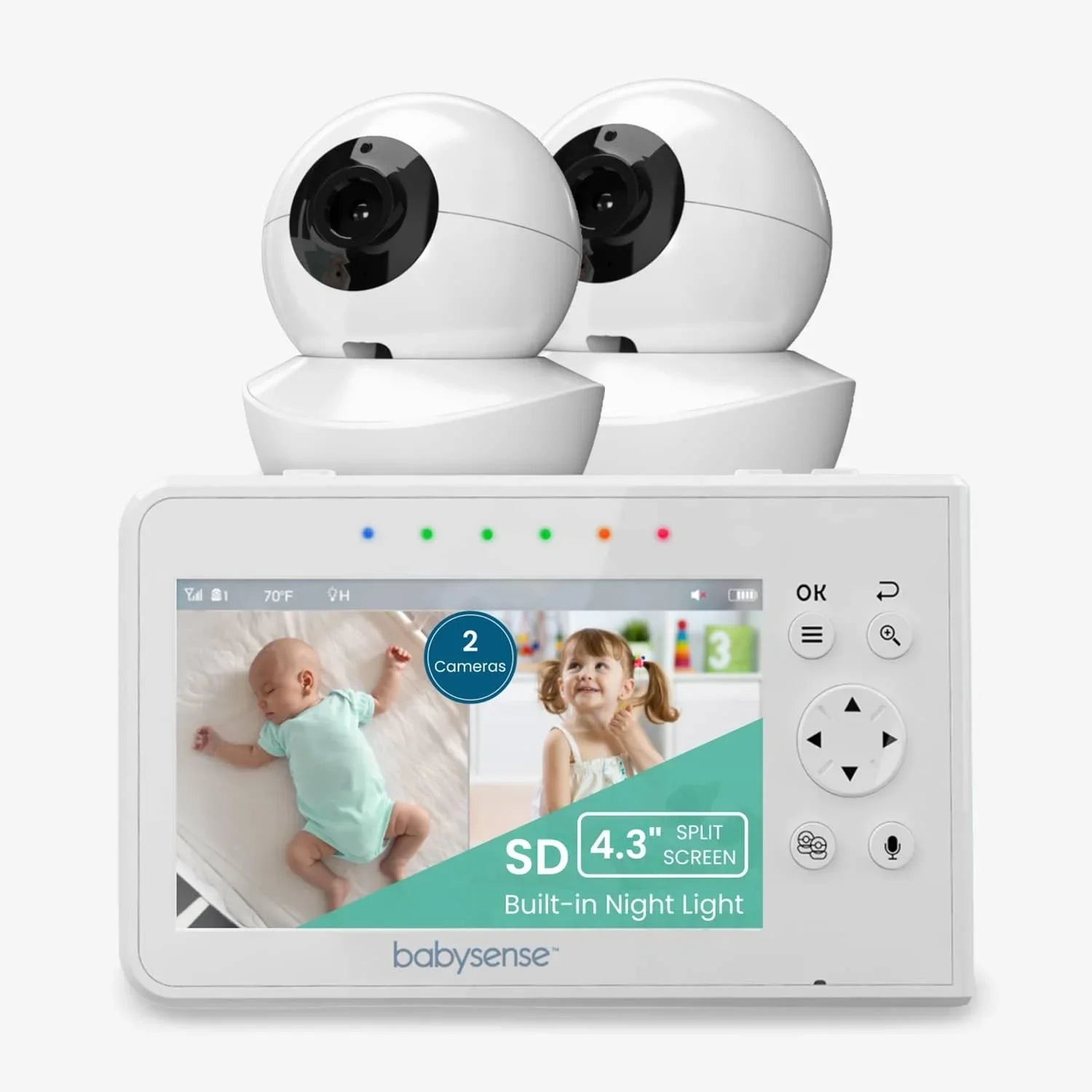
Yes. The current two-camera page and V43-2 manual document the exact twin package; split-screen shows two images and the highlighted camera supplies one audio feed.
Explore this need in the finder →Does the V43 provide local pan/tilt on its dedicated receiver without home Wi-Fi?
Yes. The exact listing calls the package non-Wi-Fi and the user guide describes direct FHSS operation and parent-unit camera controls; no away-from-home phone stream is documented.
Explore this need in the finder →Is 4.3 inches enough if I do not require a five-inch minimum?
The V43 manual specifies a 4.3-inch TFT display. It should not meet a five-inch essential size requirement.
Explore this need in the finder →Does this manual establish a guaranteed 950-foot range or six-hour minimum runtime?
No. The manual and product page disagree on range wording/units and describe runtime as “up to,” not a guaranteed minimum; numeric cutoff fields remain unknown.
Explore this need in the finder →The reviewed unit is the two-camera V43 kit
This review covers the current U.S. Babysense V43 listing titled “Video Baby Monitor with 2 Cameras,” not every monitor that shares the V43 name. Its retailer SKU is “V43 TWO cams,” UPC 854459007697, and the user guide labels the two-camera package V43-2. The same guide names a V43-1 one-camera version, but that name alone does not establish a current U.S. retail package, stock status, SKU or included image. The package assessed here is the exact listed two-camera configuration.
The manual’s box list for V43-2 is one parent display, two camera units, three power adapters and the user guide; the parent unit’s rechargeable battery is preinstalled. Two cameras arrive with this kit, so the split view can be used without counting on a separate purchase. The camera units can also be paired individually and moved through the parent receiver. The monitor is a local radio design, rather than a connected camera that sends video to an app.
Two pictures are not two simultaneous audio feeds
The useful V43 distinction is its 4.3-inch dedicated parent screen and side-by-side picture mode. In split-screen, you can keep two paired camera images visible together. But the manufacturer’s operating guidance says the receiver listens to one selected camera at a time; its highlighted camera is the audio source. If the parent unit scans between cameras, the sound focus moves sequentially rather than mixing both rooms. A household that needs two-room video but can listen to one selected room at a time may find that workable. If both rooms must be audible simultaneously, do not treat the split-screen label as evidence of dual audio; the reviewed Infant Optics DXR-8 PRO SS has a documented selectable dual-audio mode.
V43 can pair up to four cameras, but that is a connection limit, not the supplied box count or a promise of four simultaneous tiles. The product page describes camera pan, tilt and zoom; the manual documents digital zoom and remote controls. Digital enlargement is not an optical lens change, and the small 4.3-inch screen leaves less room for two reduced pictures than a larger panel. For a room where each view must be easy to inspect at a glance, compare the 5.5-inch Babysense PRO twin; it still selects one audio source, so it solves screen size, not dual sound.
A no-router routine, with sound-activated standby as a choice
V43 uses the manufacturer-described 2.4 GHz FHSS camera-to-parent link and a separate receiver screen. No home Wi-Fi, internet connection or away-from-home phone viewing path is documented. It cannot meet a requirement to see the nursery from work, and published reach figures cannot guarantee a signal through a particular home.
The manual gives “up to 960 feet / 300 meters” in open space, while the current product page advertises “up to 1,000 ft.” The imperial and metric figures are not equivalent, and neither statement describes performance through walls, floors or interference. For that reason a hard numeric range cutoff is not a safe match for this exact package. Treat these as manufacturer claims only and test the receiver from the places where it will actually be used.
Eco mode can turn off video and audio standby after a quiet interval and wake when sound exceeds the selected sensitivity. That saves the display from staying continuously active, but it also means a very quiet room may not keep a live picture on screen. The receiver can instead stay in audio-only mode with the screen off, and the camera provides infrared night vision, talk-back, a built-in night light, temperature display/alerts and four lullabies plus white noise. The temperature reading belongs to the camera’s placement, not the baby’s body or a medical instrument. White noise does not loop with the lullabies according to the manual.
Battery and installation limits matter more than the headline features
The V43 guide is inconsistent about parent-unit battery capacity: its setup section says 3.7 V, 1,200 mAh, while its specification table says 3.7 V, 2,100 mAh. The listed product specification follows the latter figure, but a buyer should not treat capacity or an “up to” runtime as a guaranteed minimum. The spec table estimates up to 10 hours in Eco mode or up to 6 hours with the monitor on and about 8 hours to recharge; it does not establish a fixed-condition endurance test or minimum. If six hours of uninterrupted screen-on runtime is essential, this documentation does not prove that threshold.
Installation also deserves more attention than a feature list. The manual says to place a camera at least six feet from the crib on a stable surface or mount it securely, keep cords beyond a child’s reach and use only the supplied power adapters. It warns about radio interference and recommends separating the units from nearby electronics. The manufacturer says this monitor is for supervision support, not a medical device or replacement for adult care.
Who should choose V43, and who should look elsewhere?
Choose the exact V43 twin when two included cameras, local split pictures, remote camera movement and a no-Wi-Fi parent screen are the core requirements—and one selected audio channel and a 4.3-inch display are acceptable.
Choose the 5.5-inch Babysense PRO twin if a larger display matters more; it has its own manual-backed two-camera package but also plays one selected room’s sound. Choose a monitor with explicitly supported dual audio if hearing both rooms is essential. Choose a documented Wi-Fi/app system if phone access away from home is required. And if the parent-unit screen must be at least five inches or a guaranteed six-hour screen-on minimum is essential, the V43 should not pass that filter. The exact kit’s features make its best use fairly narrow: two local views for a caregiver who values a separate receiver more than phone reach or simultaneous audio.
Babysense V43 two-camera listing · Babysense V43 manual page · Official split-screen guidance
Key details at a glance
| Parent-unit screen | 4.3 in |
|---|---|
| Published display resolution | 4.3-inch TFT LCD per the V43 manual; pixel resolution not stated in the reviewed manual. |
| Camera-to-parent-unit connection | Local 2.4 GHz FHSS link from camera unit(s) to the dedicated parent receiver; product page identifies it as non-Wi-Fi and no remote app viewing is documented. |
| Advertised maximum range claim | 1000 ft |
| Cameras in the reviewed kit | 2 |
| Maximum camera units supported | 4 |
| Video rooms visible at once | 2 |
| Phone viewing away from home | No |
| Supplied camera lens setup | Two included motorized pan/tilt camera units; manual documents digital zoom. Exact pan/tilt angle and zoom magnification are not set as numeric facts. |
| Recommended stable operation uses home Wi-Fi | No |
| Audio-only system | No |
| Parent talk-back | Yes |
| Room-temperature readout | Yes |
| Camera-side mood light | Yes |
| Separate under-mattress movement-monitor system included | No |
| Parent receivers included | 1 |
Use the exact model’s instructions for operating limits, supplied equipment and version differences.
Sources for this assessment
- Babysense V43 video baby monitor with two cameras, exact U.S. page and SKU
- Babysense Split-Screen Video Baby Monitor user manual; V43-1 and V43-2 family
- How can I use the Split-Screen Feature?
- Can I hear from 2 cameras at the same time?
- Babysense V43 two-camera package rendering from the exact product page
- CPSC exact-string recall query for Babysense V43
- CPSC Babysense Max View recall, model VBM55/VBM55RX; retained as a separate-model check

Check the room and the receiving setup.
Read the exact model's constraints, camera count and supervision limits before choosing a package.