
Your needs, this model
Does it fit your priorities?
Can one VM919HD camera meet a seven-inch local-viewer need when remote pan and tilt matter?
Yes. The exact VM919HD U.S. guide specifies a seven-inch 1200 × 800 IPS parent display and the page/guide document camera pan and tilt.
Explore this need in the finder →Does the one-camera VM919HD show two camera pictures at once?
No. This exact package includes one Baby Unit; the VM919-2HD is the separately listed two-camera package with Split mode.
Explore this need in the finder →Does the “up to 15 hours” video headline establish eight hours with the screen continuously on?
No. The Parent Unit is rechargeable, but the guide does not specify a guaranteed screen-on duration or test conditions.
Explore this need in the finder →Can the VM919HD provide a phone picture away from home?
No remote-phone mode is documented in the exact package materials; it is described as a local Parent Unit and Baby Unit system.
Explore this need in the finder →A large local viewer for one included camera
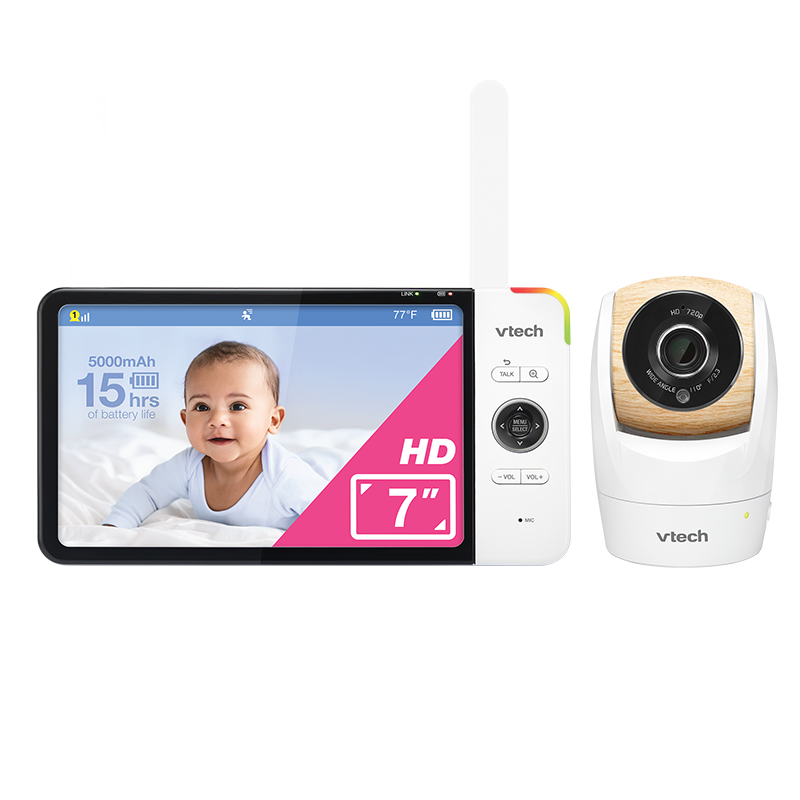
The VTech VM919HD is the one-camera version of VTech’s seven-inch HD monitor family. Its appeal is straightforward: a parent unit with a screen large enough for a glance across the room, a camera that can be redirected remotely, and a direct camera-to-viewer link rather than a phone app. The exact U.S. package lists one Parent Unit, one Baby Unit, two power adapters and mounting hardware. That makes this a sensible place to start if one nursery is the whole job. The separately listed VM919-2HD adds a second camera and two-room display modes; it is a different box, not an accessory that can be presumed to come with this one.
Seven inches, with a useful specification distinction
The current product page markets a 720p HD picture on a seven-inch display. The U.S. quick-start guide specifies a 1200 × 800 IPS color LCD. Those labels describe different parts of the system and should not be collapsed into a promise that the panel itself has 720p pixels. In ordinary use, the more important difference is size: the VM919HD offers a broader parent-unit picture than VTech’s 2.8-inch VM923 or the 3.5-inch VM4263. It is a better fit for someone who glances at a receiver from a chair or carries it between rooms than for a buyer who wants a pocket-size monitor. Digital zoom can enlarge a selected area, but it cannot create detail that the camera did not capture.
Local operation and an adjustable camera
The exact guide describes a direct local radio connection between Baby Unit and Parent Unit, with 32 channels in the 2.406–2.475 GHz band. It does not document an away-from-home phone feed. That changes the choice questionnaire in a practical way: if you require a separate receiver and a setup that does not need home Wi-Fi, the VM919HD has a matching plan; if checking from work or another location is essential, this is not the right configuration to assume. Its camera supports pan, tilt and zoom from the parent controls, so a caregiver can make modest framing adjustments without entering the room. That is useful when the crib or furniture layout changes, but it is not automatic tracking and the movement does not replace careful initial placement.
Alerts and comfort controls are not medical monitoring
The product materials list automatic infrared night vision, two-way talk, a temperature display and alert, sound activation, and a motion alert with sensitivity settings. The sound-activated screen is a practical choice if you prefer a dark display until the room makes noise; it is different from requiring the screen to remain on continuously. The camera also offers a night light, five melodies and four soothing sounds. Those options can help make the monitor easier to use as part of a routine, but a temperature or movement prompt is a household cue, not a medical measurement or a substitute for checking on a child.
Range and battery headlines need context
The product title uses a 1,000-foot range claim. The guide cautions that actual operating range varies with the environment, and it does not provide a measured result for a particular house. Floors, walls and nearby electronics can change reception; test the link where you actually intend to use it. The Parent Unit has a built-in battery. VTech advertises up to 15 hours of video and 22 hours of audio-only use, and the exact manufacturer rendering labels a 5,000mAh battery. Neither that capacity label nor the “up to” headline is a guaranteed minimum with the display continuously on. If you need a verified runtime threshold, the unknown screen-on duration should keep the VM919HD out of that match rather than turn a maximum claim into a test result. The camera is powered separately from the Parent Unit; a charged receiver cannot keep a camera transmitting through a camera-side power failure.
Choose the base package or the twin
For a single room, the VM919HD’s strengths are its larger local screen, adjustable camera and set of sound, motion and temperature prompts. If two rooms matter, compare the exact VM919-2HD instead: it includes two cameras and can show two pictures in Split mode or alternate the displayed camera in ten-second Patrol mode. Split lets the parent select a picture for its audio; the guide does not establish two continuously audible rooms at once. So the twin can answer a two-picture requirement, but neither model should satisfy an essential dual-audio requirement unless that behavior is confirmed separately. If you only need a small viewer and remote pan/tilt, the less expensive-to-space VM923 family may be easier to place; if phone access is essential, compare a documented connected model instead.
Who is it for?
Choose the VM919HD if you want one camera, a seven-inch dedicated viewer, local operation and remote camera movement, and you do not need phone-away access. Choose a twin only when the second camera is genuinely useful; the extra camera adds coverage, not a second parent screen. Before relying on the system, follow the guide’s setup instructions: keep the camera outside the crib or playpen, keep its cord more than three feet from a child, stay within the stated mounting-height limit, and check the link after moving equipment. A monitor supports supervision; it does not replace it.
VTech VM919HD product page · VTech VM919HD / VM919-2HD U.S. quick-start guide
Key details at a glance
| Parent-unit screen | 7 in |
|---|---|
| Published display resolution | The U.S. family guide specifies a 7-inch IPS color LCD at 1200 × 800 pixels; the current product page markets the system as HD/720p. Do not treat those as the same pixel specification. |
| Camera-to-parent-unit connection | Direct local camera-to-Parent-Unit radio. The exact family guide specifies 32 channels and 2.406–2.475 GHz Baby Unit transmission; no away-from-home phone feed is documented. |
| Advertised maximum range claim | 1000 ft |
| Cameras in the reviewed kit | 1 |
| Video rooms visible at once | 1 |
| Phone viewing away from home | No |
| User-replaceable parent-unit battery | No |
| Supplied camera lens setup | One included motorized pan/tilt/zoom camera |
| Recommended stable operation uses home Wi-Fi | No |
| Motion alert | Yes |
| Audio-only system | No |
| Parent talk-back | Yes |
| Room-temperature readout | Yes |
Use the exact model’s instructions for operating limits, supplied equipment and version differences.
Sources for this assessment
- VTech current U.S. VM919HD product page (page 4498)
- VTech VM919HD technical support and linked family guide
- VTech VM919HD / VM919-2HD U.S. Quick Start Guide (01/21)
- VTech VM919HD manufacturer product composite
- CPSC exact-name query for VM919HD (empty response; not proof about other indexing or future notices)

Check the room and the receiving setup.
Read the exact model's constraints, camera count and supervision limits before choosing a package.