
Your needs, this model
Does it fit your priorities?
Can the VM919-2HD show two camera pictures together on a seven-inch local receiver without Wi-Fi?
Yes. The Twin-only Split mode displays both Baby Unit pictures; the guide describes a direct Parent Unit connection and a seven-inch 1200 × 800 IPS display.
Explore this need in the finder →Does the VM919-2HD meet a strict requirement to hear two rooms at once?
No. Split selects one camera for audio, and the guide does not establish continuous dual-room audio.
Explore this need in the finder →Is Patrol the same as seeing two pictures at once?
No. Patrol alternates the displayed camera about every ten seconds; use Split when two pictures must be visible together.
Explore this need in the finder →Does the “up to 15 hours” video headline establish eight hours with the screen continuously on?
No. The Parent Unit has a built-in battery, but the guide does not specify a guaranteed screen-on duration or test conditions.
Explore this need in the finder →Two cameras and a seven-inch parent screen
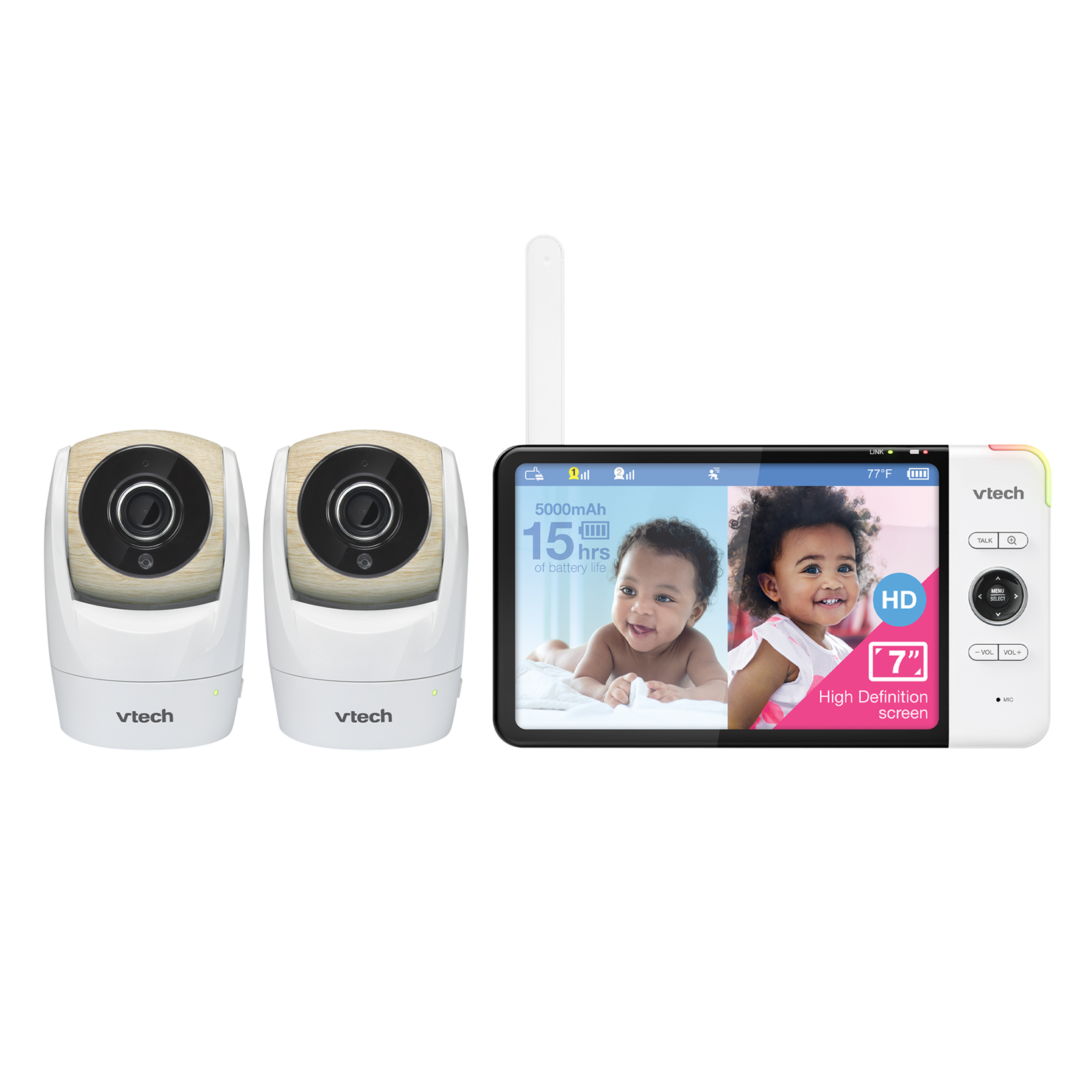
The VTech VM919-2HD is the twin-camera package in VTech’s seven-inch HD local-monitor family. The exact U.S. listing and quick-start guide distinguish it from the VM919HD: this package has two Baby Units, one Parent Unit and the power and mounting pieces for both cameras. That difference matters more than the “twin” label. The receiver can use Patrol to move between camera pictures or Split to show two pictures together. If your need is simply to put one camera in each of two rooms and glance at either, the twin is the relevant version. If one room is enough, the standard VM919HD avoids paying for a second camera you will not place.
Split solves a picture problem, not every two-room problem
The 06/25 U.S. guide documents a Twin-only Split mode that displays both camera pictures at once. A highlighted or selected camera supplies the sound the parent unit plays. Patrol works differently: it alternates the displayed picture between paired cameras about every ten seconds. In other words, the VM919-2HD offers two-room video in Split, and one-at-a-time visual checking in Patrol; it does not turn two included cameras into two independent monitors. The guide does not establish simultaneous audio from both rooms. If you must hear both rooms at the same time, that is an essential condition the VM919-2HD cannot be assumed to meet. A monitor with a documented dual-audio mode is the better comparison.
A large display, not a phone-first camera
The product page markets a seven-inch 720p HD display. The family quick-start guide gives the IPS color LCD dimensions as 1200 × 800 pixels; keep the page’s HD marketing wording separate from the screen’s stated pixel count. Even so, seven inches is the useful distinction here: it is larger than the 2.8-inch VM923-2, which also has two cameras but switches between feeds rather than showing both at once. The VM919-2HD’s cameras can pan, tilt and zoom from the parent unit, allowing a caregiver to reframe without walking to each camera. This is not motion tracking, and digital zoom enlarges the image rather than adding optical detail.
Local viewing and everyday prompts
Both cameras connect to the included Parent Unit over the local radio system. The guide specifies 32 channels and 2.406–2.475 GHz Baby Unit transmission; it does not document Wi-Fi or remote phone viewing. That is convenient when you want a receiver that does not depend on a home router, but it rules out assuming a live picture from outside the home. The feature list includes automatic infrared night vision, two-way talk, temperature display and alert, sound detection, sound-activated screen and a motion alert with sensitivity settings. A night light, five melodies and four soothing sounds add routine controls. These are useful prompts and conveniences, not medical measurements or evidence that a child is safe without adult supervision.
Range and battery claims are not guarantees
The product title claims range up to 1,000 feet, but the guide cautions that actual range depends on the environment. Two cameras in two rooms create two separate placement decisions, so test both paths before relying on the second view. A parent-unit battery can make the receiver portable, but it does not power a camera through an outlet interruption. VTech advertises up to 15 hours of video or 22 hours of audio-only use; the official Twin image also labels a 5,000mAh battery. The exact guide confirms a built-in Parent Unit battery without defining a continuous-screen runtime test. If your questionnaire says you need a fixed minimum of screen-on hours, this product’s headline should not satisfy it. If screen-off or sound-activation use fits your routine, those controls may be more relevant than the maximum claim.
Which requirements does the twin satisfy?
The VM919-2HD is a strong fit for a household that wants a dedicated seven-inch screen, two included camera positions, local operation and both pictures visible in Split. It is not the right fit if a phone-away feed or confirmed two-room audio is essential. The standard VM919HD is the one-camera alternative with the same large-screen family approach. VTech’s VM923-2 also supplies two cameras and remote movement, but its smaller screen and one-at-a-time Patrol view make it a different tradeoff. A strict two-picture-at-once question should exclude VM923-2; a strict simultaneous-audio question should exclude the VM919-2HD as well unless you find a separate exact source proving both feeds remain audible.
Safe placement still matters
Plan the two camera locations before mounting either unit. Keep each camera outside a crib or playpen, route its cord more than three feet from a child, observe the guide’s mounting-height limit, and test reception after relocating a unit. Follow the included adapters and keep an adult responsible for supervision. A second image on the parent screen does not change those basics.
VTech VM919-2HD product page · VTech VM919HD / VM919-2HD U.S. quick-start guide
Key details at a glance
| Parent-unit screen | 7 in |
|---|---|
| Published display resolution | The U.S. family guide specifies a 7-inch IPS color LCD at 1200 × 800 pixels; the current product page markets the system as HD/720p. Do not treat those as the same pixel specification. |
| Camera-to-parent-unit connection | Direct local camera-to-Parent-Unit radio. The exact family guide specifies 32 channels and 2.406–2.475 GHz Baby Unit transmission; no away-from-home phone feed is documented. |
| Advertised maximum range claim | 1000 ft |
| Cameras in the reviewed kit | 2 |
| Video rooms visible at once | 2 |
| Phone viewing away from home | No |
| User-replaceable parent-unit battery | No |
| Supplied camera lens setup | Two included motorized pan/tilt/zoom cameras; Twin guide documents Split and ten-second Patrol picture modes. |
| Recommended stable operation uses home Wi-Fi | No |
| Motion alert | Yes |
| Audio-only system | No |
| Parent talk-back | Yes |
| Room-temperature readout | Yes |
Use the exact model’s instructions for operating limits, supplied equipment and version differences.
Sources for this assessment
- VTech current U.S. VM919-2HD product page (page 4526)
- VTech VM919-2HD technical support and linked family guide
- VTech VM919HD / VM919-2HD U.S. Quick Start Guide (01/21)
- VTech VM919-2HD manufacturer product composite
- CPSC exact-name query for VM919-2HD (empty response; not proof about other indexing or future notices)

Check the room and the receiving setup.
Read the exact model's constraints, camera count and supervision limits before choosing a package.