
Your needs, this model
Does it fit your priorities?
Does the standard VM4263 suit a one-room local-video setup with a 3.5-inch screen?
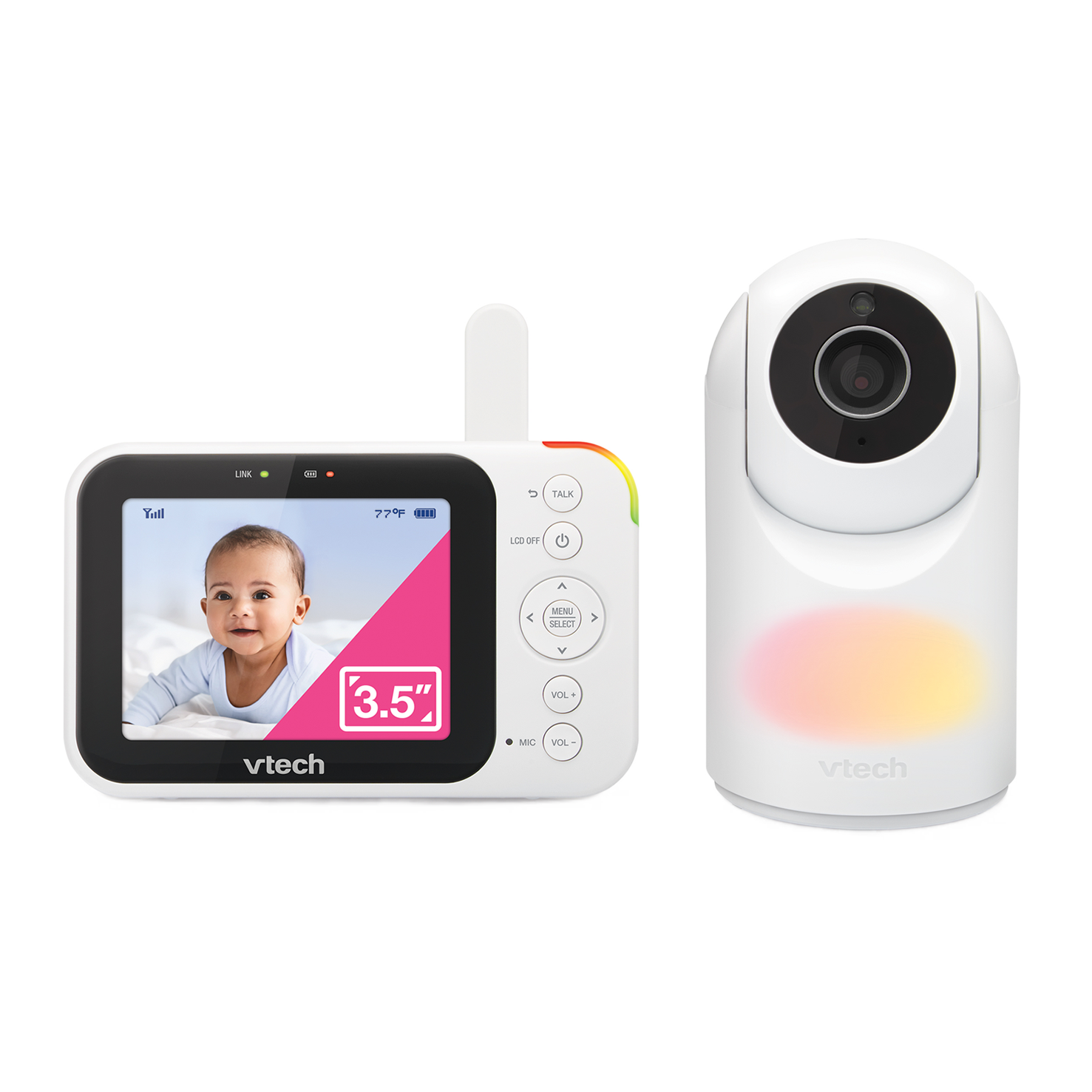
Yes. The current standard package contains one camera and one parent viewer, and the exact U.S. guide specifies a 3.5-inch local display. It is a compact, no-Wi-Fi path; the manual gives QVGA 320 × 240 while the current comparison table says 480p, so the resolution label is not treated as settled.
Explore this need in the finder →Does the VM4263 meet an essential two-camera or away-from-home phone requirement?
No for the reviewed standard set. It includes one camera and is a no-Wi-Fi local-viewer system. A guide names the separate VM4263-2 bundle, but the current two-camera listing and matching package image were not verified, so the VM4263 record does not claim two included cameras.
Explore this need in the finder →Can VTech's 19-hour battery-life table claim satisfy a six-hour screen-on minimum?
No. The U.S. guide specifies battery capacity and says standby varies with sensitivity, use and age, but does not document screen-on runtime. The 19-hour product-table claim has no stated screen-on condition, so an essential numeric screen-on requirement remains unknown.
Explore this need in the finder →Can the standard VM4263 meet a required motion-alert feature?
No match is made. The inspected exact-model page and U.S. guide document sound activation and temperature alerting, but do not establish motion detection for this model.
Explore this need in the finder →A simple local monitor for one room
The VTech VM4263 is a non-Wi-Fi video system with one camera and a separate handheld parent unit. The current listing labels the standard set as VM4263 and describes its color screen as 3.5 inches. Its appeal is a direct room-to-viewer setup, not away-from-home app use.
There is one detail worth treating carefully before comparing picture quality. The U.S. quick-start guide specifies a QVGA 320 × 240 display. VTech’s comparison table on the current product page instead labels the VM4263 screen “480p.” Those descriptions do not align cleanly, so the manual is the firmer specification and I would not buy this model on the strength of the table’s higher-resolution shorthand. The 3.5-inch screen is best understood as a compact check-in display, not an HD upgrade.
Camera movement and small routine controls
From the parent unit, the camera can pan, tilt and zoom in up to 2× digitally. VTech advertises 360-degree panning and 108-degree tilt, while the guide gives arrow-key controls without angles. Digital zoom enlarges the transmitted view rather than adding optical detail. Automatic infrared night vision switches the picture to black and white in darkness.
The camera also has a multi-color night light, two lullabies and two soothing sounds, temperature display and a two-way talk button. The light can be set to adapt to ambient brightness, and its automatic mode can turn on after sound is detected. The parent unit shows a three-level sound indicator. These are convenience controls, not a sleep or health assessment: a temperature threshold is only a prompt to check the room, and a sound response cannot tell you why a sound occurred.
VOX helps dim the screen, but it is not motion detection
The voice-activated alert setting lets you choose microphone sensitivity: the parent screen can stay off below that threshold, wake when a sound exceeds it, and turn off again after 50 seconds below the threshold. You can also turn the screen off manually while continuing to hear the selected camera. Try the sensitivity in the actual room rather than assuming it will filter every sound.
The manufacturer documentation reviewed for this exact model describes sound and temperature functions, but does not establish a motion alert. A motion-alert requirement should therefore rule out the VM4263 rather than turning sound activation into a proxy. The same is true of a two-room essential need: the currently listed standard package contains one camera.
VM4263 and VM4263-2 are distinct camera counts
VTech’s U.S. guide labels “1 set for VM4263” and “2 sets for VM4263-2,” and marks Patrol and camera-selection controls as -2-only. The parent unit can cycle through linked cameras or select one. The guide does not describe split-screen, simultaneous two-room audio or a patrol interval.
The current page and exact image inspected here are for the one-camera VM4263. I found no separate current U.S. VM4263-2 listing or matching twin-kit image. Confirm the suffix and box contents before buying; the one-camera image does not prove a second camera is included. The -2 is a documented variant, not a separate finder result.
Range and battery headlines need context
VTech advertises up to 1,000 feet, but the exact U.S. guide gives no numeric open-space test range and warns actual reach varies by conditions. Treat the headline as a maximum, not a promise through your walls. Follow placement guidance and test reception after installation and after moving a component.
The parent viewer has a built-in 3.6-volt, 2,600-mAh Li-ion battery. VTech’s comparison table lists 19 hours of battery life, but the guide says standby varies with sensitivity, use and battery age and gives no screen-on runtime. A minimum number of hours with video continuously visible should not be matched from that headline.
Who should choose it—and when a different monitor fits better
The VM4263 fits a household that wants one local camera, a dedicated screen, camera movement and sound-triggered screen behavior without router or app setup. It can make sense where a compact display is enough and the parent unit will usually stay in one part of the home. It is a poor fit when a phone feed away from home, two included cameras, a five-inch minimum, a measured open-space range or a known screen-on runtime is essential.
For a larger local picture, compare VTech’s VM5263: its exact U.S. guide specifies a five-inch 1280 × 720 viewer, and its current standard set also includes one camera. The Infant Optics DXR-8 PRO is another five-inch local option, with documented active noise reduction and manual-stated battery durations; its review explains where that feature matters. If two rooms must be visible and audible together, the Infant Optics DXR-8 PRO SS documents a distinct dual-audio arrangement. If the priority is a phone view outside the house, VTech’s VM901 family has Wi-Fi and app operation, but it is not a drop-in no-Wi-Fi equivalent.
Follow the installation and supervision instructions
VTech says this product is an aid, not a replacement for responsible adult supervision, and not a medical monitor. The quick-start guide says never to place or mount the camera in a crib or playpen, keep cords more than three feet from a child, and do not install the camera above 6.5 feet. Follow the included guide for mounting, adapters and cord routing; a radio link and a sound prompt do not replace an adult checking in.
Primary references: the current VTech VM4263 listing, the VTech product support page, and the U.S. VM4263 / VM4263-2 quick-start guide.
Key details at a glance
| Parent-unit screen | 3.5 in |
|---|---|
| Published display resolution | QVGA 320 × 240 pixels in the exact U.S. quick-start guide; VTech's current comparison table says 480p, an unresolved source discrepancy. |
| Camera-to-parent-unit connection | Direct local radio between the included camera and parent viewer; the U.S. guide specifies 2405–2475 MHz transmission and 32 channels. This no-Wi-Fi configuration does not provide remote phone viewing. |
| Advertised maximum range claim | 1000 ft |
| Cameras in the reviewed kit | 1 |
| Video rooms visible at once | 1 |
| Phone viewing away from home | No |
| User-replaceable parent-unit battery | No |
| Supplied camera lens setup | One camera in the standard VM4263 set; VTech's current product page describes remote pan, tilt and up-to-2× digital zoom. |
| Recommended stable operation uses home Wi-Fi | No |
| Audio-only system | No |
| Parent talk-back | Yes |
| Room-temperature readout | Yes |
Use the exact model’s instructions for operating limits, supplied equipment and version differences.
Sources for this assessment
- VTech Baby current U.S. VM4263 product listing
- VTech VM4263 product support page and support FAQ
- VTech VM4263 / VM4263-2 U.S. Quick Start Guide, 08/23, version 1
- VTech official VM4263 manufacturer product rendering
- CPSC public recall API exact model-string query for VM4263; empty result on check date
- CPSC public recall API exact model-string query for VM4263-2; empty result on check date

Check the room and the receiving setup.
Read the exact model's constraints, camera count and supervision limits before choosing a package.