
Your needs, this model
Does it fit your priorities?
Is one camera and a separate screen without Wi-Fi enough for the room you need to check?
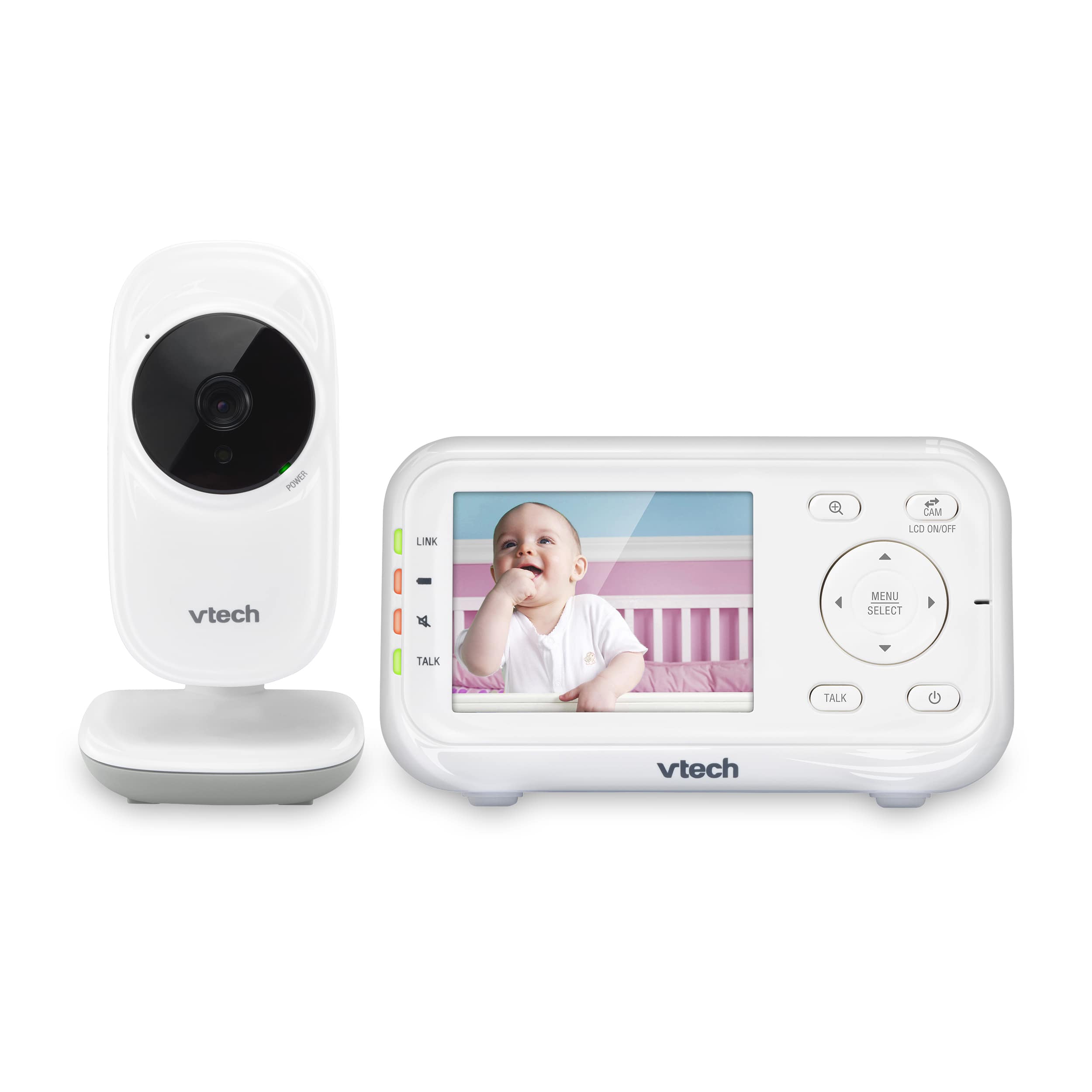
The exact U.S. VM3252 package lists one camera and one viewer. Its manual specifies a direct local link rather than an app or internet connection.
Explore this need in the finder →Would the small 2.8-inch screen be large enough for your check-ins?
The family manual lists a 2.8-inch QVGA 320 × 240 LCD; the current comparison table calls it 270p. Either way, this is a compact screen, not a larger or HD parent display.
Explore this need in the finder →Do you need a manufacturer-verified six-hour continuous screen-on battery minimum?
No such screen-on runtime is stated in the manual. The product page comparison table lists nine hours without conditions, while the manual describes battery-only use as short-time and recommends AC for continuous monitoring.
Explore this need in the finder →The VTech VM3252 is a compact, local video kit for a household that wants one room on a dedicated parent screen. Its useful distinction is straightforward: the exact U.S. listing packages one camera and one viewer, while the separate VM3252-2 package uses the same family platform with two camera sets. The VM3252 is not a phone camera, and it does not require a home Wi-Fi account to carry its feed.
One camera and a small dedicated display
The U.S. product page lists one viewer, one camera, two AC adapters, mounting screws, a manual and a quick-start guide. The monitor therefore arrives ready for one nursery feed, not two. Its 2.8-inch color screen keeps the handheld receiver small, but the manual specifies a QVGA 320 × 240 LCD. The current comparison table uses a 270p label; because those published descriptions do not align exactly, treat the display as a compact low-resolution screen rather than assuming a higher definition from the product-page headline. If screen size or fine detail matters, VTech’s larger VM350 or another larger-screen model is a more relevant comparison.
The camera can be physically aimed during installation, and the parent unit offers 2× digital zoom. Those are different from remote pan and tilt: the camera stays in its installed position until someone adjusts it by hand. The current comparison table calls the camera position fixed, and no motorized framing control is documented. This suits a single well-planned crib view, but it is limiting if furniture moves or you need to scan a wider room from the receiver.
Useful prompts without an app
VTech documents automatic infrared night vision, a six-level sound indicator, sound-activated screen behavior, temperature display and alert, two-way talk, five lullabies and four soothing sounds. The manual describes several VOX sensitivity levels; the sound-activated screen turns itself off after 50 seconds without detected sound, then wakes when a selected threshold is crossed. This can reduce an always-lit display, but sensitivity is a tradeoff: a low threshold may keep the screen active around household noise, while a higher threshold may not react to quieter sounds. A room’s sound machine or fan can change what the microphone detects, so use the manual’s sensitivity guidance and check the intended routine rather than assuming alerts will classify every sound correctly.
The user guide identifies a direct 2.4 GHz radio link, 32 channels across 2405–2475 MHz, and up to 1,000 feet outdoors. That number is a manufacturer maximum, not an indoor promise; walls, doors and interference can reduce the usable signal. The important practical benefit is that this camera-to-viewer link does not rely on a router, internet connection or phone app. The corresponding limitation is that the VM3252 cannot provide remote viewing away from home.
Power and setup deserve attention
The parent unit has a rechargeable battery, but the manual says battery-only operation is for a short time and recommends using AC power for continuous monitoring. The current U.S. comparison table advertises nine hours of battery life, without a stated screen, brightness or test condition. Do not treat that figure as guaranteed continuous screen-on runtime or as a backup plan for a long outage. The camera is adapter-powered, so a power interruption at the camera also interrupts the feed.
Keep the camera and cord placement within the exact manual’s safety instructions: the baby unit stays outside the crib or playpen and out of the child’s reach; keep the cord more than three feet from the child, and place the receiver far enough from the camera to avoid feedback. The monitor is an aid, not a replacement for adult supervision or safe-sleep practice. Test reception at the actual camera and parent-unit locations before relying on it.
Who should shortlist it?
Consider the VM3252 if a small handheld display, one local camera, talk-back and simple sound or temperature prompts cover the room you need. It avoids Wi-Fi setup and makes its most important limitation—one supplied camera—easy to verify. Choose another setup if you need a larger picture, remote phone access, motorized camera movement, documented long screen-on battery runtime, a camera that survives power loss, or simultaneous coverage of two rooms.
The manual-named VM3252-2 is the closest family comparison: it includes two camera sets but its manual describes a single full-screen camera view and a patrol mode that switches to the other camera every ten seconds, not two pictures at once. VTech’s larger VM350-2 offers a different two-camera family arrangement, while the VM923 adds remotely controlled camera movement with a similarly small 2.8-inch screen. Compare the exact package suffix and manual before choosing; a second camera, split picture, and simultaneous room audio are three separate capabilities.
Key details at a glance
| Parent-unit screen | 2.8 in |
|---|---|
| Published display resolution | QVGA 320 × 240 LCD in the exact family manual; current U.S. comparison table labels it 270p, so retain the manual figure and disclose the mismatch. |
| Camera-to-parent-unit connection | Direct local 2.4 GHz video/audio radio link; the family manual specifies a crystal-controlled PLL synthesizer, 32 channels and 2405–2475 MHz. No Wi-Fi, internet or app route is documented. |
| Manufacturer-stated open-space range | 1000 ft |
| Advertised maximum range claim | 1000 ft |
| Cameras in the reviewed kit | 1 |
| Video rooms visible at once | 1 |
| Phone viewing away from home | No |
| Supplied camera lens setup | One fixed-position camera; physically aim the camera during installation. The parent unit provides 2x digital zoom, but no remote pan or tilt. |
| Recommended stable operation uses home Wi-Fi | No |
| Motion alert | No |
| Audio-only system | No |
| Parent talk-back | Yes |
| Room-temperature readout | Yes |
| Preloaded lullaby count | 5 |
| Parent receivers included | 1 |
Use the exact model’s instructions for operating limits, supplied equipment and version differences.
Sources for this assessment

Check the room and the receiving setup.
Read the exact model's constraints, camera count and supervision limits before choosing a package.