
Your needs, this model
Does it fit your priorities?
Are you identifying a two-camera VM3252-family package where one room is shown at a time?
The U.S. family manual distinguishes one set for VM3252 from two sets for VM3252-2. On -2, Single CAM fills the screen with one camera and Patrol switches the single view every ten seconds. The exact -2 remains reference-only because a current U.S. retail route was not verified.
Explore this need in the finder →Do both rooms need to be pictured on the screen simultaneously?
No. The VM3252-2 manual describes a single-camera view that changes every ten seconds in Patrol, not split-screen. The reference model is excluded from purchase results; consider a current model whose exact manual documents concurrent pictures.
Explore this need in the finder →Is a current, verifiable U.S. purchase route essential for this two-camera setup?
Yes. The available exact VM3252-2 listing is from VTech Canada; the U.S. manual confirms the family configuration but no current exact U.S. retail listing was verified. The -2 stays a library reference, not a buying result.
Explore this need in the finder →VTech’s VM3252-2 is the two-camera package in the VM3252 family, not simply a “bigger” version of the one-camera VM3252. The U.S. family manual says one set is supplied with VM3252 and two sets with VM3252-2. It pairs those cameras with one shared Parent Unit. VTech’s current Canadian product page also identifies VM3252-2 as a two-camera model. I could not verify a current U.S. retail listing for this exact suffix, so this is a model-identification and owner-reference review, not a purchase recommendation.
Two rooms, but one full-screen view at a time
The extra camera changes the kit contents; it does not turn the receiver into a split-screen monitor. The manual marks Patrol mode as a VM3252-2-only feature. In Single CAM, the parent screen shows one camera full-screen. Patrol keeps a single-camera view and transitions to the other Baby Unit every ten seconds. You can also switch manually. The exact guide therefore supports a way to alternate attention between two camera locations, not two pictures displayed simultaneously. It also does not document continuous sound from both rooms at once. If a caregiver must hear or see two rooms concurrently, do not infer that from the two-unit box or Patrol label.
That distinction is the main decision point for someone comparing a used package or identifying a hand-me-down. A separate current two-camera system may offer split viewing, selected-camera audio, or another arrangement; those are not interchangeable. The VM3252-2 manual describes a single picture and an alternating patrol. It also describes selected Baby Unit operation for talk and sound activation. When deciding whether this meets a real household routine, ask whether periodic switching is enough or whether one room could be missed while the display is on the other feed.
Shared family strengths and limits
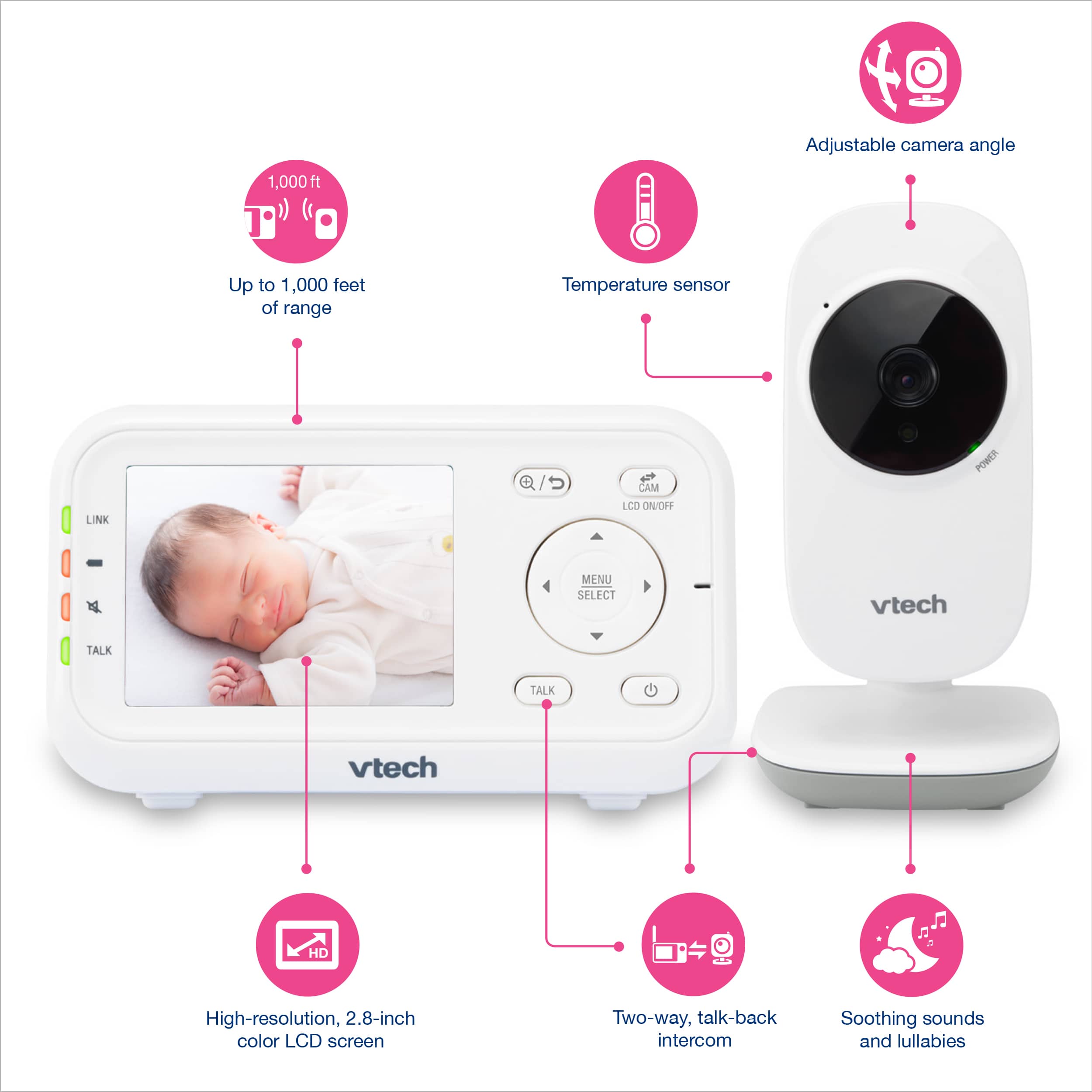
The -2 retains the family’s compact 2.8-inch color viewer, manual camera aiming, automatic infrared night vision, 2× digital zoom, six-level sound indicator, temperature display and alert, talk-back, five lullabies and four soothing sounds. Its receiver connects directly to the cameras over local radio; the manual lists 32 channels at 2405–2475 MHz. No home Wi-Fi, internet service or phone-app path is documented, so it is useful for home-only viewing without network setup—but it cannot send a feed to a caregiver away from the receiver.
For display detail, use the manual’s exact QVGA 320 × 240 specification. The current U.S. product-page comparison calls the panel 270p, a different label; the conservative reading is a small, lower-resolution screen, not a high-definition display. The camera can be positioned by hand and digital zoom can enlarge the picture, but remote pan or tilt is not supported. A camera aimed well at installation remains pointed there until someone physically changes it.
The manual’s operating-range figure is up to 1,000 feet outdoors and warns that walls, doors and other obstructions affect actual range. Treat it as a qualified maximum, then test the route through your own home. The parent receiver uses a rechargeable battery, but the manual describes battery-only use as short-time operation and recommends AC for continuous use. The camera units need their adapters; a power cut at a camera means that room’s feed is unavailable. A battery-life number on a retailer or comparison page is not a substitute for a stated screen-on test condition.
Fit, placement and safer alternatives
This reference matters most when you already own, have been offered, or are trying to identify a VM3252-2. It can clarify why the second camera exists and what the patrol mode does. It is a poor fit when the essential requirement is a current, verifiable U.S. purchase route, split-screen viewing, two simultaneous audio feeds, remote phone access, a larger screen, or remotely controlled framing. Do not buy a used set on the assumption that its second camera will play both rooms continuously; confirm both cameras, adapters and the exact suffix, then test every unit before use.
For a currently documented two-camera option, compare exact listings such as VTech’s VM350-2 or other current local kits, and inspect whether their manuals promise split pictures or only sequential views. For a larger display, compare the VM350 family. For remote camera movement, the VM923 family is a more relevant feature comparison, though it keeps a small 2.8-inch screen. Each changes a different constraint, so two cameras alone should not decide the choice.
Follow the family manual’s placement directions: keep the baby units outside the crib or playpen, beyond the child’s reach, and keep cords more than three feet away. Put the parent unit at least three feet from the camera units to reduce feedback, and test the actual signal path. Temperature and sound indicators are household prompts, not medical measurements. This product is not a medical device or a substitute for an adult supervising a child.
Key details at a glance
| Parent-unit screen | 2.8 in |
|---|---|
| Published display resolution | QVGA 320 × 240 LCD in the exact family manual; current U.S. comparison table labels it 270p, so retain the manual figure and disclose the mismatch. |
| Camera-to-parent-unit connection | Direct local 2.4 GHz video/audio radio link; the family manual specifies a crystal-controlled PLL synthesizer, 32 channels and 2405–2475 MHz. No Wi-Fi, internet or app route is documented. |
| Manufacturer-stated open-space range | 1000 ft |
| Advertised maximum range claim | 1000 ft |
| Cameras in the reviewed kit | 2 |
| Video rooms visible at once | 1 |
| Phone viewing away from home | No |
| Supplied camera lens setup | Two included fixed-position cameras; physically aim each camera during installation. The Parent Unit shows one full-screen camera at a time. VM3252-2-only Patrol changes the single-camera view every 10 seconds; no remote pan or tilt. |
| Recommended stable operation uses home Wi-Fi | No |
| Motion alert | No |
| Audio-only system | No |
| Parent talk-back | Yes |
| Room-temperature readout | Yes |
| Preloaded lullaby count | 5 |
| Parent receivers included | 1 |
Use the exact model’s instructions for operating limits, supplied equipment and version differences.
Sources for this assessment

Check the room and the receiving setup.
Read the exact model's constraints, camera count and supervision limits before choosing a package.