
Your needs, this model
Does it fit your priorities?
Do you need two camera units in the exact kit but only one room picture at a time?
Yes. The VM320-2 support title identifies two cameras, and its official guide says the twin package has two sets. The parent viewer selects one image or uses Patrol to switch pictures every 10 seconds.
Explore this need in the finder →Must both rooms remain visible on screen simultaneously?
No. The two-camera kit uses single-cam or 10-second Patrol viewing; the documentation does not establish a simultaneous split view.
Explore this need in the finder →Can VM320-2 keep two rooms’ audio open together while the screen patrols?
That is not confirmed. The manual describes selecting one baby-unit view and timed picture patrol, not two simultaneous room-audio streams, so an essential dual-audio requirement should not count this kit.
Explore this need in the finder →Is at least six hours of continuous parent-screen runtime a must-have?
The manual gives battery type and charging advice but no screen-on hours. The model cannot satisfy a strict runtime minimum from the information documented.
Explore this need in the finder →The distinction is the box, not a different kind of monitor
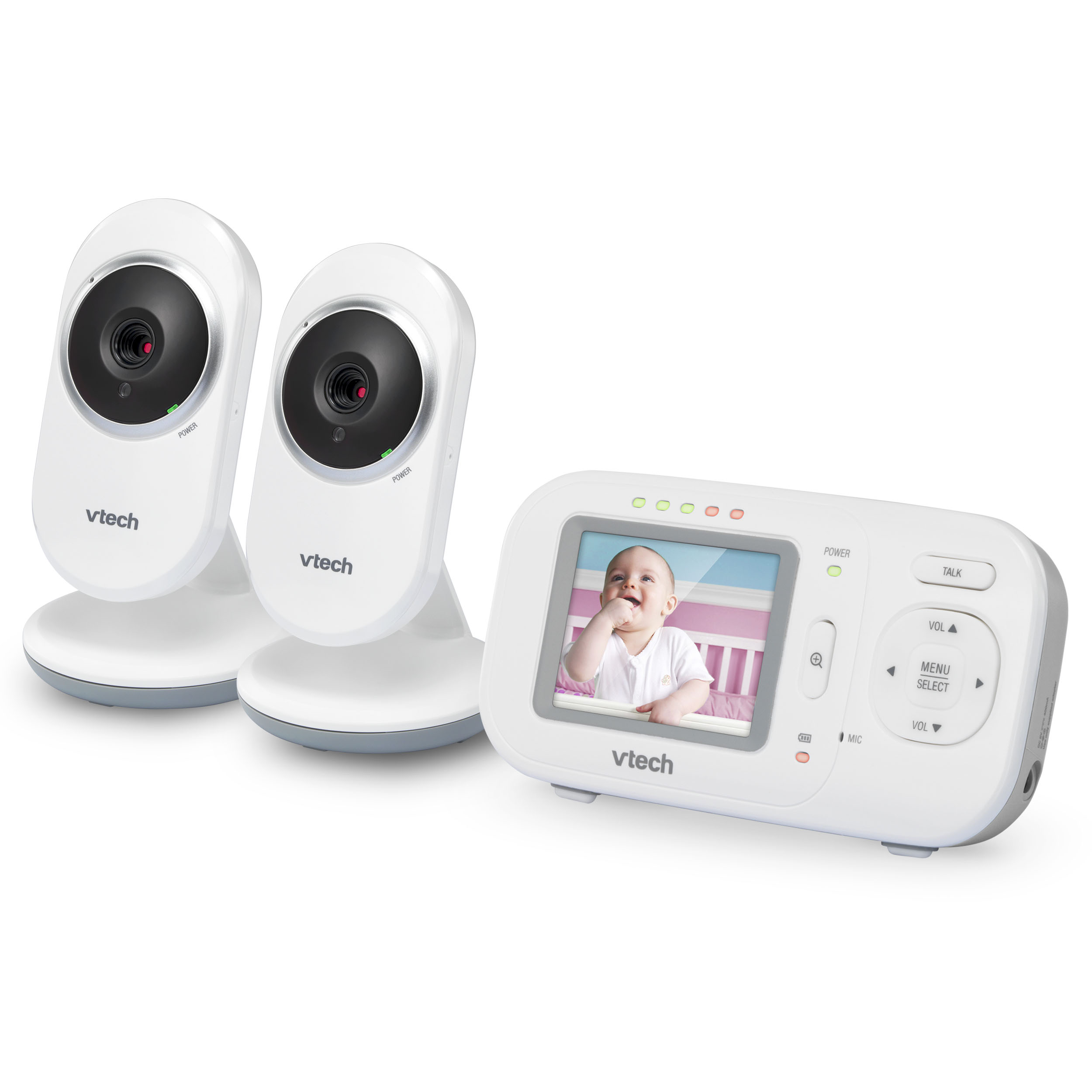
VTech’s VM320-2 is the two-camera package in the VM320 family. That suffix matters: the official support page calls the model a “2 Cameras” monitor, and the family User’s Manual says one set is supplied with VM320 while two sets come with VM320-2. If two rooms need a camera from the beginning, this exact kit solves the included-equipment question. It does not turn the small viewer into a two-window screen, and it does not add a phone app.
Each camera is a fixed-view unit. The adult sets the angle when placing it; the parent screen does not pan or tilt the cameras. The distinctive convenience is being able to choose between camera feeds on the same handheld receiver, not seeing two rooms in parallel.
Two cameras, one selected picture
The VM320-2 uses a 2.4-inch color LCD with a documented 320-by-240 QVGA resolution. In Single-cam mode, one selected camera fills that screen. Its Patrol mode changes the displayed picture from one camera to the other every ten seconds. That is useful for periodic checks when you can accept a scan, but the parent unit does not show both scenes together. A toddler moving between spaces or two children whose rooms need simultaneous visibility calls for a different arrangement.
The manual also does not establish two simultaneous audio feeds. It explains switching among baby units and describes one selected camera view; do not count the patrol as continuous listening to both rooms. If two-room audio is an essential requirement, the VM320-2 should be rejected unless you can verify a specific operating behavior beyond the published instructions. Camera count is not the same as simultaneous monitoring capacity.
Simple local setup, no remote phone feed
The U.S. guide lists a direct 2405–2475 MHz radio link with 32 channels. It does not require home Wi-Fi or internet for the local parent-screen arrangement, but it also does not document checking the cameras from a phone while away. The two baby units arrive already paired to the parent viewer. Test each view in the intended rooms before relying on the system; obstacles and nearby wireless equipment can change the connection.
The manual states up to 1,000 feet outdoors, with actual range affected by doors, walls and other obstructions. VTech support separately says up to 150 feet indoors and notes that the result varies. Neither is a room-by-room test, and neither promises coverage through a specific house. VTech’s support FAQ says its local baby-monitor systems are not expandable with newer standalone cameras, so the second camera is a fixed part of this package decision rather than an add-on pathway. A useful pre-purchase question is not only “How many cameras?” but “Will this one handset work from the place I plan to sit or sleep?”
Shared controls: sound activation, talk and temperature
As in the base VM320, the parent unit can adjust sound sensitivity and use sound activation to turn the screen on when the selected camera detects a sound above the set threshold. The audio can be kept on when the LCD is turned off. This helps conserve screen use, but it is not a motion alert and cannot replace checking a child directly. Two lullabies and two soothing sounds can be played through a baby unit; push-to-talk is also documented.
A temperature sensor gives a room-temperature display and lets the adult set minimum and maximum alert thresholds. It is not a precision room-control instrument. The VM320-2’s larger operational caveat is switching: when Patrol advances the image, the listener should not assume that both rooms are being heard together. If split-screen or a second audio channel is non-negotiable, pick a system whose exact manual clearly documents that mode.
Small-screen, unknown-runtime tradeoffs
The two-camera package keeps the receiver screen at 2.4 inches, so alternating views may be less comfortable than viewing a single room on a larger display. Digital zoom is described, but it enlarges the image rather than adding resolution. Automatic infrared night vision produces a black-and-white image in darkness. If close visual inspection is important, a larger display is likely a more practical choice.
The preinstalled rechargeable parent-unit battery is 3.6 V Ni-MH. The manual gives about 11 hours for a full uninterrupted charge and says standby varies with use, but it does not document a continuous screen-on runtime. The twin package therefore cannot be credited with a specific number of viewing hours. The cameras use supplied adapters; choose wall locations with safe cord routing instead of assuming they can operate untethered.
Who should choose the VM320-2?
Choose this package only when two cameras in the box are more important than simultaneous room pictures, a large display or remote app access. It can fit a parent who wants a local dedicated viewer, two fixed camera positions and a simple camera-switching routine. It is not a fit for an essential split-screen view, dual-room audio, motorized pan-and-tilt, phone-away monitoring or a known battery-runtime target.
Compare the single-camera VM320 if only one room needs a view; it has the same screen and controls without the second unit. If you need simultaneous rooms, the Infant Optics DXR-8 PRO SS assessment discusses a genuinely different dual-room setup. For larger local screens, compare VTech VM5263 or Motorola VM75; if phone-away access matters, look at the separate app-connected products and accept their network and account requirements.
Safe placement and availability
VTech’s manual says a monitor is an aid, not a substitute for adult supervision or a medical device. Keep each camera outside the crib or playpen, route power cords beyond a child’s reach, place parent and baby units more than three feet apart to avoid feedback, and test each camera after moving it. This is an earlier-model assessment rather than a claim that the kit is currently stocked. Its separate support record is VM320-2, model 4086; current retail availability was not confirmed, so any search should retain the exact “VM320-2” model suffix.
Key details at a glance
| Parent-unit screen | 2.4 in |
|---|---|
| Published display resolution | 2.4-inch color LCD, QVGA 320 × 240 pixels (VTech U.S. manual). |
| Camera-to-parent-unit connection | Direct local radio; exact U.S. manual lists 2405–2475 MHz and 32 channels. No app or away-from-home phone feed is documented. |
| Manufacturer-stated open-space range | 1000 ft |
| Advertised maximum range claim | 1000 ft |
| Cameras in the reviewed kit | 2 |
| Maximum camera units supported | 2 |
| Video rooms visible at once | 1 |
| Phone viewing away from home | No |
| Supplied camera lens setup | Two fixed-view cameras whose angles are set during placement; the parent unit selects one full-screen camera or patrols between pictures every 10 seconds. Remote pan/tilt and split-screen are not documented. |
| Recommended stable operation uses home Wi-Fi | No |
| Audio-only system | No |
| Parent talk-back | Yes |
| Room-temperature readout | Yes |
| Preloaded lullaby count | 2 |
| Parent receivers included | 1 |
Use the exact model’s instructions for operating limits, supplied equipment and version differences.
Sources for this assessment

Check the room and the receiving setup.
Read the exact model's constraints, camera count and supervision limits before choosing a package.