
Your needs, this model
Does it fit your priorities?
Is one local audio room with one receiver enough, without a picture or app?
The current TM8112 package carries one Baby Unit's sound to one Parent Unit over local DECT radio; there is no camera picture or phone route.
Explore this need in the finder →Is one included Parent Unit enough for the one-way nursery feed?
The exact TM8112 listing contains one Parent Unit and one Baby Unit. The sound indicator gives a visual level, but not a second listener.
Explore this need in the finder →Is one included Parent Unit enough for your routine?
The exact TM8112 package lists one Parent Unit and one Baby Unit. If two separate receivers are essential, use a kit whose exact page includes both.
Explore this need in the finder →A single-room audio receiver with a ceiling projector
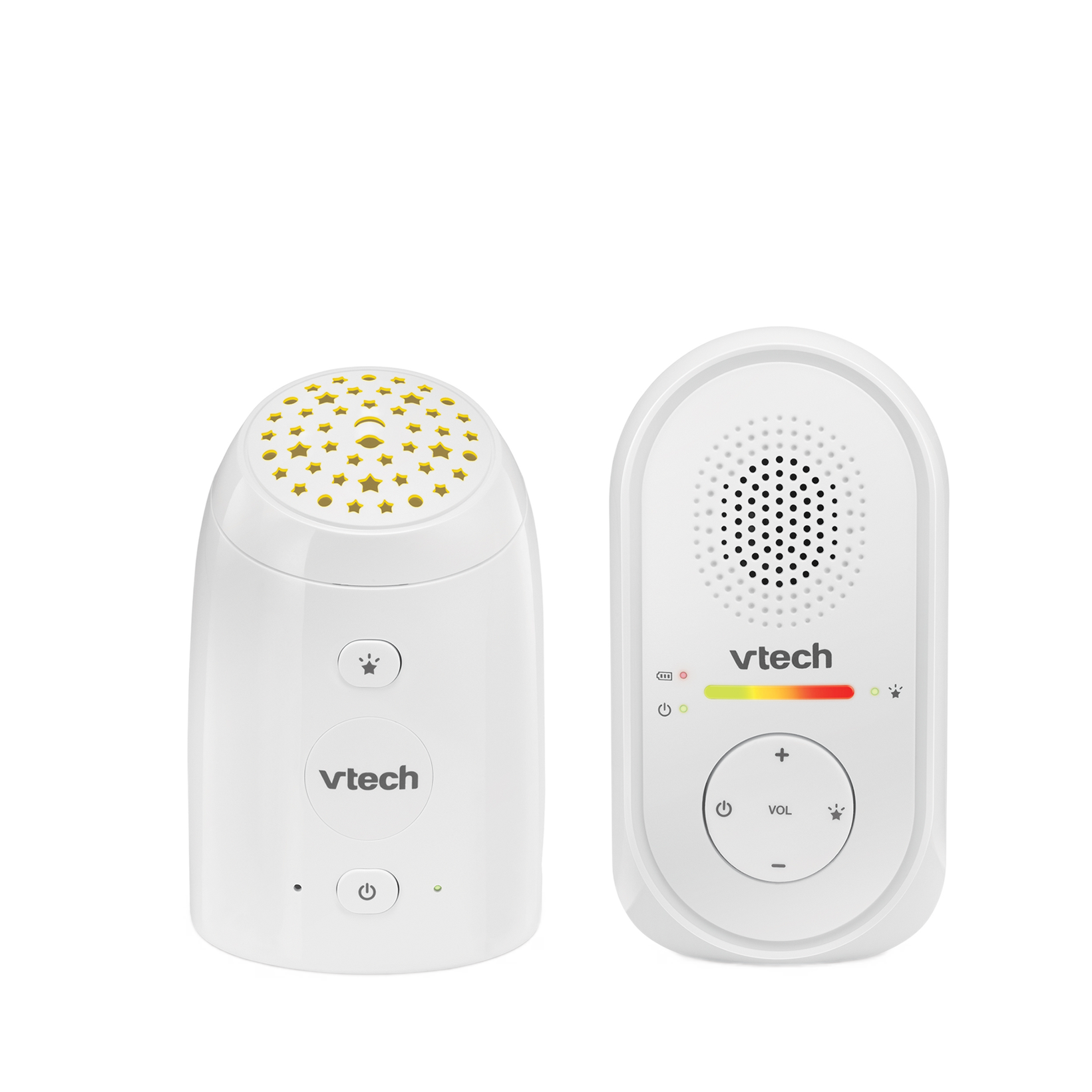
The VTech TM8112 is a fit for a caregiver who wants one local nursery sound feed, a portable parent receiver and a small projected star pattern rather than a camera picture. The current U.S. package page identifies the model and lists one Parent Unit, one Baby Unit, two adapters and a rechargeable battery pack. VTech calls the radio DECT 6.0 and claims up to 1,000 feet of range. That maximum is not a household distance test; walls and doors can shorten reception, so test the actual route before relying on it.
There is no phone app or video view to set up. That is useful if a simple receiver is your preference, but it is a firm limit if you need to see the room, check two bedrooms at once or view from away from home. The one Baby Unit is one source, and the included Parent Unit is one receiver. The separate manual-named TM8112-2 is a different two-set package; its exact U.S. retail identity has not been established here, so do not treat it as part of this current one-set listing.
Visible sound levels, not two-way talk
A five-level colored light bar lets you glance at sound activity with the Parent Unit muted. It can be helpful when you do not want the speaker on continuously, but it is only an indicator: the manufacturer does not describe cry classification, motion detection or a special sound-recognition alert for this model. The manual lists low-battery and out-of-range beeps; those warn about the monitor’s state, not a particular nursery sound.
The exact product feature list and the linked manual’s control diagram do not document Parent-to-Baby talk-back. If speaking through the receiver matters, compare the TM8212 family or VTech’s separately reviewed DM221/DM1215 audio systems instead. On the other hand, the TM8112’s projection is a distinctive feature: its Baby Unit shines a star pattern onto a ceiling, and the manual shows the light can be switched from either unit. Place the projector where the beam has a clear ceiling surface. The support FAQ says the light can switch itself off after 15 minutes without detected sound, so it is not a continuously lit room lamp.
Battery numbers conflict; plan around power
VTech’s current product page advertises up to eight hours of portable Parent Unit use. The manual does not give a fixed runtime; it says standby time changes with volume, use and battery age. The charging instructions say a first continuous charge takes 16 hours, while the model-support FAQ says a full charge takes about 12. Those are real manufacturer-source differences, not a basis for promising an overnight run. Treat the eight-hour figure as a best-case marketing claim, keep the receiver charged and leave an outlet available for longer stretches.
The manual identifies a 2.4-volt, 400-mAh Ni-MH battery pack for the Parent Unit. The Baby Unit uses its supplied AC adapter; battery backup there is not documented. This is therefore not the choice for a camera that must keep transmitting through a mains outage. Its manual also gives the radio band as 1921.536–1928.448 MHz across five channels. Nearby electronics, building materials and placement can affect a link even when the advertised maximum seems ample.
Position it safely and test the real room
VTech says to keep the Baby Unit outside the crib or playpen and the cord at least three feet from the child. The setup illustration keeps the Parent Unit more than 6.5 feet from the Baby Unit to reduce feedback. That matters for an audio monitor: setting the two units close together can cause a high-pitched squeal. Test sound reception after setup and again whenever you move a component. Do not read the manufacturer’s range figure as an indoor performance measurement, and do not treat the light bar or an audio feed as a substitute for adult supervision.
Choose the TM8112 when a one-room, no-Wi-Fi sound link and its ceiling projection suit your routine, and you are comfortable keeping the Baby Unit on AC. Choose the TM8212-2 if two caregivers each need a receiver, talk-back or vibration prompts; its second Parent Unit still does not add a second room. Choose a video model if a picture is essential. The TM8112 product page, model support page and family user manual establish the exact package and operating limits.
Key details at a glance
| Camera-to-parent-unit connection | Direct local DECT 6.0 digital audio; no camera picture, Wi-Fi, internet, app or phone-away viewing is documented. |
|---|---|
| Advertised maximum range claim | 1000 ft |
| Cameras in the reviewed kit | 0 |
| Maximum camera units supported | 0 |
| Video rooms visible at once | 0 |
| Phone viewing away from home | No |
| Recommended stable operation uses home Wi-Fi | No |
| Motion alert | No |
| Audio-only system | Yes |
| Parent talk-back | No |
| Room-temperature readout | No |
| Parent-unit batteries included | Yes |
| Camera-side mood light | No |
| Separate under-mattress movement-monitor system included | No |
| Included crib-mount option | No |
| Eco Max quiet-interval mode | No |
| Starry night projector | Yes |
| Parent-unit vibration prompt | No |
| Parent receivers included | 1 |
Use the exact model’s instructions for operating limits, supplied equipment and version differences.
Sources for this assessment

Check the room and the receiving setup.
Read the exact model's constraints, camera count and supervision limits before choosing a package.