
Your needs, this model
Does it fit your priorities?
Is one Parent Unit enough when talk-back is useful?
DM221 includes one Parent Unit and documents Parent-to-Baby talk-back. Sound stops while talking.
Explore this need in the finder →Must the exact kit include two receivers?
DM221 contains one Parent Unit; choose a confirmed two-parent package for a two-receiver minimum.
Explore this need in the finder →Must both rooms be audible at once?
DM221 has one Baby Unit and one room feed, so it cannot satisfy a two-room simultaneous-audio need.
Explore this need in the finder →One parent receiver with more ways to respond
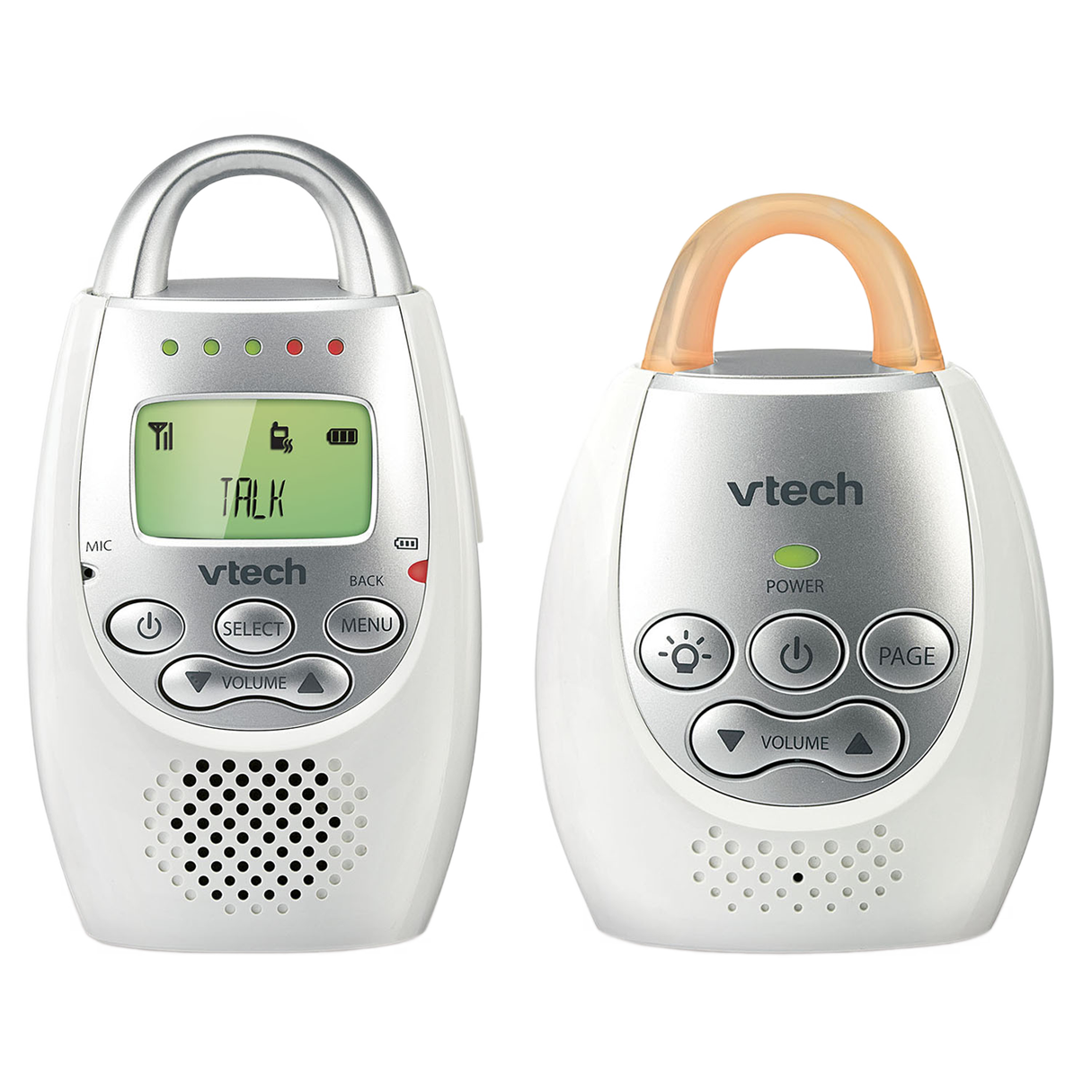
The VTech DM221 is a one-room, audio-only monitor whose exact U.S. package contains one Baby Unit, one Parent Unit, two adapters and one rechargeable battery. The parent receiver provides the sound feed without a phone, home network or camera screen. A five-level LED sound indicator remains visible when the speaker is muted, and its belt clip lets a caregiver carry the receiver from room to room. The Baby Unit also has a manually controlled night light. If a picture or away-from-home viewing is central to your routine, this is not a video model with a missing screen; it is a distinct local-audio arrangement.
Compared with the simpler DM112-2, DM221 trades the second included receiver for functions that address how one caregiver monitors a room: talk-back, an optional beep and vibration alert, and a documented Baby Unit night light. Compared with DM221-2, it has the same basic single-Baby-Unit approach but only one receiver. That makes it a more sensible package when there is one primary listener rather than two people who each need a separate Parent Unit.
The alerts are thresholded sound prompts
The DM221 manual describes five VOX sensitivity settings, with the highest setting leaving the speaker continuously on. The optional beep and vibration are set separately from that speaker behavior and are preset off. The manual ties the prompt to the Baby Unit’s sound indicator reaching its red/loud range; it does not describe automatic cry classification. A sound threshold can be useful when the Parent Unit is muted or you are doing something that makes a quiet speaker easy to miss, but you still need to choose a sensitivity and verify the alert in ordinary use. It is not a medical or sleep-analysis function.
Talk-back adds another practical choice: pressing the Parent Unit’s intercom broadcasts your voice to the Baby Unit, but the manual says nursery audio is not transmitted to the Parent Unit during talk-back. A soothing message therefore interrupts the sound feed while you speak. That limitation is easy to overlook if you assume full-duplex conversation. The same interruption matters more in the two-receiver DM221-2 family because the manual says the other Parent Unit also hears the talk-back broadcast while nursery sound is withheld.
Battery and range need a realistic plan
VTech advertises up to 1,000 feet. The family manual gives up to 1,000 feet outdoors and 160 feet indoors, while cautioning that walls, doors, floor plan and interference affect actual reception. Treat those as manufacturer figures, not a test result in your home. The Baby Unit requires AC and has no documented battery backup. The supplied rechargeable Parent Unit battery is useful for carrying the receiver, but the manual says battery-only operation lasts a short time and gives about eleven hours for a full charge. That is a charge time, not a runtime promise. Keep a powered receiver available for long stretches and check the connection whenever you relocate a unit.
Setup is straightforward, but placement still matters: the manual calls for the Baby Unit to remain outside the crib or playpen and away from water, and advises keeping cords out of a child’s reach. The five indicator lights are a visual sound-level aid, not a room image or proof that the receiver is linked. Learn the link and battery indicators and test normal sounds before relying on the device.
When the DM221 fits—and when it does not
DM221 is a reasonable fit for a household that wants one portable local receiver, one nursery sound feed, a soft night light and the option to use talk-back or a threshold-based silent alert. It does not provide a second caregiver receiver in the exact package, two-room simultaneous audio, a camera view, remote phone access, temperature data or documented cry detection. A second receiver is not a substitute for a second Baby Unit; two-room sound should be treated as a hard requirement and matched to a separate system that documents two sources.
Choose DM221-2 if a second caregiver needs their own receiver for the same nursery. Choose DM1215 if rechargeable batteries in both units, lullabies, a voice message and a reminder timer are more valuable; its family manual and product page differ on battery runtime, so do not assume a particular untethered duration. Choose an audio/video system if a live picture is essential. These distinctions are based on the DM221 listing, exact support page and linked DM221 family manual. A consumer monitor is only an aid to supervision, not a substitute for it.
Key details at a glance
| Camera-to-parent-unit connection | Local digital DECT 6.0 audio link; exact family manual lists 1921.536–1928.448 MHz and five channels. |
|---|---|
| Manufacturer-stated open-space range | 1000 ft |
| Advertised maximum range claim | 1000 ft |
| Cameras in the reviewed kit | 0 |
| Maximum camera units supported | 0 |
| Video rooms visible at once | 0 |
| Phone viewing away from home | No |
| User-replaceable parent-unit battery | Yes |
| Recommended stable operation uses home Wi-Fi | No |
| Motion alert | No |
| Audio-only system | Yes |
| Parent talk-back | Yes |
| Room-temperature readout | No |
| Parent-unit batteries included | Yes |
| Camera-side mood light | No |
| Separate under-mattress movement-monitor system included | No |
| Included crib-mount option | No |
| Eco Max quiet-interval mode | No |
| Starry night projector | No |
| Parent-unit vibration prompt | Yes |
| Parent receivers included | 1 |
Use the exact model’s instructions for operating limits, supplied equipment and version differences.
Sources for this assessment

Check the room and the receiving setup.
Read the exact model's constraints, camera count and supervision limits before choosing a package.