
Your needs, this model
Does it fit your priorities?
Do two caregivers need their own receivers for one nursery?
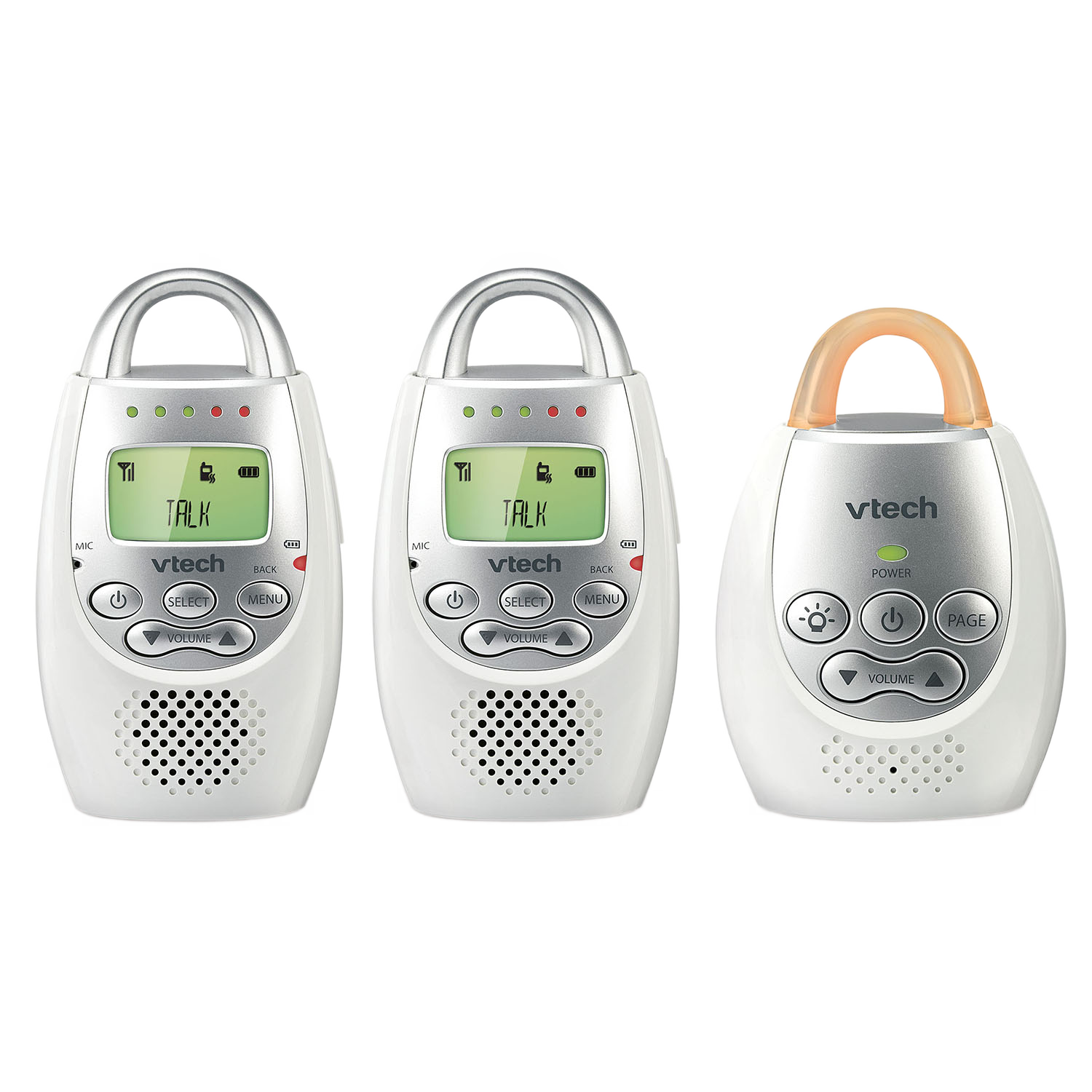
The DM221-2 package has two Parent Units and one Baby Unit; both receive the same local audio.
Explore this need in the finder →Must audio from two nurseries be audible simultaneously?
Two Parent Units are receivers for one Baby Unit, not two room sources.
Explore this need in the finder →Would three separate receivers be essential?
The exact kit contains two Parent Units; it does not meet a three-receiver minimum.
Explore this need in the finder →A second receiver for the same room
The VTech DM221-2 packages two Parent Units with one Baby Unit, three AC adapters and two rechargeable batteries. This is the twin-receiver version of VTech’s DM221 audio monitor, not a two-nursery system. Both receivers get the sound from the same Baby Unit; they do not provide separate inputs or make two rooms audible at once. That package distinction matters more than the suffix: a household asking for two caregivers to carry their own receiver may value this model, while a household asking to hear two bedrooms simultaneously should look for two Baby Units and a stated all-room audio mode.
The underlying feature set is more hands-on than DM112-2. VTech lists a Baby Unit night light, up to 1,000 feet, a five-level sound indicator, a belt clip, talk-back and vibrating sound alert. The manual describes the optional alert as a beep and vibration when the sound indicator reaches its red/loud range; settings are preset off and controlled separately for each Parent Unit. This is a thresholded sound prompt, not a detector that identifies crying or tells you why the Baby Unit is noisy. If both adults use different alert settings, check each receiver individually rather than assuming the settings mirror each other.
Talk-back affects both listeners
Either Parent Unit can send a voice message through the Baby Unit. But the DM221 family manual says that while talk-back is active, the Baby Unit’s sound is not sent to the Parent Units; the second receiver hears the broadcast voice rather than a second feed. If you press the intercom to reassure a child, the sound monitor is briefly not reporting nursery audio. Keep that in mind when choosing between a receiver with talk-back and a monitor whose purpose is continuous passive listening.
The sound indicator on each Parent Unit is useful when a caregiver prefers to mute the speaker yet glance at a sound level. The five LEDs are not a screen, cry analysis or connection guarantee. The manual says the highest of five VOX sensitivity levels leaves the speaker on continuously, while lower settings can reduce unnecessary transmitted sound. Establish the setting and test it in the nursery rather than assume the default catches every sound you care about.
Do not mistake battery capacity for all-night runtime
The exact manual lists a rechargeable battery for each Parent Unit and recommends keeping AC connected alongside the battery for continuous monitoring. It describes battery-only use as short and estimates around eleven hours for a full charge. The current product page separately says up to eight hours of cordless operation. Those claims are not reconciled in the manual, and the charge time is not an operating-time measurement. Use the supplied adapters, keep a receiver charged before carrying it, and don't build a night-long power plan around the headline. The single Baby Unit uses an adapter and has no documented backup battery, so the source end of the audio path still depends on household power.
Range also needs an in-home check. VTech advertises up to 1,000 feet, and the family guide distinguishes up to 1,000 feet outdoors from 160 feet indoors. Walls, floors, doors and nearby electronics can reduce usable reach. Test the Parent Units in the rooms where each caregiver will actually use them and confirm both links. Keep the Baby Unit and all cables outside the crib and playpen, follow its placement instructions, and never treat the monitor as supervision by itself.
Who should choose the twin package?
Choose DM221-2 when two adults or two household areas each need a local receiver for a single nursery. It can be more convenient than passing one Parent Unit back and forth, and the optional alert provides a quiet cue when the audio crosses the documented loud threshold. Do not choose it because the home has two children in different rooms: the exact set contains only one Baby Unit. For two-room coverage at once, a separate dual-source audio monitor is the meaningful alternative. For a single listener and talk-back, compare the one-receiver DM221; for rechargeable power on the Baby Unit, lullabies and a spoken message, consider the DM1215 family, with its own runtime and vibration documentation caveats.
The DM221-2 exact product listing, support record, and linked family manual distinguish this package from the one-parent DM221. Their documentation supports two listeners and one audio source, not two independent rooms.
Key details at a glance
| Camera-to-parent-unit connection | Local digital DECT 6.0 audio link; manual lists 1921.536–1928.448 MHz and five channels. |
|---|---|
| Manufacturer-stated open-space range | 1000 ft |
| Advertised maximum range claim | 1000 ft |
| Cameras in the reviewed kit | 0 |
| Maximum camera units supported | 0 |
| Video rooms visible at once | 0 |
| Phone viewing away from home | No |
| User-replaceable parent-unit battery | Yes |
| Recommended stable operation uses home Wi-Fi | No |
| Motion alert | No |
| Audio-only system | Yes |
| Parent talk-back | Yes |
| Room-temperature readout | No |
| Parent-unit batteries included | Yes |
| Camera-side mood light | No |
| Separate under-mattress movement-monitor system included | No |
| Included crib-mount option | No |
| Eco Max quiet-interval mode | No |
| Starry night projector | No |
| Parent-unit vibration prompt | Yes |
| Parent receivers included | 2 |
Use the exact model’s instructions for operating limits, supplied equipment and version differences.
Sources for this assessment

Check the room and the receiving setup.
Read the exact model's constraints, camera count and supervision limits before choosing a package.