
Your needs, this model
Does it fit your priorities?
Would you use an audio-only receiver with a portable soother and built-in Baby Unit battery?
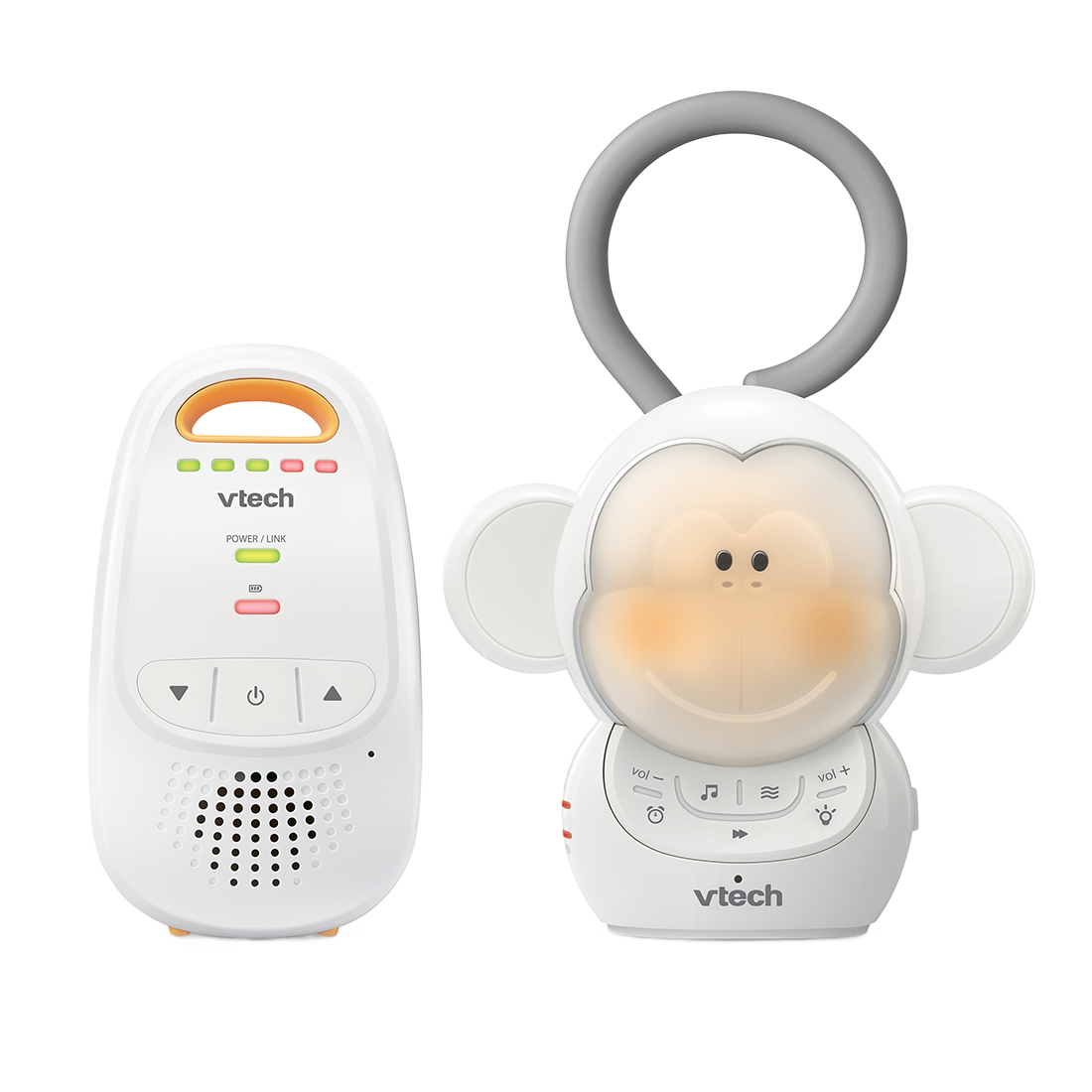
DM1411 is a local sound-only plan with a rechargeable soother Baby Unit and no camera. Keep it outside the crib and beyond reach.
Explore this need in the finder →Must a parent speak back through the unit?
No talk-back function is documented for the exact DM1411 page or Quick Start Guide.
Explore this need in the finder →Is a camera image required?
The DM1411 is a sound-only monkey-shaped soother system; choose a video monitor for a picture.
Explore this need in the finder →An audio monitor wrapped around a portable soother
The VTech DM1411 is unusual in this group because its Baby Unit is a soft-cheeked monkey-shaped soother rather than a conventional tabletop box. The exact U.S. product page names model DM1411 and describes one Parent Unit and one Baby Unit, a belt clip, dimmable soft-glow cheeks, lullabies and ambient sounds. The monkey’s flexible tail is marketed for wrapping around a stroller handle or other nearby support. That makes the product different from a plain audio monitor intended to remain on a shelf, but it is still one local sound feed to one receiver. It does not provide a camera view, phone app or second-room listening plan.
The sound library includes five lullabies and five ambient sounds such as white noise, a stream, crickets, birds and a heartbeat; the Parent Unit controls playback and volume. The Parent Unit receives nursery sound and can show sound levels with indicator lights. The manual does not document talk-back, so choose a different model if speaking back to the Baby Unit is essential. The product page calls out up to eight hours of portable operation but does not clearly break that figure down by each rechargeable unit. The Quick Start Guide does not give an independent fixed runtime. Treat this as a portable-use claim, not a measured battery promise, and charge both devices before a day out.
Portable does not mean crib-safe
The design encourages moving the soother with a child, so placement deserves particular attention. VTech’s guide says the Baby Unit should not be placed in a crib or playpen and must remain more than three feet from the baby; it also warns to keep the adapter cord out of reach. A stretchable tail or a stroller handle is not an invitation to hang the powered unit in the sleep space, around a child’s neck, or anywhere it can fall or pull a cord toward the child. Follow the guide’s out-of-reach placement limits in every location, including travel and visits. The sound timer on the soother turns off its audio after 60 minutes, but that does not power down the monitor or change its location.
The soft-glow cheeks can be dimmed or brightened, and the guide says the light automatically turns off after 15 minutes without detected sound. That is useful as a short comfort cue, but it is not a room lamp or a promise that the child will settle. As with any monitor, the sound path can be interrupted by power, range or setup; check the link each time it is moved and do not rely on a single technology to supervise a child.
Range and setup should be tested where you travel
The manufacturer guide gives up to 1,000 feet outdoors and 160 feet indoors, with the usual qualification that walls, floors and interference change actual range. That is particularly relevant for a portable soother because you may carry it to a different room or location than its usual nursery. Test the Parent Unit with the Baby Unit in the position you plan to use, check the link and sound, and avoid assuming a yard or hotel layout will behave like home. The monitor uses local digital radio rather than Wi-Fi, so no network or app is required, but local radio coverage is still bounded by distance and the surrounding environment.
The product page advertises DECT 6.0 in its feature copy; the comparison table’s technology cell is blank, which is an omission rather than a contrary specification. The model-specific Quick Start Guide gives range and setup details but does not add frequency or protocol detail. The exact units are digitally linked and no video is offered; there is no need to add specifications beyond what the manufacturer states. For a technical radio detail that affects a particular setup, ask VTech about the exact unit revision rather than infer from the blank table cell.
Who should consider the DM1411?
DM1411 may suit a household that wants a portable, sound-only monitor with a built-in comfort sound and a small light, especially when the same audio unit is useful away from the crib. It is a less natural fit if you want a conventional fixed camera, two-way talk, temperature monitoring, a long documented runtime, vibration alerts or two-room coverage. A compact receiver and a portable soother are still separate components with placement and charging needs. Do not treat the monkey as a toy left in a crib; the manual’s spacing and cord instructions take priority over the portability marketing.
For two people listening to one nursery, compare exact two-parent packages such as DM221-2 or DM1215-2. For a display and a camera picture, choose a video system. For the more traditional audio feature set of adjustable sound sensitivity and talk-back, the DM221 or DM1215 is the closer alternative. The DM1411 product listing, exact support page and Quick Start Guide support the identity, included setup and safety limits described here.
Key details at a glance
| Camera-to-parent-unit connection | Local digital audio radio; product feature copy advertises DECT 6.0. The comparison table leaves its technology cell blank and the QSG gives no frequency/protocol detail; the blank is not a contrary claim. |
|---|---|
| Manufacturer-stated open-space range | 1000 ft |
| Advertised maximum range claim | 1000 ft |
| Cameras in the reviewed kit | 0 |
| Maximum camera units supported | 0 |
| Video rooms visible at once | 0 |
| Phone viewing away from home | No |
| Recommended stable operation uses home Wi-Fi | No |
| Motion alert | No |
| Audio-only system | Yes |
| Parent talk-back | No |
| Room-temperature readout | No |
| Parent-unit batteries included | Yes |
| Camera-side mood light | No |
| Separate under-mattress movement-monitor system included | No |
| Included crib-mount option | No |
| Eco Max quiet-interval mode | No |
| Starry night projector | No |
| Parent-unit vibration prompt | No |
| Parent receivers included | 1 |
Use the exact model’s instructions for operating limits, supplied equipment and version differences.
Sources for this assessment

Check the room and the receiving setup.
Read the exact model's constraints, camera count and supervision limits before choosing a package.