
Your needs, this model
Does it fit your priorities?
Would two caregivers benefit from their own local receiver for one nursery?
Yes. DM1211-2 includes two Parent Units but only one Baby Unit, so both can receive the same nursery audio through the local DECT link.
Explore this need in the finder →Do both receivers need the optional talk-back feature?
Both Parent Units can talk to the Baby Unit; the manual says talk-back broadcasts to the other Parent Unit too. Nursery audio is not transmitted to either Parent Unit while talk-back is active.
Explore this need in the finder →Would a second Parent Unit provide a second room's audio?
No. The exact package contains two Parent Units but only one Baby Unit; the manual does not document two simultaneous room feeds.
Explore this need in the finder →Two places to listen, one nursery to hear
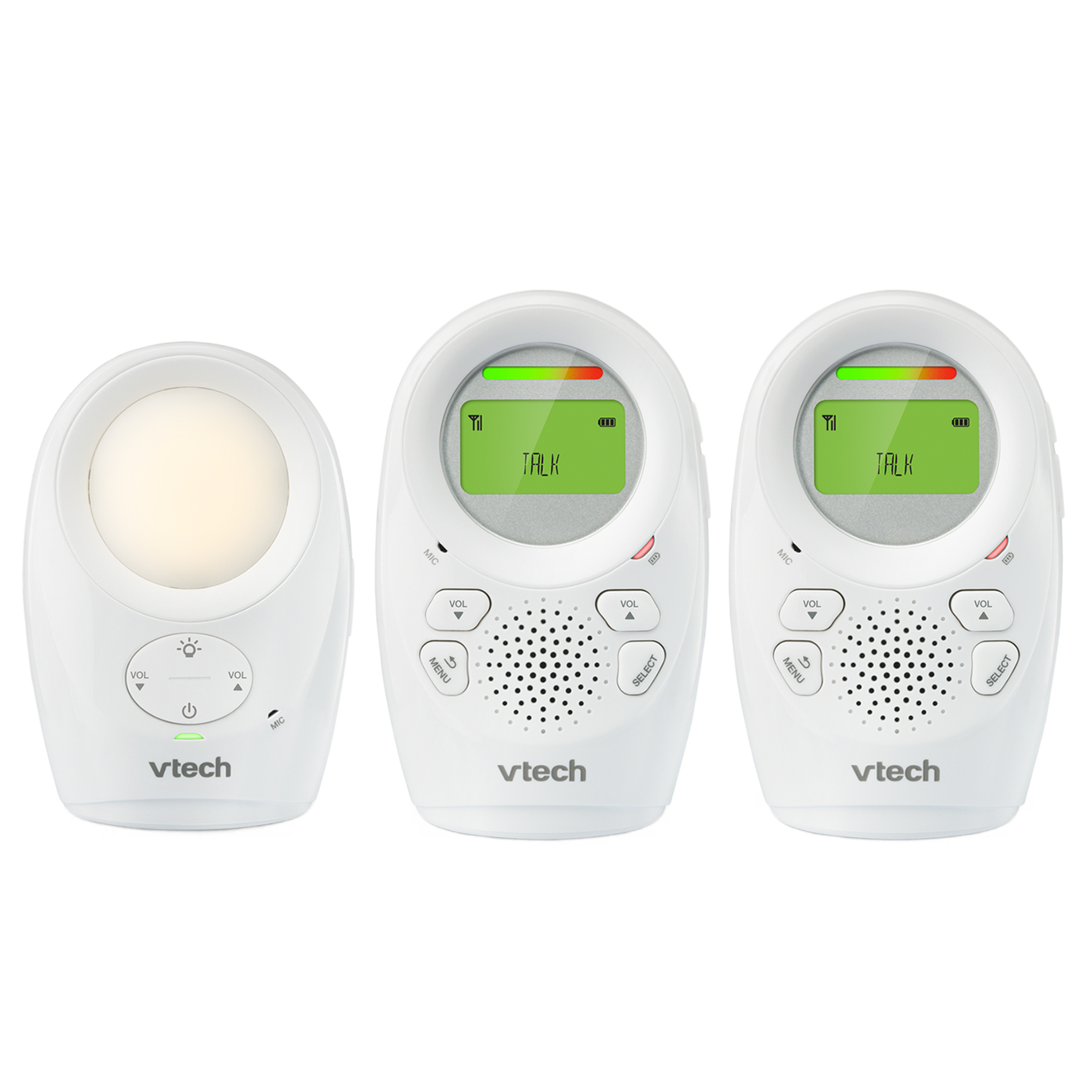
The VTech DM1211-2 is the two-parent-unit package of the DM1211 local audio monitor. It includes two Parent Units, one Baby Unit, two AC adapters and two batteries. The extra receiver can matter when two caregivers want to carry their own monitor, or when one person moves between parts of the home and wants to leave a second unit with another adult. Both receive the same nursery sound over a DECT 6.0 link; this is not a two-room system. The kit still has only one Baby Unit.
The parent units have their own speaker, display, belt clip and battery, while the Baby Unit is the shared sound source. VTech's guide says certain preferences—such as the sound alert, vibration alert and language—can be set independently on each receiver. That makes it possible for one caregiver to use a vibration prompt while the other uses a speaker. The settings should be checked on each unit before use rather than assuming one change updates both.
Talk-back can be heard on both receivers, but monitoring pauses
Each Parent Unit can send talk-back to the Baby Unit. In the two-parent configuration, the manual says the voice broadcast also reaches the other Parent Unit. It also makes an important qualification: while a parent is talking, sound from the Baby Unit is not sent to either Parent Unit. If you need uninterrupted nursery audio during an exchange, talk-back introduces a brief listening gap. The second receiver is not a backup audio feed or a way to keep listening while the first unit speaks.
Sound sensitivity is more adjustable than the package count might suggest. Five VOX levels range from a continuously open speaker at the highest level to a threshold that opens only for loud crying or screeching at the lowest. The default is the most sensitive setting. Separate from that continuous/threshold listening choice, a loud-sound beep and a vibration prompt can alert when the sound indicator reaches its red range; both are off by default and each can be configured on a Parent Unit. VTech support states that vibration alert turns the speaker off on that unit. Neither prompt is a specific cry detector, and the guide does not provide a calibrated decibel threshold.
What the package does not change
The DM1211-2 uses the same radio and power behavior as the single-receiver DM1211. The family manual gives a maximum of 1,500 feet outdoors and 160 feet indoors, with actual range varying by walls, doors and other conditions. These are not measured room-to-room guarantees. VTech's product page says up to eight hours of cordless use, while the exact guide says battery-only operation is short and recommends AC plus the rechargeable battery for continuous monitoring. The manual estimates about three hours for a full charge; its support FAQ provides a conflicting charge estimate. Treat the runtime as unresolved rather than planning an overnight unplugged shift.
The Baby Unit still needs its AC adapter. The extra battery is for the second Parent Unit, not for a second nursery and not a power backup for the transmitter. There is no camera image, phone or internet path, temperature reading, movement sensor or second room. If two children sleep in separate rooms and both need to be heard concurrently, choose an exact system with two Baby Units and a documented all-room audio mode, rather than relying on the -2 suffix. If you want to see a room, this audio-only set is the wrong kind of monitor.
Safe placement and who should choose it
Put the Baby Unit outside the crib or playpen, more than three feet from the child, and route its cord out of reach. VTech also recommends more than 6.5 feet between the Parent and Baby Units to avoid feedback; move them farther apart if you hear squealing. Check the link and battery indications before use. The instructions expressly describe the product as an aid, not a substitute for adult supervision.
Choose DM1211-2 when the concrete need is two separate portable Parent Units for one nursery's sound. Prefer the single DM1211 package if only one caregiver needs a receiver. Choose a true multiroom audio monitor if both rooms must remain audible together, or a video model if you need a picture. The DM1211-2 U.S. product listing, exact support record and shared family manual distinguish the included receivers from the single audio source.
Key details at a glance
| Camera-to-parent-unit connection | Direct local DECT 6.0 digital audio; no Wi-Fi, internet, app or camera picture is documented. |
|---|---|
| Manufacturer-stated open-space range | 1500 ft |
| Advertised maximum range claim | 1500 ft |
| Cameras in the reviewed kit | 0 |
| Maximum camera units supported | 0 |
| Video rooms visible at once | 0 |
| Phone viewing away from home | No |
| User-replaceable parent-unit battery | Yes |
| Recommended stable operation uses home Wi-Fi | No |
| Motion alert | No |
| Audio-only system | Yes |
| Parent talk-back | Yes |
| Room-temperature readout | No |
| Parent-unit batteries included | Yes |
| Camera-side mood light | No |
| Separate under-mattress movement-monitor system included | No |
| Included crib-mount option | No |
| Eco Max quiet-interval mode | No |
| Parent-unit vibration prompt | Yes |
| Parent receivers included | 2 |
Use the exact model’s instructions for operating limits, supplied equipment and version differences.
Sources for this assessment

Check the room and the receiving setup.
Read the exact model's constraints, camera count and supervision limits before choosing a package.