
Your needs, this model
Does it fit your priorities?
Would two caregivers benefit from separate local receivers for one nursery?
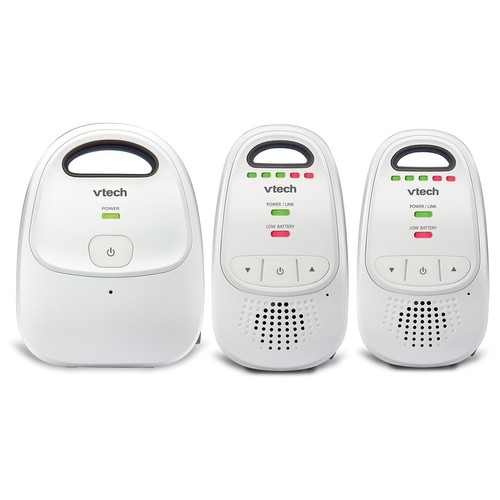
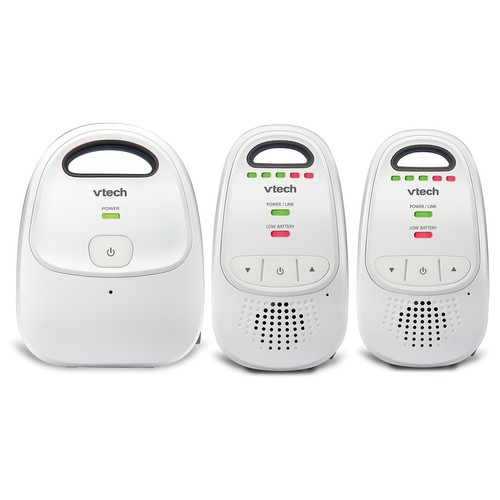
The exact DM112-2 package includes two Parent Units and one Baby Unit; both hear the same room.
Explore this need in the finder →Must the monitor provide two simultaneous nursery audio feeds?
No. The two Parent Units share one Baby Unit and do not supply a second room feed.
Explore this need in the finder →Is a camera picture essential?
The DM112-2 package is audio-only; a video model is needed for a live picture.
Explore this need in the finder →Two listeners, one nursery feed
The VTech DM112-2 is an audio-only package for a household that wants a receiver in two places. Its exact U.S. product page identifies the model and lists two Parent Units, one Baby Unit, three AC adapters and two rechargeable batteries. The additional receiver changes who can carry the monitor; it does not add a second microphone or let you listen to two nurseries at once. Both Parent Units are tied to the single Baby Unit in this set. If two rooms need to be audible simultaneously, look for a kit with two Baby Units and a documented multi-room mode, not a higher receiver count.
The plan is deliberately simple: the nursery unit sends sound over a local digital-radio link to the portable receivers. There is no camera image, phone app, away-from-home feed or Wi-Fi setup to maintain. A five-level light bar on a Parent Unit can show sound activity if its speaker is turned down or muted, and the belt clip is useful when a caregiver moves around the house. Those are useful but limited signals: the LEDs do not show the room, identify a cry, or establish that the link is still working. Keep the units powered and confirm their connection and sound in the actual rooms before relying on them.
How it differs from a talk-back set
DM112-2 is the quieter, less feature-heavy two-receiver option among these VTech audio models. The product page promotes DECT 6.0, range up to 1,000 feet, a five-level sound indicator and parent-unit battery use. It does not clearly document talk-back or a sound-triggered alert threshold for this exact package. Its light information is internally inconsistent: a generic feature block describes a Baby Unit night light, but the model comparison row has a blank night-light entry and the linked DM111/DM112 family guide does not explain a light. Treat that feature as unconfirmed rather than a buying reason. If a built-in night light or the ability to answer from the receiver is essential, compare the DM221-2 or DM1215-2, whose exact pages describe those functions and whose manual families explain their operation.
The exact product page labels the system DECT 6.0; the linked DM111/DM112 family guide adds a 1921.536–1928.448 MHz band and five channels. Those descriptions are compatible, not a demonstrated radio-standard conflict. The separate operating caveat is battery duration: the page says the Parent Unit can run cordless for up to eight hours, while the guide calls battery-only use a short time and recommends AC plus battery for continuous monitoring. The unit ships with batteries, but that does not independently confirm an overnight runtime. If receiver endurance matters to your routine, consult the instructions supplied with the exact unit and plan for a nearby outlet.
Range and daily-use limits
VTech lists up to 1,000 feet, and the family guide gives that as an outdoor figure with up to 160 feet indoors. The practical path depends on walls, floors, interference and where the Baby Unit is positioned; neither number predicts your home. Test the connection at the farthest place a caregiver expects to use a receiver. The Baby Unit needs its adapter, so a power failure interrupts the nursery source even if a Parent Unit still has charge. Keep the Baby Unit and its cord outside the crib and play area, follow the supplied placement directions, and do not regard the monitor as a replacement for attentive supervision.
Before choosing this package, decide whether two receivers actually solve a household problem: two caregivers may each want to hear the same room, or one person may want to leave a receiver upstairs and another downstairs. If only one adult needs a receiver, a one-parent set such as DM1211 or DM221 may be more appropriate. If you need a soft alert while the receiver is muted, DM221’s manual describes optional beeps and vibration triggered by the loud/red sound-indicator range; that is a sound threshold, not cry recognition. If you need a camera view, a temperature readout, or two separate nursery streams, this DM112-2 configuration is the wrong kind of system.
Who should consider it?
Choose DM112-2 when the core requirement is one local audio feed and two included receivers, and when a plain monitor is preferable to video or a connected app. Its strongest distinction is the package itself, not a second room, long-range guarantee or advanced alert. A separate receiver is not extra monitoring coverage. The exact-page feature question around a night light and the page/manual disagreement about cordless battery duration remain unresolved, so those claims should not decide the purchase. The manual’s radio-band detail does not contradict the product page’s DECT 6.0 label. For two receivers plus talk-back, compare DM221-2; for rechargeable power in both Baby and Parent Units, compare DM1215-2, while checking the runtime and vibration caveats discussed in that review.
Sources for the exact model identity and package are the DM112-2 product listing, its support record, and the linked DM111/DM112 family guide. They establish the relevant package and operating cautions, but do not resolve every copy discrepancy.
Key details at a glance
| Camera-to-parent-unit connection | Local digital audio radio. The product page labels it DECT 6.0; linked family guide gives the 1921.536–1928.448 MHz band and five channels as compatible technical detail. |
|---|---|
| Manufacturer-stated open-space range | 1000 ft |
| Advertised maximum range claim | 1000 ft |
| Cameras in the reviewed kit | 0 |
| Maximum camera units supported | 0 |
| Video rooms visible at once | 0 |
| Phone viewing away from home | No |
| User-replaceable parent-unit battery | Yes |
| Recommended stable operation uses home Wi-Fi | No |
| Motion alert | No |
| Audio-only system | Yes |
| Parent talk-back | No |
| Room-temperature readout | No |
| Parent-unit batteries included | Yes |
| Camera-side mood light | No |
| Separate under-mattress movement-monitor system included | No |
| Included crib-mount option | No |
| Eco Max quiet-interval mode | No |
| Starry night projector | No |
| Parent-unit vibration prompt | No |
| Parent receivers included | 2 |
Use the exact model’s instructions for operating limits, supplied equipment and version differences.
Sources for this assessment
Check the room and the receiving setup.
Read the exact model's constraints, camera count and supervision limits before choosing a package.