
Your needs, this model
Does it fit your priorities?
Can the exact 346800 kit display two camera pictures together without a router?
Yes. The linked U.S. guide documents Split mode for the Twin only and says the parent unit connects directly to baby units.
Explore this need in the finder →Does Split view establish that both room sounds remain audible at once?
No. The 06/25 guide documents two pictures but no continuous dual-audio mode; an essential two-room audio request must reject this configuration as unknown.
Explore this need in the finder →Can the Twin meet a seven-inch local-viewer need without assuming a third camera?
Yes for its exact two-camera kit. A third camera is not confirmed, and this family does not document screen-on runtime.
Explore this need in the finder →The Twin is a real two-camera kit, not an expansion promise
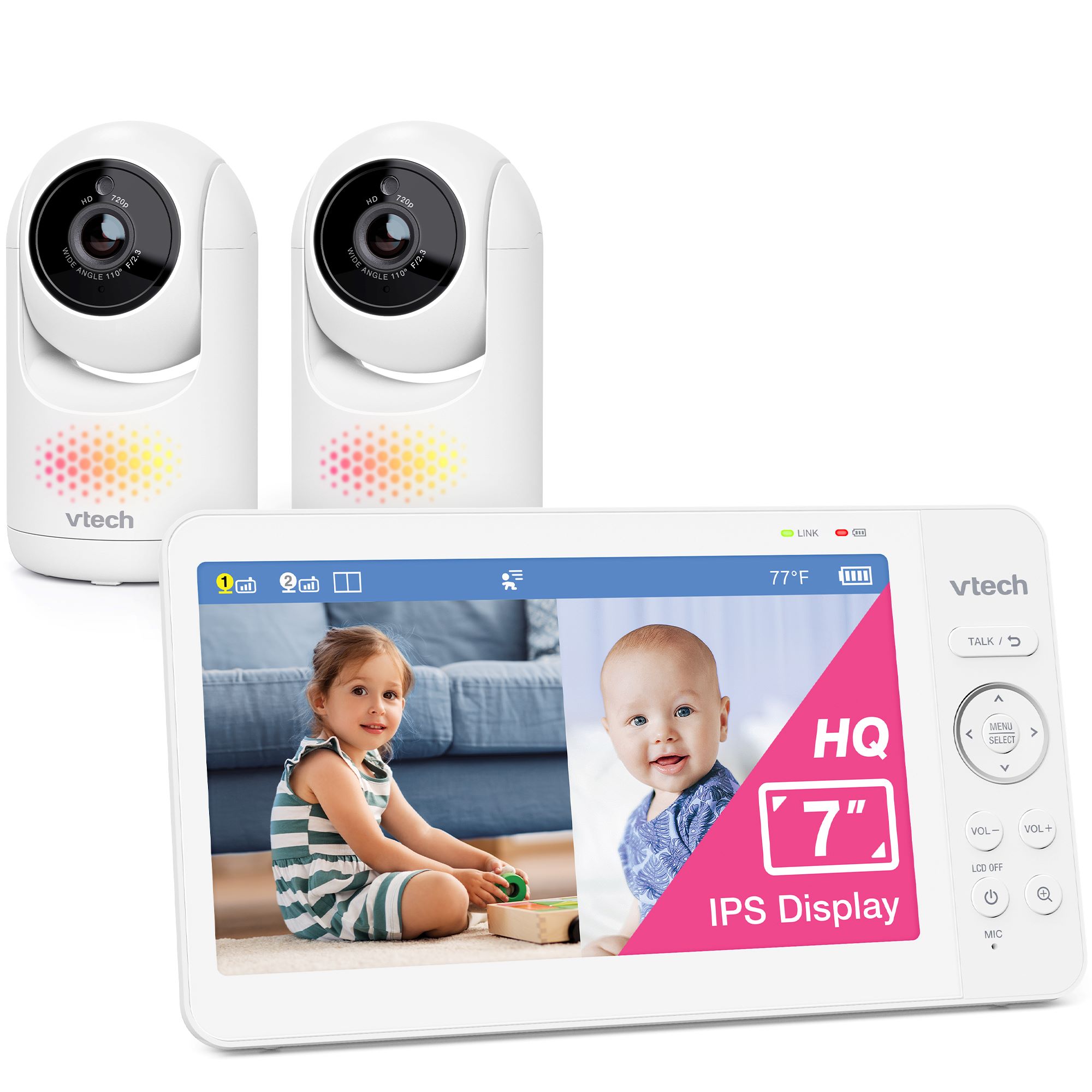
The VTech Advanced HQ Max Twin is the 346800 package: one parent unit and two baby units. Its current product page lists that exact model separately from the one-camera Advanced HQ Max 346700, and the U.S. quick-start guide says the Twin supplies two sets. That matters if two sleeping rooms are part of the routine. You are not being asked to buy the single-camera model and hope that an unrelated camera will pair.
Both cameras connect directly to the local parent viewer; the manual does not describe an app-away-from-home feed. The Twin fits households that want two rooms on a separate screen without router setup, not those who need phone viewing outside the home. Compare the Wi-Fi VM901-2HD if remote access matters.
Split and Patrol answer different two-room questions
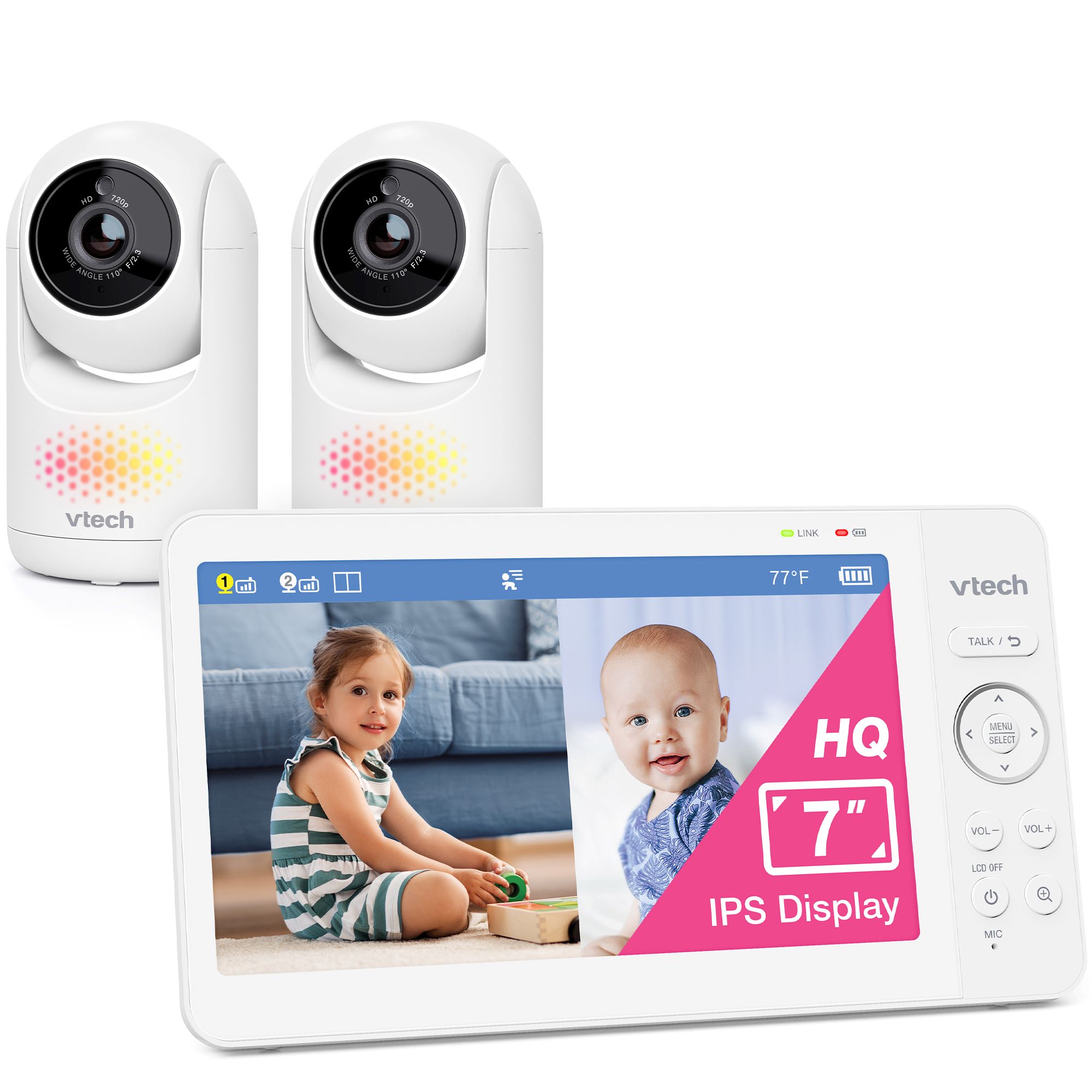
The newer 06/25 guide linked by the Twin’s exact support page documents three viewing arrangements. Single mode shows one selected camera. Patrol alternates the displayed camera every ten seconds, so it is a rotation rather than two simultaneous pictures. Split mode places both camera images on the parent display together. Those are useful differences: select Patrol when you want a repeating glance at each room, and Split when both visible images need to stay on screen at once.
A split picture is not the same as two-room audio. The Twin’s current guide describes its visual modes but does not establish whether both room sound channels remain open continuously in Split, whether one camera’s audio is selected, or how sound behaves while Patrol changes views. It likewise does not document a selectable dual-audio mode. If hearing both rooms at the same time is an essential condition, the finder must treat the Twin as unknown and exclude it rather than inferring audio from the split-screen photograph. The Infant Optics DXR-8 PRO SS is a more suitable manual-documented comparison when selectable simultaneous dual audio is the requirement.
The larger screen is 600p, despite the camera badge
The exact 06/25 U.S. guide specifies a seven-inch IPS parent display at 1024 by 600 pixels. VTech’s current comparison table calls it 600p. The Twin product image also carries a “HD 720p” label on the camera lens graphic; that marking is not the parent-screen specification. The display is large, but the VM5263’s five-inch 1280 by 720 panel has more pixels. If you mostly want a larger view of two rooms, the Max Twin’s format is attractive; if finer panel detail matters most, compare resolution and split-screen pane size rather than buying by screen diagonal alone.
The listing advertises pan, tilt, zoom and a 110-degree wide-angle view but gives no numeric movement range or zoom ratio. A second camera adds another room, not a 360-degree sensor; test both views in their final positions.
Alerts, night light and runtime have document limits
The Twin’s newer guide lists sound activation, a parent-unit screen-off timer, a three-level sound indicator, temperature measurement/alerts, talk-back, and five melodies and five soothing sounds. It supports an automatic mode that wakes the display above a chosen sound threshold and turns it off after fifty seconds of quiet. Those features can make a dedicated screen less obtrusive. They are not medical measurements, movement diagnosis or a safety guarantee.
There is an important manual-version boundary. The older 07/24 guide linked from the one-camera 346700 support page includes a Motion Detect alert and ten night-light colors. The newer 06/25 guide linked from the Twin page omits the motion-detection setting and specifies seven colors or cycling all. Do not transfer the base model’s motion-alert fact to the Twin: the 346800 current guide does not confirm it. Both guides identify a 5,000mAh internal battery, but the product page’s up-to-twelve-hour video claim is not a manual-stated continuous screen-on runtime. The user unit’s actual standby time varies; keep it on the supplied adapter when a predictable powered display matters.
Range, interference and safe placement
The listing advertises up to 1,000 feet, while the guide reports no numeric open-space test. Walls, metal objects and other wireless devices can disrupt the link. Test both cameras from their final positions, and confirm that Patrol sees each before relying on it.
Keep each camera out of a crib or playpen and its cord at least three feet from a child; the guide warns not to mount above 6.5 feet. It also asks that the parent unit stay more than three feet from a camera to avoid feedback.
Who fits this package—and what should change the shortlist?
Choose the Twin when the exact two-camera kit, separate local viewer and true simultaneous two-room picture fit your household. The finder can return it for two included cameras and a two-picture Split-mode requirement. It should not present a two-room audio request as satisfied, because that ability is not confirmed. A phone-away requirement also changes the answer to a networked option such as VM901-2HD; a strict minimum for screen-on hours or an open-space range likewise cannot be verified from this guide.
Compared with the single-camera 346700, the Twin adds the second included camera and Split/Patrol modes; its shared seven-inch display, resolution, local access and documented battery limits are similar. Compared with the 5-inch VM5263, the Twin supplies two rooms and a larger panel, but VM5263 states a higher 720p panel resolution in its exact guide. Compared with VM901-2HD, the Twin stays local but does not provide the phone-access route. If simultaneous audio is the deciding need, compare the DXR-8 PRO SS instead of assuming a split picture carries both sounds.
VTech describes this as an aid, not a medical monitor or substitute for adult supervision. Consult the current listing, support page and 06/25 U.S. guide.
Key details at a glance
| Parent-unit screen | 7 in |
|---|---|
| Published display resolution | 1024 × 600 pixels (7-inch color IPS LCD; exact 06/25 U.S. Quick Start Guide) |
| Camera-to-parent-unit connection | Direct local radio between two included cameras and parent viewer; exact 06/25 guide specifies 2405–2475 MHz baby-unit transmission and 32 channels. No remote phone mode is documented. |
| Advertised maximum range claim | 1000 ft |
| Cameras in the reviewed kit | 2 |
| Video rooms visible at once | 2 |
| Phone viewing away from home | No |
| User-replaceable parent-unit battery | No |
| Supplied camera lens setup | Two included cameras; product page describes pan, tilt, zoom and 110-degree wide-angle view, but gives no numeric movement or zoom travel. |
| Recommended stable operation uses home Wi-Fi | No |
| Audio-only system | No |
| Parent talk-back | Yes |
| Room-temperature readout | Yes |
Use the exact model’s instructions for operating limits, supplied equipment and version differences.
Sources for this assessment
- VTech current U.S. Advanced HQ Max Twin model listing
- VTech Advanced HQ Max Twin support page and linked 06/25 guide
- VTech U.S. Advanced HQ Max QSG, model nos. 346700 / 346800, 06/25; exact Twin page link
- VTech Advanced HQ Max Twin split image
- CPSC exact model string 346800; empty response on check date
- CPSC exact model name Advanced HQ Max Twin; empty response on check date
Check the room and the receiving setup.
Read the exact model's constraints, camera count and supervision limits before choosing a package.