
Your needs, this model
Does it fit your priorities?
Is one seven-inch local picture enough when a separate no-Wi-Fi screen is essential?
Yes for one room. The exact 819 Max listing shows a dedicated seven-inch Parent Unit and one included camera in a no-Wi-Fi product; it does not establish more than one simultaneous room.
Explore this need in the finder →Can the fixed 819 Max camera pan and tilt remotely when a child moves around the room?
No. The official comparison table identifies a fixed-position camera; manually adjusting its angle at setup is not the same as remote motorized movement.
Explore this need in the finder →Does one 819 Max package meet an essential two-room picture and audio requirement?
No. The observed package contains one baby camera and the listing does not establish simultaneous multi-camera viewing or dual-room audio.
Explore this need in the finder →Does the up-to-12-hour video headline guarantee six hours of continuous screen-on use?
No. The official page gives a maximum streaming claim without test conditions or a defined screen-on minimum; the screen-on runtime remains unknown.
Explore this need in the finder →A large local screen, with a different identity from VM819
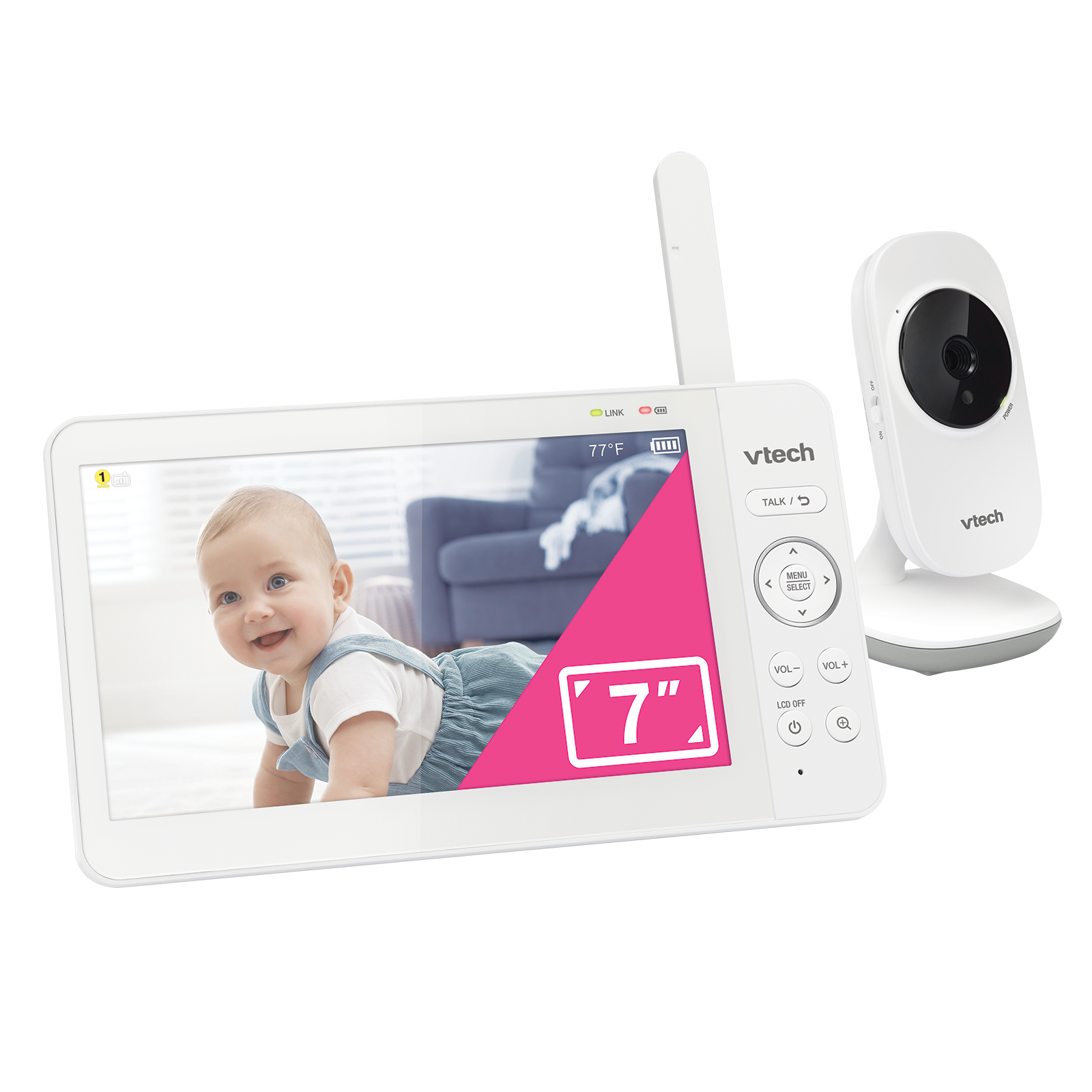
VTech’s 819 Max is a dedicated-screen video monitor for a household that wants a larger parent display without setting up home Wi-Fi. The official U.S. listing calls this exact model “819 Max,” identifies a seven-inch color screen and shows a box with one Parent Unit and one Baby Unit. It is not the separately listed 2.8-inch VM819. That naming distinction matters: the VM819 manual’s smaller screen and battery figures do not describe the 819 Max, and the two systems should not be treated as one kit.
One included camera and a fixed view
The seven-inch screen gives you more viewing area than the 2.8-inch VM819 or five-inch VM5263. VTech’s comparison table labels the 819 Max display 480p, so the larger panel should not be mistaken for a higher-resolution image than every smaller-screen rival. It is a practical format difference: a larger picture is easier to glance at, but it cannot change what the camera sees.
The package shown by VTech includes one parent screen, one baby camera and two AC adapters. The comparison table calls the camera fixed-position, while the product description says its angle can be adjusted. In practice, set the camera’s aim during installation; a caregiver cannot pan or tilt the camera head from the parent unit. The listing does not establish an add-on-camera limit or a simultaneous multiroom mode. If a second room is an essential requirement, treat the one-camera box as insufficient rather than assuming compatible cameras or split-screen controls.
A no-Wi-Fi arrangement for nearby check-ins
The dedicated parent unit receives the camera without a Wi-Fi setup. That is useful if you want a separate screen that does not depend on a router, account or phone app. It also means the 819 Max is not the right fit for checking the nursery from outside the house on a phone. “No Wi-Fi” describes the intended path, not a promise that the local signal will reach every room: walls, floors and nearby electronics can still affect reception.
VTech markets this as a long-range monitor but does not put a numerical range on the current product page. There is no specific open-space distance to use as a guarantee. Plan to test the receiver where you will actually carry it, and do not equate an advertised reach with performance through a particular floor plan.
Helpful household controls, not extra detection
The listing describes automatic infrared night vision, two-way talk, a room-temperature sensor, a three-level sound indicator and sound-activation mode that turns on the screen and speaker when nursery sound passes a selected level. Five melodies and four ambient sounds—including white noise and a stream—give caregivers some settling options. These are ordinary monitoring conveniences; sound activation is not a motion alarm, and a room-temperature display is not a medical measurement or a substitute for checking the room yourself.
The fixed camera can suit a predictable crib-side angle, but a child or room layout that changes often may make remote camera movement more useful. Compare the VM5263 if you want a camera that pans and tilts from its receiver, or the Advanced HQ Max if you want that movement alongside another seven-inch local display. Those are separate products and their features should not be attributed to the 819 Max.
Battery claims need context
VTech lists a 5,000-mAh rechargeable Parent Unit battery and advertises up to 12 hours of continuous video streaming or up to 18 hours in audio-only use. Those are manufacturer maximums, not a guaranteed result for every brightness, sound setting or battery age. The product page does not describe the test conditions or a minimum screen-on runtime. If you require a proven number of hours with the screen continuously on, the “up to” headline does not satisfy that need; leave the measured runtime unknown rather than converting battery capacity into an estimate.
The product page includes two AC adapters, but it does not state a battery backup for the camera. A charged Parent Unit cannot keep a separately powered camera transmitting during an outage. Do not select the 819 Max for camera-side backup unless the exact instructions for the purchased set confirm it.
Who should choose 819 Max?
Consider it when your priorities are a seven-inch dedicated viewer, a single fixed camera and a no-Wi-Fi local connection. The bigger display, sound-triggered screen, talk-back and temperature readout cover the common check-in routine without adding an app or router dependency. It is a less suitable choice when remote phone access, camera movement, confirmed two-room viewing, a numeric range requirement or a guaranteed screen-on battery duration is essential.
For the smallest local setup, compare the VM819, but check the exact model name: that is a separate 2.8-inch product. For a moving camera, start with the VM5263 or Advanced HQ Max reviews. For two simultaneous room pictures and sound, compare the Infant Optics DXR-8 PRO SS, whose twin-camera arrangement is specifically designed around that need. Each alternative changes a real capability; none is a generic upgrade for every home.
Use a monitor as one part of supervision
A live picture can make a nearby check easier, but it cannot interpret every sound or replace an adult’s attention. Follow the instructions supplied with the exact 819 Max set for camera placement, power, charging and cord routing. A baby monitor is not a medical monitor and should not be used as one.
VTech’s 819 Max product listing is the source for the model name, package contents and capabilities described here.
Key details at a glance
| Parent-unit screen | 7 in |
|---|---|
| Published display resolution | 480p in the current official comparison table; the product page does not provide pixel dimensions. |
| Camera-to-parent-unit connection | Dedicated local camera-to-parent-unit video system. The exact U.S. listing says no Wi-Fi; it does not specify the 819 Max radio band or channel count. |
| Cameras in the reviewed kit | 1 |
| Video rooms visible at once | 1 |
| Phone viewing away from home | No |
| Supplied camera lens setup | One fixed-position camera; its viewing angle is adjusted at placement. The exact product page does not document remote motorized pan or tilt. |
| Recommended stable operation uses home Wi-Fi | No |
| Audio-only system | No |
| Parent talk-back | Yes |
| Room-temperature readout | Yes |
Use the exact model’s instructions for operating limits, supplied equipment and version differences.
Sources for this assessment

Check the room and the receiving setup.
Read the exact model's constraints, camera count and supervision limits before choosing a package.