
Your needs, this model
Does it fit your priorities?
For an existing SCD730/86 owner, is local room sound enough without a picture or remote phone access?
Yes: the exact SCD730/86 setup links one Baby Unit and a dedicated Parent Unit over local DECT audio. Its LCD is for status and room temperature, not video; the product is discontinued and is not a current buying result.
Explore this need in the finder →Can the SCD730 show room temperature locally, and does its cry prompt identify crying?
The exact manual describes a temperature reading and configurable high/low alert on the Parent Unit. Its separate cry alert vibrates at the fourth sound-level-light threshold, so it can react to loud non-cry sounds and should not be treated as a cry classifier.
Explore this need in the finder →Does the maximum outdoor range clear 900 feet, but not 1,050 feet?
Philips publishes up to 1,000 feet outdoors and up to 150 feet indoors. The first threshold is below the outdoor maximum; the second exceeds it. Neither predicts reception through this owner's walls.
Explore this need in the finder →Can you rely on Eco Max being present in every SCD730/86 set?
No firm yes/no is established for the exact set. Philips links an earlier SCD73x manual that names SCD730 and includes Eco Max, plus a later exact SCD730 manual that omits it. Treat Eco Max as unknown unless the actual unit and its manual confirm the control.
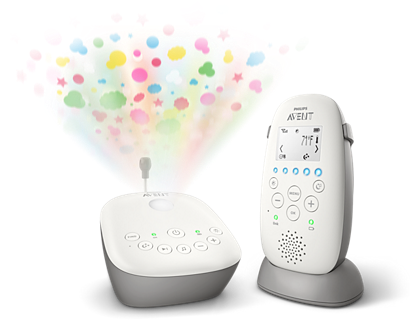
Explore this need in the finder →The Philips Avent SCD730/86 is a discontinued U.S. DECT audio monitor with one Baby Unit and one dedicated Parent Unit. Its defining extra is a starry ceiling projector, controlled at the Baby Unit or remotely from the Parent Unit. This is an owner reference for identifying a matching set, not a current buying recommendation.
Local audio, not a camera picture
The exact SCD730/86 product page and its linked manual describe a local DECT sound connection. The Parent Unit's small LCD shows the link, battery, menu and room-temperature information; it does not display a camera image. Philips documents no Wi-Fi, phone app or away-from-home viewing path for this model. If your essential requirement is a picture, or checking from outside the home, this set cannot meet it. A separate receiver also means you need to keep the Parent Unit charged and within its radio coverage rather than relying on a household phone.
There are five sound-level lights, adjustable microphone sensitivity and a volume-off setting. Those controls let an owner choose how quiet the nursery must become before the Parent Unit speaker comes on, while the lights can still show sound level when audio is muted. A light or a sound-level threshold is not an assessment of why a noise occurred. The Parent Unit also has talk-back, so an adult can speak through the Baby Unit while in range.
The projector is the real difference from SCD720/86
Philips' exact comparison lists a starry night projector on the SCD730/86 and not the closely related SCD720/86. The SCD730 manual describes six colored patterns and a projector timer that can run for five, ten, fifteen or twenty minutes, or continuously. An owner can start or stop it at the Baby Unit or use the Parent Unit's soothing menu. This is useful only if a projector is welcome in that room and the image can reach the ceiling; it does not add video monitoring, room coverage or a safety sensor. The product also has a simple nightlight and five lullabies. Philips links two English U.S. manual revisions to the exact SCD730/86 support route: the newer SCD730-only manual documents Smart Eco but omits Eco Max, while an earlier SCD73x family manual names SCD730 and includes Eco Max instructions and its range-alert caveat. That is a real documentation conflict, so I leave exact /86 Eco Max status unverified rather than saying it is absent or promising that it is present. Check the label and manual for the actual used set before relying on that mode.
Temperature is a household reading; “cry alert” is a threshold
The Parent Unit displays the room temperature and lets an owner set a minimum and maximum range and choose how an out-of-range prompt is given. The manual's selectable limits are 50–66°F for the lower threshold and 72–99°F for the upper threshold. This is a household reference, not a medical measurement or a guarantee that a particular part of the room is at the displayed value.
Philips calls another option a cry alert, but the manual explains its actual trigger: the Parent Unit vibrates when nursery sound reaches the fourth of five sound-level lights, then repeats the prompt while that sound remains high. It does not distinguish a cry from other loud noise. The vibration can be useful if the receiver is muted, but anyone who needs a true cry-classification system should not treat this threshold feature as one. Smart Eco is documented for SCD730/86, but it is distinct from Eco Max. One exact-route manual revision includes an Eco Max menu for the SCD730 family; a later exact-code SCD730 revision does not. Since Philips has not reconciled those documents, the mode remains unknown in matching for this exact U.S. package. Do not assume an ordinary Smart Eco label settles that question.
Range and battery figures need a used-set check
Philips gives up to 330 metres (1,000 feet) outdoors and up to 50 metres (150 feet) indoors. These are published maxima, not a prediction through a specific home. The manual shows that metal, walls and other materials can sharply reduce reach. Test the link where the Parent Unit will actually be used and pay attention to its connection indicator; do not depend on an outdoor number to promise reception upstairs or through masonry.
The SCD730 manual says the Parent Unit's supplied rechargeable batteries need a full ten-hour charge for up to eighteen hours of cordless use, and that a new set reaches full capacity after four charge/discharge cycles. Those are instructions and maximum claims, not a measurement of a discontinued receiver. Inspect the actual batteries, charging base and adapters in a used package. The Baby Unit normally runs from its adapter; four non-rechargeable AA alkaline cells may be installed as backup, but Philips does not include them or state a backup duration.
Place the units safely and compare exact labels
Philips says to keep the Baby Unit and its cord at least one metre from the child and never put the unit in a bed or playpen. Keep the Parent Unit at least one metre from the Baby Unit during setup to reduce feedback. This consumer monitor is an aid, not a medical device or replacement for adult supervision and safe-sleep practices.
For owners, check the full SCD730/86 label and the Parent and Baby Unit labels before buying a used replacement component; a similar Avent shape does not prove compatibility. Philips marks this exact model no longer available, so it stays out of current shopping matches even if its functions fit a profile. If choosing a monitor now, use the finder to decide whether one-room audio is enough or whether a camera or phone connection changes the requirement. The SCD730's projector is a distinct comfort extra, but its age, used-battery condition, local-only link and lack of video are central tradeoffs—not small omissions.
Key details at a glance
| Camera-to-parent-unit connection | Local DECT audio between the included Baby Unit and Parent Unit; no app or away-from-home phone viewing is documented. |
|---|---|
| Manufacturer-stated open-space range | 1000 ft |
| Advertised maximum range claim | 1000 ft |
| Cameras in the reviewed kit | 0 |
| Maximum camera units supported | 0 |
| Video rooms visible at once | 0 |
| Phone viewing away from home | No |
| User-replaceable parent-unit battery | Yes |
| Recommended stable operation uses home Wi-Fi | No |
| Motion alert | No |
| Audio-only system | Yes |
| Parent talk-back | Yes |
| Room-temperature readout | Yes |
| Parent-unit batteries included | Yes |
| Camera-side mood light | No |
| Preloaded lullaby count | 5 |
| Starry night projector | Yes |
| Parent-unit vibration prompt | Yes |
| Parent receivers included | 1 |
Use the exact model’s instructions for operating limits, supplied equipment and version differences.
Sources for this assessment
- Philips U.S. All Series directory, exact SCD730/86 row
- Philips U.S. exact SCD730/86 product page
- Philips support for exact SCD730/86
- Philips Avent SCD730 user manual, English section from exact SCD730/86 support route
- Philips SCD73x Quick Start Guide linked from SCD730/86 support
- Philips Important Information Manual linked from SCD730/86 support
- Philips U.S. SCD730/86 and SCD720/86 official comparison
- Philips-hosted SCD730/86 exact product rendering
- Philips exact-support-linked prior English U.S. user-manual revision
Check the room and the receiving setup.
Read the exact model's constraints, camera count and supervision limits before choosing a package.