
Your needs, this model
Does it fit your priorities?
For an existing SCD720/86 owner, can a dedicated receiver provide one offline audio feed without video?
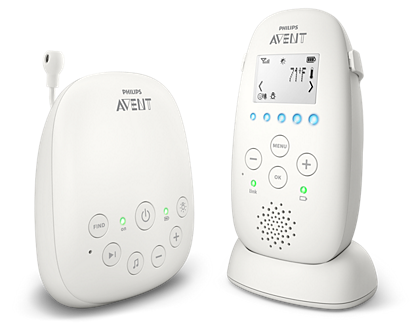
Yes. Its exact U.S. product page and linked manual describe a one-room DECT Baby Unit/Parent Unit audio setup, not a camera image or phone route. It is discontinued and stays outside current purchase results.
Explore this need in the finder →Can it show room temperature, and does its named cry alert classify sounds?
The exact manual documents a temperature display and configurable alert. Its cry prompt is triggered when sound reaches the fourth of five level lights; it does not identify crying rather than another loud sound.
Explore this need in the finder →Does the manual document a specific Eco Max mode, including its range-alert compromise?
Yes. In Eco Max, the Baby Unit's DECT transmission is off when quiet and resumes when sound occurs. Philips warns that there is no out-of-range alert during silence and feedback is delayed; this is not a substitute for a conventional live-link warning.
Explore this need in the finder →The Philips Avent SCD720/86 is a discontinued U.S. DECT audio monitor: one Baby Unit sends local sound to a dedicated Parent Unit with a status-and-temperature LCD. Its optional Eco Max mode has a specific warning that matters more than the energy label. This is a setup and identification reference for existing owners, not a current buying recommendation.
What the Parent Unit does—and does not show
The exact U.S. product page and SCD720 manual describe a local DECT link, adjustable microphone sensitivity, volume, five sound-level lights and parent talk-back. The LCD can show link and battery information, menu choices and room temperature, but it is not a camera screen. Philips documents no Wi-Fi or away-from-home phone route for this exact monitor. If a picture or remote access is essential, this one-room audio setup cannot satisfy that need. If you only need to hear from one nearby room without a household network, its dedicated receiver is the relevant operating plan.
A nightlight and five lullabies are controlled through the Baby Unit, with additional controls in the Parent Unit menu. The unit can show sound-level lights when its speaker is muted. The exact Philips comparison with SCD730/86 lists nearly the same main audio, temperature and alert functions on both, but explicitly gives the starry night projector only to SCD730/86. Do not expect a projector from an SCD720/86 kit just because the sibling model has one.
Eco Max is optional—and turns off the range warning
The current and prior English U.S. manuals linked from the exact SCD720/86 support route both document Smart Eco as an automatic reduction in DECT signal and a separate Eco Max mode: when the nursery is quiet, the Baby Unit stops transmitting and resumes when sound is detected. Philips says that feedback is delayed in Eco Max and, during that quiet interval, the Parent Unit will not alert if it has moved out of range. The mode also cannot be activated at the highest microphone-sensitivity setting. So Eco Max is not a free improvement to an otherwise unchanged monitor. An owner who relies on a continuous link warning should leave it off; anyone who enables it needs to understand the changed alert behavior and verify the setup. The finder treats this exact consistently documented mode as an optional advanced requirement, not an assumed benefit for other monitors. A related SCD730/86 manual discrepancy is described in its own review; do not transfer its unknown status onto this SCD720.
Temperature and vibration prompts are not medical detection
The Parent Unit displays room temperature, and the manual describes selectable lower and upper thresholds plus sound, sound-and-vibration, vibration-only or display-only alert choices. Its adjustable lower bound is 50–66°F and upper bound 72–99°F. The reading is a household reference, not a diagnosis, and a displayed value does not establish the temperature at every location in a room.
The manual's “cry alert” is a sound threshold: when room sound is high enough to light the fourth of the five level indicators, the Parent Unit vibrates and shows a prompt. This is not an algorithm that identifies crying; another loud sound can also cross that threshold. The SCD720 has vibration alerts, but should not be selected when a specific cry-recognition alert is essential. Five sound-level lights and sensitivity settings provide simpler feedback, not an explanation of what produced the noise.
Range, charging and backup are conditional
Philips publishes up to 330 metres (1,000 feet) outdoors and up to 50 metres (150 feet) indoors. Treat both as maximum figures, not a promise through a particular floor plan. The manual describes losses from metal and building materials, so test the link from the places where you will carry the Parent Unit and check the displayed connection status.
The manual identifies two rechargeable AA batteries supplied for the Parent Unit and says a full ten-hour charge can provide up to eighteen hours cordless. It also describes four charge/discharge cycles before the pack reaches full initial capacity. Those are manufacturer conditions, not a test of a used set. Check the batteries, charging station, adapters and receiver before relying on a secondhand kit. The Baby Unit normally uses mains power; four non-rechargeable AA alkaline cells can provide backup during an outage, but the cells are not included and the manual gives no backup duration.
Placement and owner-reference limits
Keep the Baby Unit and its cord at least one metre from the child and outside the bed or playpen; the manual also advises keeping the two units apart during setup to prevent feedback. A monitor is only an aid to supervision, never a medical device or substitute for adult care and safe-sleep practices.
Philips marks the exact SCD720/86 discontinued. Use the exact label when checking an owner set, and do not assume another Avent receiver or camera is interchangeable from appearance alone. For new shopping, compare currently available local audio models separately; this old model's temperature display or Eco Max option does not make it a present-day purchase recommendation. Its key choice is between conventional local audio with a link warning and an optional quiet-period transmission mode that removes that particular warning while silent.
Key details at a glance
| Camera-to-parent-unit connection | Local DECT audio between the included Baby Unit and Parent Unit; no app or remote-phone path is documented. |
|---|---|
| Manufacturer-stated open-space range | 1000 ft |
| Advertised maximum range claim | 1000 ft |
| Cameras in the reviewed kit | 0 |
| Maximum camera units supported | 0 |
| Video rooms visible at once | 0 |
| Phone viewing away from home | No |
| User-replaceable parent-unit battery | Yes |
| Recommended stable operation uses home Wi-Fi | No |
| Motion alert | No |
| Audio-only system | Yes |
| Parent talk-back | Yes |
| Room-temperature readout | Yes |
| Parent-unit batteries included | Yes |
| Camera-side mood light | No |
| Preloaded lullaby count | 5 |
| Eco Max quiet-interval mode | Yes |
| Starry night projector | No |
| Parent-unit vibration prompt | Yes |
| Parent receivers included | 1 |
Use the exact model’s instructions for operating limits, supplied equipment and version differences.
Sources for this assessment
- Philips U.S. All Series directory, exact SCD720/86 row
- Philips U.S. exact SCD720/86 DECT audio product page
- Philips support for exact SCD720/86
- Philips Avent SCD720-family user manual, English instructions from exact SCD720/86 support route
- Philips SCD720/86 official product specification sheet
- Philips U.S. SCD720/86 and SCD730/86 official comparison
- Philips-hosted SCD720/86 exact product rendering
- Philips exact-support-linked prior English U.S. user-manual revision
Check the room and the receiving setup.
Read the exact model's constraints, camera count and supervision limits before choosing a package.