
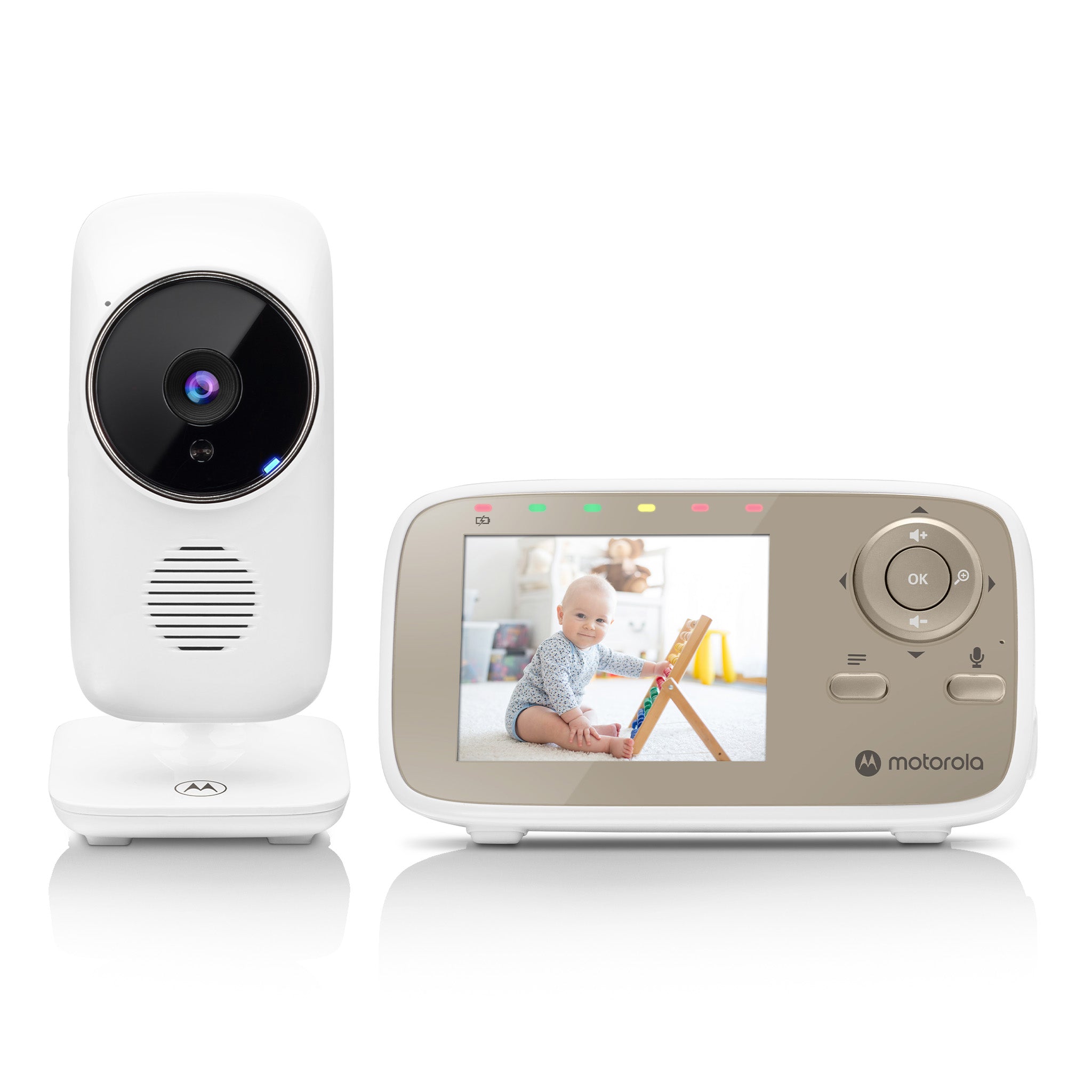
Your needs, this model
Does it fit your priorities?
Do you need a parent-to-camera talk-back control?
The VM483 manual documents a press-and-hold talk-back control for speaking to the Baby Unit.
Explore this need in the finder →Would a larger 2.8-inch screen with talk-back suit the room routine?
The VM483 is listed at 2.8 inches and supports parent talk-back; its camera view is local to the receiver.
Explore this need in the finder →Is one selected camera room at a time sufficient?
The base kit contains one camera. If cameras are added, Patrol changes views sequentially and audio is heard only from the selected camera.
Explore this need in the finder →The compact local monitor that adds parent talk-back
The Motorola Nursery VM483 is a one-camera video monitor with a dedicated parent receiver. The exact U.S. store record identifies SKU 810036771238, and the U.S./EU user guide's standard kit list contains a parent unit, one baby camera and a rechargeable parent battery pack. Its page showed sold out on October 23, 2026; this dated status does not remove the model from the comparison or imply anything about another seller. The phone-viewing question is straightforward: the listed setup uses a direct 2.4 GHz FHSS link, with no Wi-Fi or app needed, so the parent unit is the intended receiver rather than an off-site phone endpoint.
The display is 2.8 inches diagonally at a listed 480 × 272 pixels. Infrared LEDs provide automatic black-and-white night vision, and the camera's picture can be enlarged with two-times digital zoom. The manual calls its zoomed-image movement “pan or tilt,” but the procedure moves the enlarged crop with the parent-unit keys; it does not describe a motorized camera head. If remotely steering the lens is essential, do not confuse that screen operation with physical camera movement.
Talk-back and lullabies are practical differences
The VM483 documents parent-to-camera talk-back and five preloaded lullabies. Talk-back lets a caregiver speak through the receiver rather than requiring an app or separate device; it is an occasional two-way feature, not evidence of a continuous intercom workflow or a guarantee that speaking will settle a child. The five songs are built into this model's supported feature set, but the guide does not make them a sleep treatment. If these two features are unnecessary, the VM482 remains smaller and includes a documented temperature display; if an ambient camera light matters, the VM482 ANXL has the mood-light feature instead.
The VM483 also measures room temperature and documents a visual and audible alert when the value crosses a selected range. The guide lets the caregiver choose Celsius or Fahrenheit and set upper and lower boundaries. Consider it a reference reading—not a medical sensor—and remember an alert limit is only useful if the parent unit is nearby and powered.
Expandability is not continuous multiroom monitoring
The VM483 guide says up to four cameras can be paired with the parent unit. When more than one is paired, the user can select a camera or use Patrol, which changes views about every 10 seconds. The manual states that audio from a camera is heard only when that camera is selected. The basic VM483 kit contains one camera; the additional-pairing feature does not mean that the box includes four cameras, shows a split screen, or continuously hears several rooms at once. A household that needs to see two rooms simultaneously or hear two rooms at once needs a different exact system with documentation for that mode.
When the parent screen is switched off, audio from the selected camera continues. This supports a quieter nighttime viewing routine, although it also means the receiver is not providing a visual check until the screen is turned back on. The video link is local: there is no app to check from another building, and the manufacturer’s up-to-1,000-foot range claim is not a numeric open-space test protocol. Walls, electronics and 2.4 GHz traffic can reduce the link; test the real rooms before relying on it.
A battery claim with an important source discrepancy
The VM483 product page lists a 2,000 mAh rechargeable parent battery and five hours of playtime. Its linked user guide instead specifies a 1,200 mAh pack and a maximum five-hour battery life. The manual does not say that five hours is a continuous screen-on result, so the finder treats exact screen-on runtime as unknown. The battery pack is installed in a compartment and the manual refers owners to customer service for a replacement; it is not a sealed main unit, though replacement may require support.
The camera is intended to remain connected to its supplied adapter. The parent unit can be carried within range, but the claimed backup duration should not be substituted for a planned all-night visual feed. Motorola's U.S. listing states a maximum range up to 1,000 feet; the manual explains that the radio link depends on environmental conditions and does not give a numeric clear-field test. Keep these marketing maxima separate from measured household expectations.
Who is it for, and when should you choose another model?
Choose the VM483 if you want a 2.8-inch dedicated screen with the higher listed 480 × 272 resolution, local receiver operation and the combination of talk-back, five lullabies and temperature alerts. It fits video, one-room viewing and a no-Wi-Fi parent screen. It should not be returned for a minimum above 2.8 inches or for a requirement for remote phone access, motorized pan/tilt, two concurrent room feeds, movement alerts or a verified five-hour screen-on runtime. A strict two-camera requirement also exceeds the included one-camera kit.
The most direct sibling comparison is the VM482 ANXL: both have 2.8-inch screens, but its documented panel is 320 × 240 and its camera has a seven-color mood light; the VM483 is 480 × 272 and adds talk-back and lullabies. For a smaller footprint and a temperature readout, the VM482 is 2.4 inches. In all cases, follow the manual's cord-placement instruction: more than three feet from the crib and out of the child's reach. A monitor is an aid to responsible supervision, not a substitute for it.
Sources: Motorola Nursery's U.S. VM483 listing, its product-support page, and the VM483 user guide and U.S. quick-start guide.
Key details at a glance
| Parent-unit screen | 2.8 in |
|---|---|
| Published display resolution | 2.8-inch color TFT; exact product specification lists 480 x 272 pixels. |
| Camera-to-parent-unit connection | Direct local 2.4 GHz FHSS camera-to-parent link; the U.S. product page says no Wi-Fi or app is needed. |
| Advertised maximum range claim | 1000 ft |
| Cameras in the reviewed kit | 1 |
| Maximum camera units supported | 4 |
| Video rooms visible at once | 1 |
| Phone viewing away from home | No |
| User-replaceable parent-unit battery | Yes |
| Supplied camera lens setup | 2x digital zoom; manual can move the enlarged image crop; no motorized remote camera pan/tilt is documented. |
| Recommended stable operation uses home Wi-Fi | No |
| Audio-only system | No |
| Parent talk-back | Yes |
| Room-temperature readout | Yes |
| Parent-unit batteries included | Yes |
| Preloaded lullaby count | 5 |
| Parent receivers included | 1 |
Use the exact model’s instructions for operating limits, supplied equipment and version differences.
Sources for this assessment

Check the room and the receiving setup.
Read the exact model's constraints, camera count and supervision limits before choosing a package.