
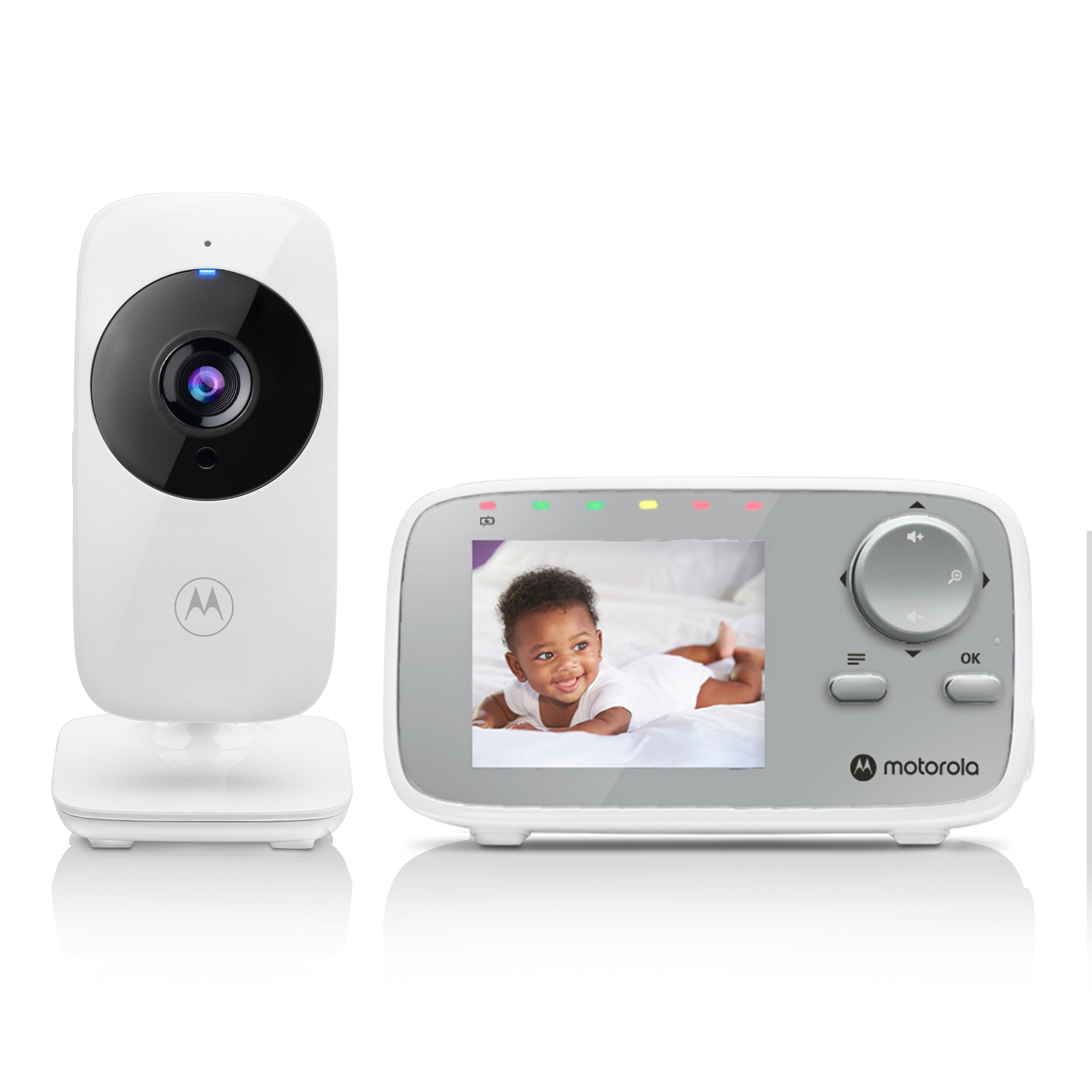
Your needs, this model
Does it fit your priorities?
Would a 2.4-inch dedicated screen with a temperature readout fit?
The U.S. listing specifies a 2.4-inch receiver and temperature monitoring; the manual describes an alert tone for temperatures outside the desired range.
Explore this need in the finder →Is a modest 2.4-inch display large enough?
The parent unit is listed at 2.4 inches. A stricter 2.8-inch threshold leads to a larger sibling.
Explore this need in the finder →Do you require parent talk-back through the camera?
Talk-back is not documented in the VM482 product features or guide, so do not count on this function.
Explore this need in the finder →A local monitor with a slightly larger view and a temperature display
The Motorola Nursery VM482 is a one-camera dedicated-screen video monitor for a home that wants a simple receiver link rather than a phone camera. Its U.S. product record identifies SKU 810036771191, and the family guide's standard parts list names one parent unit, one baby camera and one rechargeable parent battery. The manufacturer's U.S. page showed the model sold out on October 23, 2026. A dated sold-out listing is not a reason to omit it from an assessment, but it does mean this review makes no claim about current seller inventory.
The screen is 2.4 inches diagonally and 480 × 272 pixels. That is larger than the VM481's two-inch panel but uses the same listed pixel resolution, so the difference is physical size rather than a higher pixel count. Digital two-times zoom can enlarge an area, and automatic infrared night vision changes the picture to black and white in low light. A high-sensitivity microphone and parent-unit sound-level indicator make the basic arrangement easy to understand: the camera sends one room's picture and sound to its own nearby receiver.
Temperature monitoring is the main reason to choose this model
The VM482 page lists a room-temperature display and alert, and the user guide confirms that the camera measures its surroundings and can alert when the value falls outside the unit's temperature range. The manual permits Celsius or Fahrenheit but does not establish a universal medically meaningful threshold. Think of the reading as an additional household cue, not a clinical sensor or an automatic way to control the room. If the temperature alert is a must-have, this feature is more clearly documented for the VM482 than for the smaller VM481, whose current listing mentions the function but whose linked guide does not contain a separate temperature section.
The camera also has a sound-level indicator, low-battery and out-of-range alerts, and a parent receiver that can turn its screen off while leaving audio on. The manual does not document cry recognition or a motion-detection alert. Nor does it document talk-back or a soothing light for the VM482. A shopper who needs to speak through the camera should compare the VM483; a shopper who wants the camera itself to glow should compare the VM482 ANXL.
Extra pairing capacity is not an extra camera in the box
The family guide says the receiver can pair up to four cameras, and its status-icon page includes a Patrol-mode indicator. The downloadable VM482 guide does not explain the patrol cadence, a split-screen mode or how sound is handled when extra cameras are paired. Do not assume a timing figure or multiroom behavior from a status icon. A single-camera VM482 box gives you one included room view; extra pairing capacity does not mean additional cameras are in the kit. If multiple rooms are essential, find an exact bundle and manual that establish the supported picture and audio modes before buying.
This distinction is important for household routines. If you only need to switch occasionally between rooms, a scheduled patrol may be acceptable. If you must see both children at the same time or hear two rooms continuously, require an exact model whose manual confirms those modes. The VM482's 2.4-inch screen is also best viewed at close range. For a larger panel while keeping a local receiver, the ANXL and VM483 measure 2.8 inches; compare their different resolution and features rather than choosing by diagonal alone.
Local radio simplifies setup, but not every real-world limit
The VM482 uses a direct 2.4 GHz FHSS connection and Motorola says no Wi-Fi or app is needed. This avoids router configuration and means the receiver is the intended viewing endpoint, but it cannot send an off-site phone picture. The manufacturer advertises up to 1,000 feet. The user guide cautions that range changes with the environment and identifies walls, metal and other radio or electrical equipment as possible obstacles. The published maximum is not a numeric open-space test protocol or a guarantee through floors, so test the actual nursery-to-parent-unit path.
Battery information is inconsistent across the product's own materials: the U.S. page lists 2,000 mAh and five hours of playtime, while the linked guide specifies a 1,200 mAh lithium-ion pack and maximum five-hour battery life. The guide does not establish the duration as continuous screen-on operation. The matching questionnaire therefore cannot treat its published five hours as a confirmed screen-on runtime. The parent pack is removable through the battery compartment; the manual says to contact customer service for a replacement pack.
How it fits—and where it does not
Choose the VM482 if a dedicated local screen, one-room video and a documented room-temperature display are more useful than app access. A two-inch minimum is sufficient, and the 2.4-inch screen satisfies a 2.4-inch preference; a strict 2.5-inch minimum does not. If temperature is not essential, the VM481 is a smaller-screen alternative with a similar direct-radio concept. If you need a 2.8-inch panel plus parent talk-back and five lullabies, the VM483 is the more feature-rich sibling. The ANXL trades a higher pixel count for its camera mood light.
The VM482 is not a good fit for an essential request for off-site phone viewing, a confirmed remote pan/tilt camera, documented simultaneous two-room video or audio, cry detection, or a measured five-hour screen-on runtime. The manual's safety section requires more than three feet between the camera/adapter cord and the crib, and says a monitor is an aid rather than a substitute for responsible supervision. Sources: the U.S. VM482 listing, its Motorola support page, the VM482 user guide and North American quick-start guide.
Key details at a glance
| Parent-unit screen | 2.4 in |
|---|---|
| Published display resolution | 2.4-inch color TFT; exact product specification lists 480 x 272 pixels. |
| Camera-to-parent-unit connection | Direct local 2.4 GHz FHSS camera-to-parent link; the U.S. product page says no Wi-Fi or app is needed. |
| Advertised maximum range claim | 1000 ft |
| Cameras in the reviewed kit | 1 |
| Maximum camera units supported | 4 |
| Video rooms visible at once | 1 |
| Phone viewing away from home | No |
| User-replaceable parent-unit battery | Yes |
| Supplied camera lens setup | 2x digital zoom; no remote motorized pan/tilt feature is documented. |
| Recommended stable operation uses home Wi-Fi | No |
| Audio-only system | No |
| Room-temperature readout | Yes |
| Parent-unit batteries included | Yes |
| Parent receivers included | 1 |
Use the exact model’s instructions for operating limits, supplied equipment and version differences.
Sources for this assessment

Check the room and the receiving setup.
Read the exact model's constraints, camera count and supervision limits before choosing a package.