
On this page
Your needs, this model
Does it fit your priorities?
Is one camera picture on a dedicated local screen enough?
The global VM35 page and standard box list identify one camera and one parent receiver on a 2.4 GHz FHSS local link. This is a reference configuration; its U.S. package is not established.
Explore this need in the finder →Would you require two camera pictures together rather than one?
The exact VM35 base package lists one camera. The family manual documents other multi-camera package variants, but that does not change the base package or verify U.S. retail contents.
Explore this need in the finder →Do you need motorized pan and tilt from the parent unit?
No remote motorized movement is documented for this exact VM35 page/manual; the camera is aimed during setup and the guide describes digital zoom.
Explore this need in the finder →A five-inch local monitor, not a phone camera
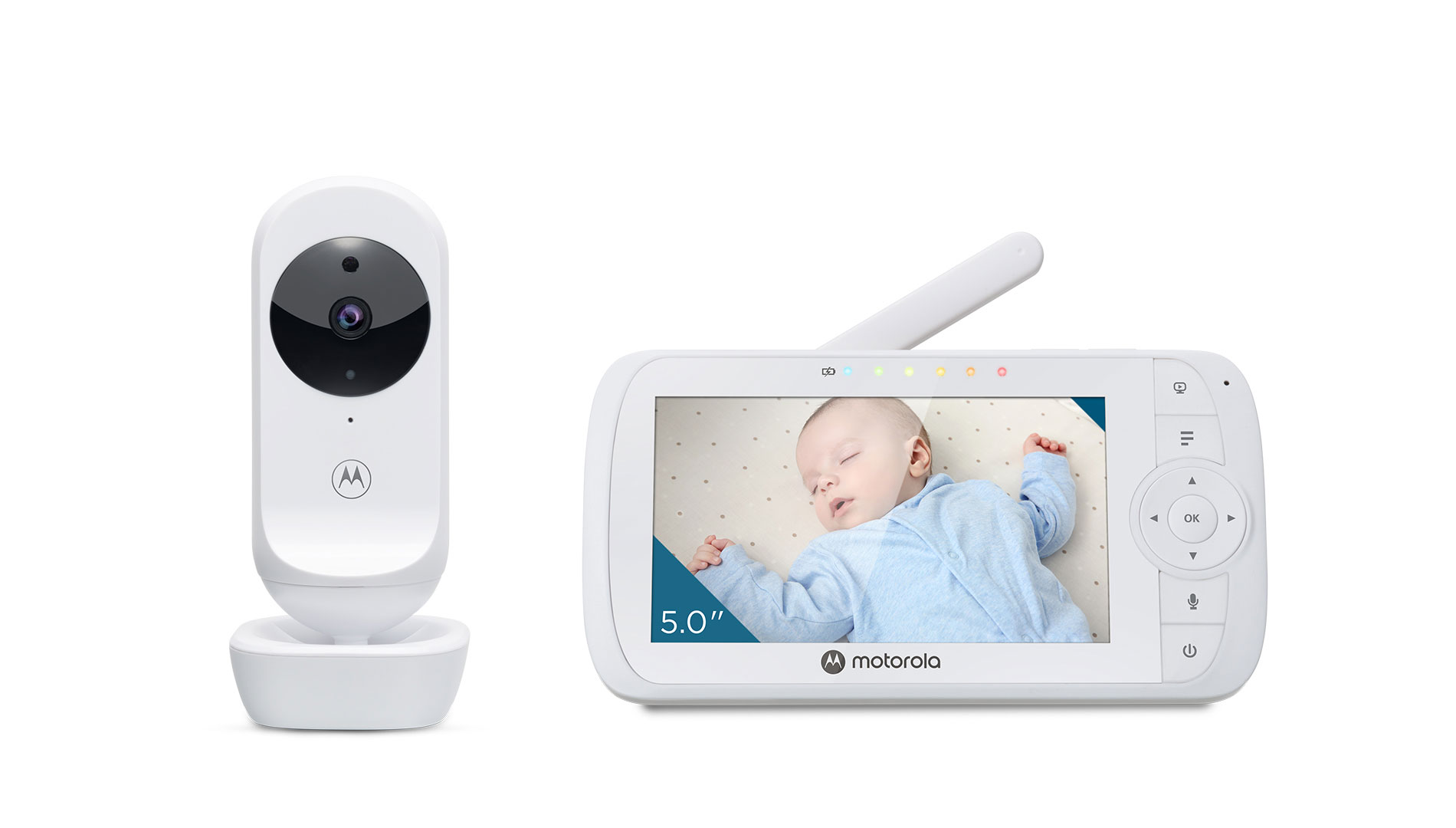
The Motorola Nursery VM35 is a conventional camera-and-parent-unit system. Its global product page identifies a one-camera package with a 5-inch color display, direct 2.4 GHz FHSS radio, two-way talk, infrared night vision and 2× digital zoom. The package list in the family guide names one parent unit, one camera, two power adapters and a quick-start guide for the base version. A rechargeable battery in the parent unit lets the receiver move around the home without dropping the local link; the manufacturer lists up to five hours of parent-unit operation. The camera itself is adapter powered in this configuration, so it is not a battery camera you can casually carry elsewhere.
That split is practical: the camera can stay placed and powered while a caregiver carries the screen. Nothing in the documented plan depends on a home router, cloud account or phone app. The product page describes an in-home range claim up to 1,000 feet, but that is a manufacturer maximum, not a room-by-room promise. Walls, metal, reinforced surfaces and competing 2.4 GHz equipment can weaken the link, as the manual warns.
Useful details for one room
The receiver combines a color picture with a sound-level light bar, a microphone/speaker path for talk-back, a temperature readout and menu controls. Infrared night vision switches the picture to black and white in darkness. Digital zoom enlarges a portion of the image; it does not add optical detail or let the camera turn toward another part of the room. The camera is positioned by hand during setup. If a child moves out of frame, a caregiver must reposition the camera rather than steer it from the parent unit.
The room-temperature display can help a caregiver notice a change in the room, but it is not a clinical instrument and should not be used to judge a child's health. The guide describes a visual change in the display outside its stated range; it does not turn the monitor into a medical alert device. The monitor also includes five lullabies. Those extras are most useful if a simple receiver matters more than app access, recording or smart-home features.
The VM35 family guide covers additional camera pairings and split-screen viewing, but this exact base package contains one camera. Buying a compatible add-on or a differently numbered kit is a separate decision: neither its availability nor the exact U.S. contents are established here. Do not treat the family guide's other suffixes as proof that the box includes more than one camera.
Who should compare it—and what to compare instead
A household seeking a no-Wi-Fi picture on a separate five-inch receiver can understand the VM35's intended role. A confirmed U.S. package such as Motorola's PIP1500 is a more defensible starting point for a current U.S. shortlist when one local camera is enough; it is a separately identified model, not a guarantee that its hardware or bundle is identical to this global VM35. If remotely steering the camera is essential, a documented U.S. local-screen model such as the VM36XL is a better comparison than assuming digital zoom will do the same job. If a two-room picture is essential, compare an exact twin-camera package such as the U.S. PIP1500-2 and check how its split-screen audio behaves.
This review is for identifying the global VM35, not for recommending it as a U.S. purchase. The exact U.S. retailer listing, SKU and current or historical U.S. package have not been verified. Motorola's international product page and family manual establish the monitor's name and documented operating plan, but a search miss on the U.S. store does not establish that it was never sold there. Keep that market boundary in view before comparing a listing or used bundle. For safe placement, follow the manual: keep the camera and its power cord out of the crib and keep cords more than three feet from a child's reach.
Key details at a glance
| Parent-unit screen | 5 in |
|---|---|
| Published display resolution | 480 × 272 pixels (manufacturer-listed) |
| Camera-to-parent-unit connection | Direct local 2.4 GHz FHSS camera-to-parent-unit link; the reviewed global page/manual do not document an app or away-from-home phone path. |
| Advertised maximum range claim | 1000 ft |
| Cameras in the reviewed kit | 1 |
| Maximum camera units supported | 4 |
More specifications and setup details
| Video rooms visible at once | 1 |
|---|---|
| Phone viewing away from home | No |
| User-replaceable parent-unit battery | No |
| Supplied camera lens setup | Fixed camera is aimed during setup; the receiver provides 2× digital zoom, not motorized steering. |
| Recommended stable operation uses home Wi-Fi | No |
| Audio-only system | No |
| Parent talk-back | Yes |
| Room-temperature readout | Yes |
| Parent-unit batteries included | Yes |
| Preloaded lullaby count | 5 |
| Included crib-mount option | No |
| Parent receivers included | 1 |
Use the exact model’s instructions for operating limits, supplied equipment and version differences.
Sources for this assessment
Check the room and the receiving setup.
Read the exact model's constraints, camera count and supervision limits before choosing a package.