
On this page
Your needs, this model
Does it fit your priorities?
Must two included cameras show two rooms together on the receiver?
The exact global VM35-2 page calls this a two-camera pack and documents split-screen viewing. The product-family guide says only the selected camera supplies audio in split-screen.
Explore this need in the finder →Would sound from two rooms at once matter more than seeing both rooms?
The VM35-2 guide documents two split-screen pictures but only the selected camera audio. For simultaneous audio without a video picture, compare a dedicated multi-unit audio monitor instead.
Explore this need in the finder →Do you require phone viewing away from home?
The VM35-2 operates over a local FHSS link to its parent receiver; an app or phone-away path is not documented for this package.
Explore this need in the finder →The point of the VM35-2 is its second camera
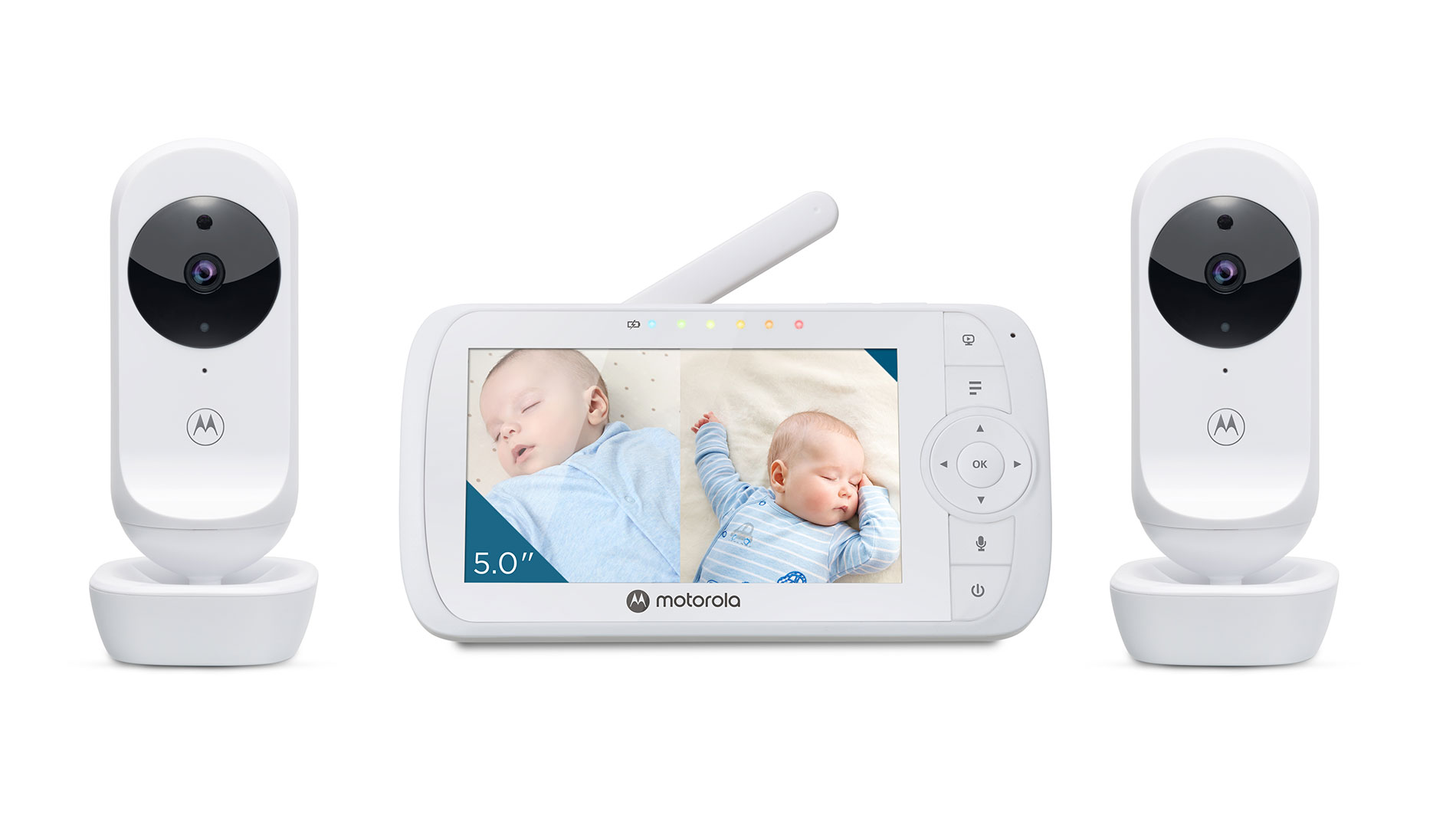
Motorola Nursery's global VM35-2 page identifies a two-camera package built around the same 5-inch parent screen as the VM35 family. It is not simply a second camera accessory name: the page calls it a two-camera pack and depicts two camera views in split-screen. The family guide names VM35-2 alongside the single-camera VM35 and other package sizes. In the standard two-camera arrangement, one receiver can show two rooms at once, which is the meaningful difference for a caregiver comparing rooms without cycling between them.
The system links camera and parent unit directly over 2.4 GHz FHSS. It does not require home Wi-Fi or a phone app for that local picture. The exact page lists two-way talk, infrared night vision, digital zoom, five lullabies, room-temperature monitoring and a sound-level indicator. Each camera still has to be positioned and powered; the family guide's standard setup connects the camera to its supplied adapter. The parent unit has a rechargeable 2,000 mAh battery and a manufacturer-claimed maximum of five hours, so moving the display between rooms is different from moving the cameras off their power leads.
Split-screen is helpful, with one important tradeoff
The 5-inch screen can keep both camera pictures visible, but two smaller panels are not the same as a full-screen close view. The manual lets the caregiver select a camera for audio while split-screen is active; it does not promise that both rooms' sounds play together. Talk-back, lullabies and the selected-camera controls also follow the chosen camera. If you need to hear two rooms simultaneously, do not infer that split-screen accomplishes that: an audio-only multi-unit monitor is a different kind of system, and a camera monitor may require choosing which room's sound is active.
The monitor's 1,000-foot range claim is a maximum, not a realistic guarantee through multiple walls. The guide warns that metal, reinforced concrete, other electronics and 2.4 GHz traffic can disrupt the connection. A direct local link is useful when you do not want to configure internet access, but it offers no away-from-home phone view. The room-temperature readout is an environmental convenience, not a measurement of the baby's health. Infrared night vision can show a monochrome image after dark; digital zoom magnifies the existing picture rather than creating a sharper one.
Choose by package, not by the family name alone
The VM35-2 suits a household where two included cameras and two visible room views are the reason to choose this version. If one nursery camera is enough, the base VM35 package is less hardware. If remote camera movement matters more than two fixed camera locations, compare a model with documented motorized pan and tilt. If you need a U.S. purchase option with two local camera pictures, Motorola's exact PIP1500-2 Twin is a separately documented package worth comparing; its own review explains its controls and operating limits. A similar model-family name is not proof that the international VM35-2 and U.S. twin kit share a SKU, included accessories or radio configuration.
This page covers the exact global VM35-2 listing as a reference. The U.S. retail identity, SKU, status and U.S. package have not been confirmed, so this review is not a U.S. buying recommendation. A current search returning no U.S. result is only a limited observation, not evidence that a U.S. sale never existed. The box shown by the global page is the two-camera variant; do not transfer its second camera to a VM35 base listing or to an unrelated suffix. Before use, follow the manual's placement rules, including keeping cameras and cords outside the crib and cords more than three feet away from a child's reach.
Key details at a glance
| Parent-unit screen | 5 in |
|---|---|
| Published display resolution | 480 × 272 pixels (manufacturer-listed) |
| Camera-to-parent-unit connection | Direct local 2.4 GHz FHSS camera-to-parent-unit link; the reviewed global page/manual do not document an app or away-from-home phone path. |
| Advertised maximum range claim | 1000 ft |
| Cameras in the reviewed kit | 2 |
| Maximum camera units supported | 4 |
More specifications and setup details
| Video rooms visible at once | 2 |
|---|---|
| Phone viewing away from home | No |
| User-replaceable parent-unit battery | No |
| Supplied camera lens setup | Fixed camera is aimed during setup; the receiver provides 2× digital zoom, not motorized steering. |
| Recommended stable operation uses home Wi-Fi | No |
| Audio-only system | No |
| Parent talk-back | Yes |
| Room-temperature readout | Yes |
| Parent-unit batteries included | Yes |
| Preloaded lullaby count | 5 |
| Included crib-mount option | No |
| Parent receivers included | 1 |
Use the exact model’s instructions for operating limits, supplied equipment and version differences.
Sources for this assessment
Check the room and the receiving setup.
Read the exact model's constraints, camera count and supervision limits before choosing a package.