
Your needs, this model
Does it fit your priorities?
Would one room picture on a five-inch local HD screen, with camera pan and tilt from the parent unit, suit your routine?
The exact standard U.S. kit includes one camera and one receiver, with a five-inch 1280 x 720 screen and local FHSS connection. It does not need Wi-Fi or an app.
Explore this need in the finder →Do you need phone access away from home or two included camera pictures at once?
The reviewed non-connected PIP1610 HD is a one-camera kit without documented remote phone access. Its manual's extra-camera slots and split-screen functions do not make extra cameras part of the standard package.
Explore this need in the finder →Is a manufacturer-verified six-hour continuous screen-on runtime essential?
No such condition is confirmed. The user guide states up to six hours of use in ideal conditions but does not specify that the screen stays on for that duration.
Explore this need in the finder →Do you require a tested 1,000-foot open-space link rather than an advertised maximum?
The product page advertises up to 1,000 feet, but the family guide has no numerical open-space range test protocol and warns about walls, metal and interference.
Explore this need in the finder →A local HD monitor with a camera you can aim from the parent unit
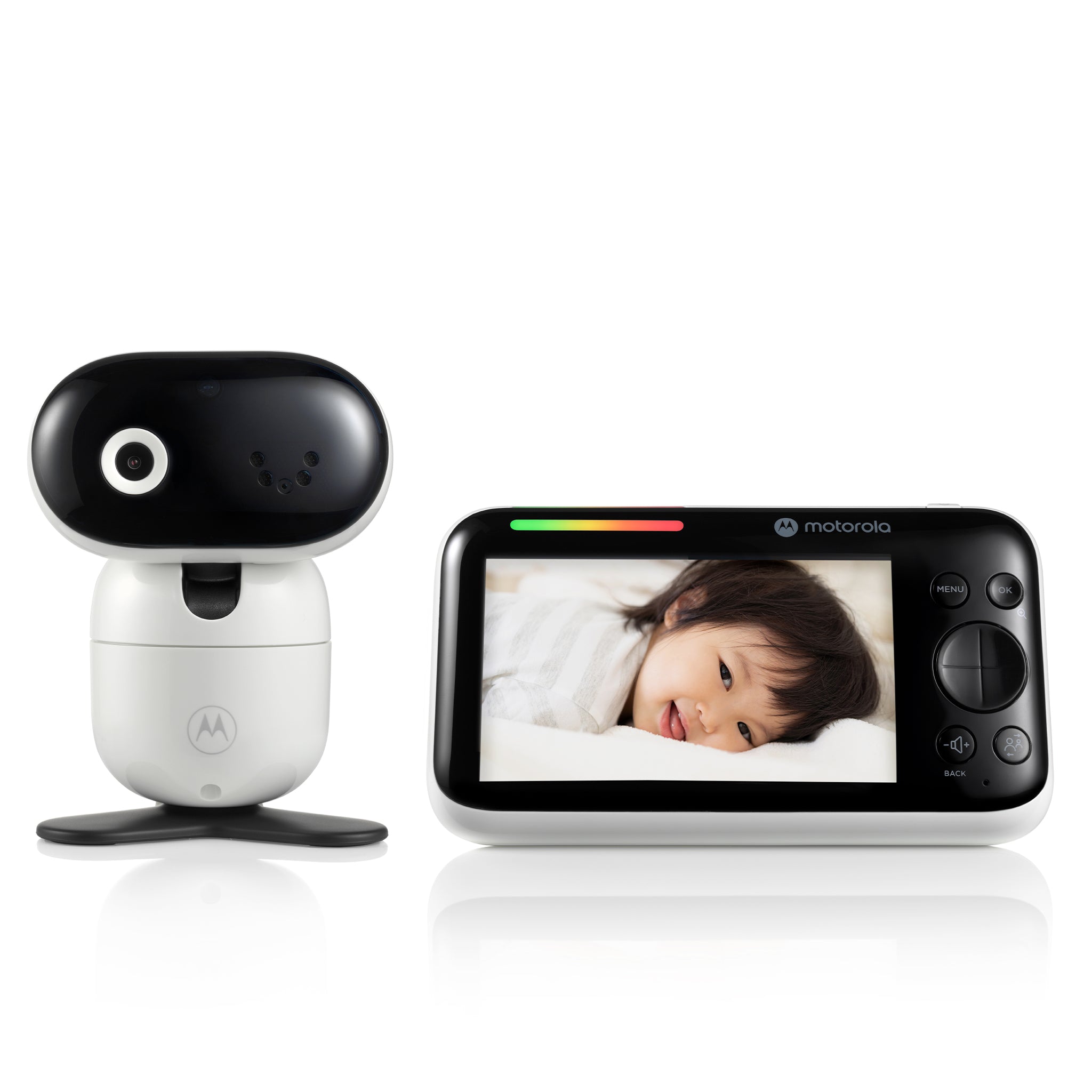
The Motorola PIP1610 HD is for a household that wants one nursery on a separate receiver and more camera control than a fixed-position unit. The U.S. shop page identifies the non-connected PIP1610 HD and lists SKU 810036772587. It is labeled a previous model while supplies last, although an Add to cart control appeared when checked on 2026-10-23. It connects directly by 2.4 GHz FHSS; the exact listing says no home Wi-Fi or app is needed. No router is required, but remote phone viewing is not documented.
The parent unit can pan and tilt the camera using its navigation control, and the screen offers 1× or 2× digital zoom. That is useful when a caregiver wants to reframe a crib or play area without moving the camera by hand. The package described on the exact U.S. page is the standard one-camera system, so it provides one room view as supplied. The user guide supports pairing as many as four camera positions and has both sequential cycling and split-screen functions, but support capacity is not the same as cameras included in the box.
Five-inch 720p detail, with simple night and sound cues
The parent screen is a five-inch IPS color display listed at 1280 × 720 pixels. In low light, infrared night vision changes the feed to black and white. Two sound-level indicators on the parent unit give a visual cue that sound is being picked up, and the receiver has a speaker-volume control. These are visual sound cues, not a documented motion alert or quantified cry-detection system. If motion notifications are essential, this exact PIP1610 HD listing and manual do not establish them; do not treat camera movement as motion detection.
The baby unit includes a temperature sensor, and the manual explains that the displayed reading turns red below 57°F or above 84°F, with LL or HH at more extreme temperatures. That is a room-temperature prompt, not a calibrated or medical measurement. The camera can play ten lullabies and ten audio books from the parent menu, and the parent display has a reminder timer. Holding the talk-back control lets the caregiver speak through the camera; while holding it, the caregiver cannot hear the baby until releasing the button.
Keep the camera powered; distinguish that from the portable receiver
The parent unit has a built-in rechargeable 3.8 V, 2,800 mAh lithium-ion polymer battery. The manual says it can provide up to six hours of use under ideal conditions and calls six hours the maximum, but it does not define a screen-on test. A strict six-hour continuous-video requirement therefore is not verified. The screen can turn off after five, 30 or 60 minutes while audio remains available, which is a different operating arrangement from leaving the display on all night. The first charge is specified as at least 16 hours, and Motorola says to contact customer service rather than try to replace the parent battery yourself.
There is an important power inconsistency for the camera: the U.S. product specifications list a built-in 1,200 mAh lithium camera battery, while the linked user guide says the camera must be plugged into its wall outlet at all times. Until Motorola clarifies those statements, plan on AC power at the camera rather than treating it as a roaming battery camera. That makes outlet position and the supplied cord part of setup. Keep camera and cable out of the crib and more than one metre (about three feet) from the child, and use only the supplied adapter.
One-camera package versus multi-camera features
The exact PIP1610 HD package contains one camera. Its family guide names separate PIP1610-2, -3 and -4 variants, supports up to four camera positions, and describes sequential cycling or split-screen after additional cameras are paired. The separate PIP1610-2 HD support image confirms a two-camera sibling, now reviewed separately as a reference model; the exact retailer page is unavailable and that older kit is not a current buying recommendation. The -3/-4 package bridges remain unresolved. Do not confuse pairing capacity with what comes in this standard one-camera box.
The product page advertises up to 1,000 feet, but the manual says walls, metal and other 2.4 GHz equipment may weaken or interrupt the link, and it supplies no numeric open-space test protocol. Treat the 1,000-foot number as an advertised maximum rather than a measured indoor promise or verified clear-line-of-sight result. Test the actual connection from the caregiver’s usual location before relying on it.
Who should choose it—and what to compare
Choose PIP1610 HD if one local camera, a larger 720p receiver, remote pan and tilt, two-way talk and no Wi-Fi setup match your routine. The camera movement is the most practical distinction from the Motorola PIP1500, whose camera is fixed and must be aimed by hand; both are local five-inch systems, but their U.S. listings specify different display resolutions. If two PIP1610 HD cameras in the box matter, read the separate PIP1610-2 HD Twin Pack reference; its split-screen pictures are documented, but dual-room sound is not, and it is not a live buying pick. For a comparable local screen with camera controls, the VTech VM5263 is another reviewed option; if phone viewing from outside home is essential, compare the connected VTech VM901HD instead.
Leave PIP1610 HD out when two cameras in the box, simultaneous two-room audio, remote phone access, an essential motion alert, a verified 1,000-foot open-space result or a guaranteed six-hour screen-on runtime is required. Those conditions are either outside this one-camera local kit or not established by its exact manual. As with every consumer monitor, use it only as an aid to responsible adult supervision and follow the full guide’s placement and cord instructions.
Sources: Motorola PIP1610 HD U.S. listing, PIP1610 HD support page, English User Guide V1, and North American Quick Start Guide V4.
Key details at a glance
| Parent-unit screen | 5 in |
|---|---|
| Published display resolution | 5.0-inch IPS, 1280 x 720 pixels per the U.S. listing and family guide |
| Camera-to-parent-unit connection | Direct local 2.4GHz FHSS camera-to-parent link; no Wi-Fi or app required and remote phone viewing is not documented |
| Advertised maximum range claim | 1000 ft |
| Cameras in the reviewed kit | 1 |
| Maximum camera units supported | 4 |
| Video rooms visible at once | 1 |
| Phone viewing away from home | No |
| User-replaceable parent-unit battery | No |
| Supplied camera lens setup | One included motorized camera with remote pan and tilt from the parent-unit navigation control; 1x/2x digital zoom. It is not documented for motion alerts. |
| Recommended stable operation uses home Wi-Fi | No |
| Audio-only system | No |
| Parent talk-back | Yes |
| Room-temperature readout | Yes |
| Parent-unit batteries included | Yes |
| Preloaded lullaby count | 10 |
| Parent receivers included | 1 |
Use the exact model’s instructions for operating limits, supplied equipment and version differences.
Sources for this assessment
- Motorola Nursery U.S. shop listing for PIP1610 HD
- Motorola Nursery product support for PIP1610 HD, productId 12288
- Motorola 5.0-inch HD Motorized Video Baby Monitor User Guide V1
- Motorola PIP1610 HD North American Quick Start Guide V4
- CPSC SaferProducts recall API exact model search for PIP1610
- Motorola Nursery exact PIP1610 HD product image from U.S. shop listing

Check the room and the receiving setup.
Read the exact model's constraints, camera count and supervision limits before choosing a package.