
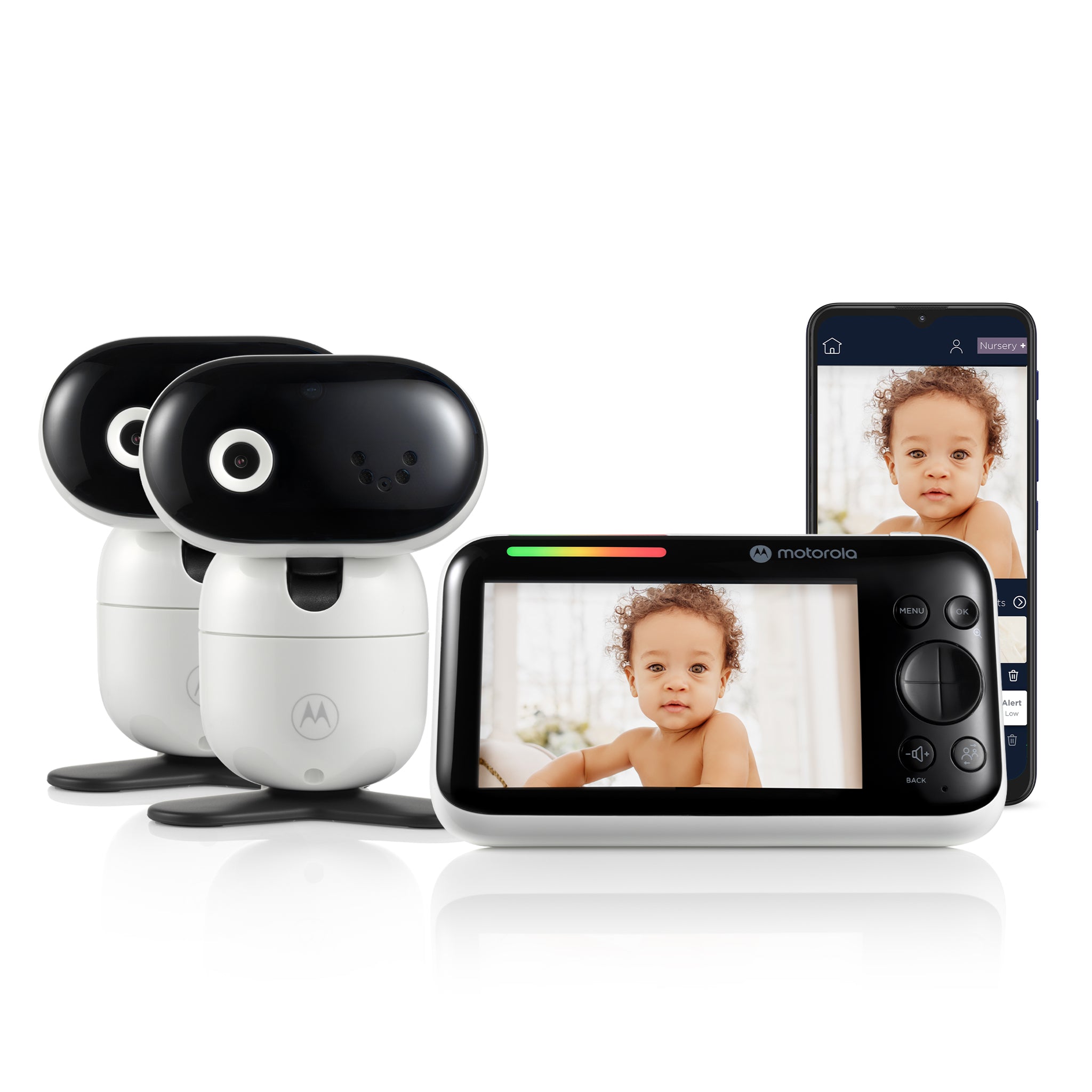
Your needs, this model
Does it fit your priorities?
Do you need two included camera pictures together on the local parent display?
The exact Twin Pack contains two cameras and the parent unit supports split-screen. The manual does not establish simultaneous audio from both rooms in split mode.
Explore this need in the finder →Would the selected-camera sound path work instead of requiring both rooms to be audible together?
The guide documents selecting and viewing an individual camera. It does not document two simultaneous room-audio feeds during split-screen.
Explore this need in the finder →Must both pictures appear at once in the phone app when away?
Phone app viewing is listed, but split-screen is documented on the parent receiver, not as a two-room app view.
Explore this need in the finder →Is remote camera movement useful across both rooms?
The U.S. page lists remote pan, tilt and zoom, and the manual documents receiver controls for movement.
Explore this need in the finder →A two-camera kit when both pictures need to be visible
The Motorola PIP1510-2 CONNECT Twin Pack is the two-camera version of the motorized PIP1510 family. Its exact U.S. listing names the Twin Pack, shows two cameras with one parent unit, and advertises split-screen viewing. That package difference matters: the one-camera PIP1510 CONNECT can pair with more cameras, but its single included camera cannot show two rooms at once. The U.S. Twin Pack page showed the offer sold out on October 23, 2026. It remains a useful model reference; stock can change, and a review does not imply that a new kit is available.
Split-screen supports two local pictures, not every two-room need
The clearest use is a caregiver who wants two nursery pictures together on the dedicated 5-inch receiver. The page specifies a color 480 × 272 display and local 2.4 GHz FHSS radio. The manual's split-screen instructions require more than one camera; this exact Twin Pack includes two. The views share the screen, so each is smaller than a full-screen camera view. When one room needs closer attention, the guide also documents selecting a camera individually or cycling through paired cameras about every 12 seconds. Motorola's family guide includes camera positions one through four, but the Twin Pack still contains only two camera units.
Do not assume the split picture means you can hear both rooms at once. Motorola documents selecting and viewing a camera and separately documents the split-screen picture. The manual does not establish simultaneous audio from two rooms in split mode, so the finder treats a two-room audio requirement as unconfirmed. For one selected room, a camera's picture and sound are documented. For a strict two-room audio requirement, a two-camera count or split-screen icon is not enough evidence.
Local viewing uses the receiver's direct radio connection; it does not need home Wi-Fi or internet. The listing claims up to 1,000 feet of radio range, but the manual warns that walls, metal and nearby 2.4 GHz equipment can reduce reception and gives no numerical open-space test method. Treat it as an advertised maximum, not a guarantee through your home's layout. Test the camera and receiver in the intended rooms before relying on them.
App access adds a network path, not a second local receiver
The camera family also supports Motorola Nursery phone-app viewing after a camera is connected to home Wi-Fi. The guide calls for an Android 7.0-or-later device or iPhone/iPad with iOS 10.0 or later and at least 0.6 Mbps upload bandwidth for each camera used for internet viewing; setup must be done on a compatible phone or tablet, not a PC. These are published manual requirements, not an assurance that a current app will still work on every older device. Each camera must remain connected to its supplied AC adapter. A two-camera package therefore means planning a safe, powered position for both units, not a portable camera setup.
Motorola advertises app motion, sound and temperature notifications and 24-hour event monitoring and streaming. The product page does not give alert thresholds or recording-retention terms. The guide does not establish that two camera feeds can be viewed simultaneously through the app, so the supported phone plan in this assessment is one selected camera at a time. The split-screen capability belongs to the parent receiver. A local screen plan and an internet-app plan should not be combined into a claim of uninterrupted service or simultaneous viewing through both paths.
The parent receiver has a built-in rechargeable 2,800 mAh battery and an up-to-seven-hour use claim in ideal conditions, not a guaranteed screen-on duration. Its display can turn off after five, 30 or 60 minutes while audio continues. The guide says the parent battery is not user-replaceable. A useful room-temperature value is displayed on the monitor, with a color change below 57°F or above 84°F; this is not a calibrated measurement. Talk-back is included, but pressing and holding the receiver's talk control temporarily prevents hearing nursery sound. Dual sound-level bars are present; an essential receiver motion alarm is not documented.
What the second camera changes in the finder
For this exact kit, camera count, simultaneous picture count and remote movement are three separate questions. The Twin Pack meets a two-camera minimum and the local two-picture split-screen choice. Each camera is motorized, so the receiver can pan or tilt the selected camera. Its local plan does not require Wi-Fi. It should not qualify for a request for two rooms' sound at once, an established split-screen phone-app setup, a numerical tested open-space range or a guaranteed screen-on battery duration: those details are not established by the page and family guide.
The one-camera PIP1510 CONNECT is the simpler purchase if you need only one room and want the same movable-camera concept. The local PIP1500-2 Twin Pack is worth comparing if two local room pictures matter but remote camera movement does not; its camera direction is fixed. The PIP1610 HD CONNECT Twin Pack is another route if its higher-resolution parent display matters more than the PIP1510's display specification. For simultaneous audio from two spaces, compare systems whose exact instructions explicitly establish that operating mode rather than inferring it from split-screen video. Use the PIP1510 family comparison to check the one-camera and two-camera packages side by side.
Key details at a glance
| Parent-unit screen | 5 in |
|---|---|
| Published display resolution | 5-inch color parent display, 480 x 272 pixels (U.S. listing); app camera video up to HD 720p is a separate manufacturer claim. |
| Camera-to-parent-unit connection | Two separate routes: direct local 2.4 GHz FHSS to the parent unit, or camera connected to home Wi-Fi for Motorola Nursery app viewing. The local receiver plan does not need Wi-Fi; away-from-home app access needs Wi-Fi and internet. |
| Advertised maximum range claim | 1000 ft |
| Cameras in the reviewed kit | 2 |
| Maximum camera units supported | 4 |
| Video rooms visible at once | 2 |
| Phone viewing away from home | Yes |
| User-replaceable parent-unit battery | No |
| Supplied camera lens setup | Motorized camera with remote pan/tilt and 1x/2x digital zoom; infrared night vision. |
| Recommended stable operation uses home Wi-Fi | Yes |
| Audio-only system | No |
| Parent talk-back | Yes |
| Room-temperature readout | Yes |
| Parent-unit batteries included | Yes |
| Preloaded lullaby count | 10 |
| Parent receivers included | 1 |
Use the exact model’s instructions for operating limits, supplied equipment and version differences.
Sources for this assessment
- Motorola Nursery U.S. PIP1510-2 CONNECT Twin Pack listing
- Motorola Nursery PIP1510-2 CONNECT Twin Pack product record
- Motorola Nursery PIP1510-2 CONNECT support page
- Motorola PIP1510 CONNECT English User Guide V3 (covers PIP1510-2)
- Motorola PIP1510 CONNECT North American/US Quick Start Guide V6 (covers PIP1510-2)
- Motorola exact PIP1510-2 CONNECT Twin Pack U.S. image
- CPSC SaferProducts exact-name PIP1510-2 CONNECT query

Check the room and the receiving setup.
Read the exact model's constraints, camera count and supervision limits before choosing a package.