
Your needs, this model
Does it fit your priorities?
Must two room pictures be visible together on a local parent screen, with both cameras included?
The exact PIP1500-2 U.S. twin package has two cameras and Motorola's manual documents split-screen display for multiple cameras. Cycling is a separate sequential mode.
Explore this need in the finder →Must both room sounds be audible simultaneously whenever both pictures are displayed?
The manual confirms simultaneous split-screen pictures but does not establish simultaneous two-room audio. Unknown audio behavior cannot meet this essential need.
Explore this need in the finder →Can one camera be selected for a single-room parent view with talk-back and temperature information?
Yes. The exact kit can select one camera; the user guide documents talk-back and a temperature reading for the camera in use.
Explore this need in the finder →The twin pack changes the number of pictures, not the connection
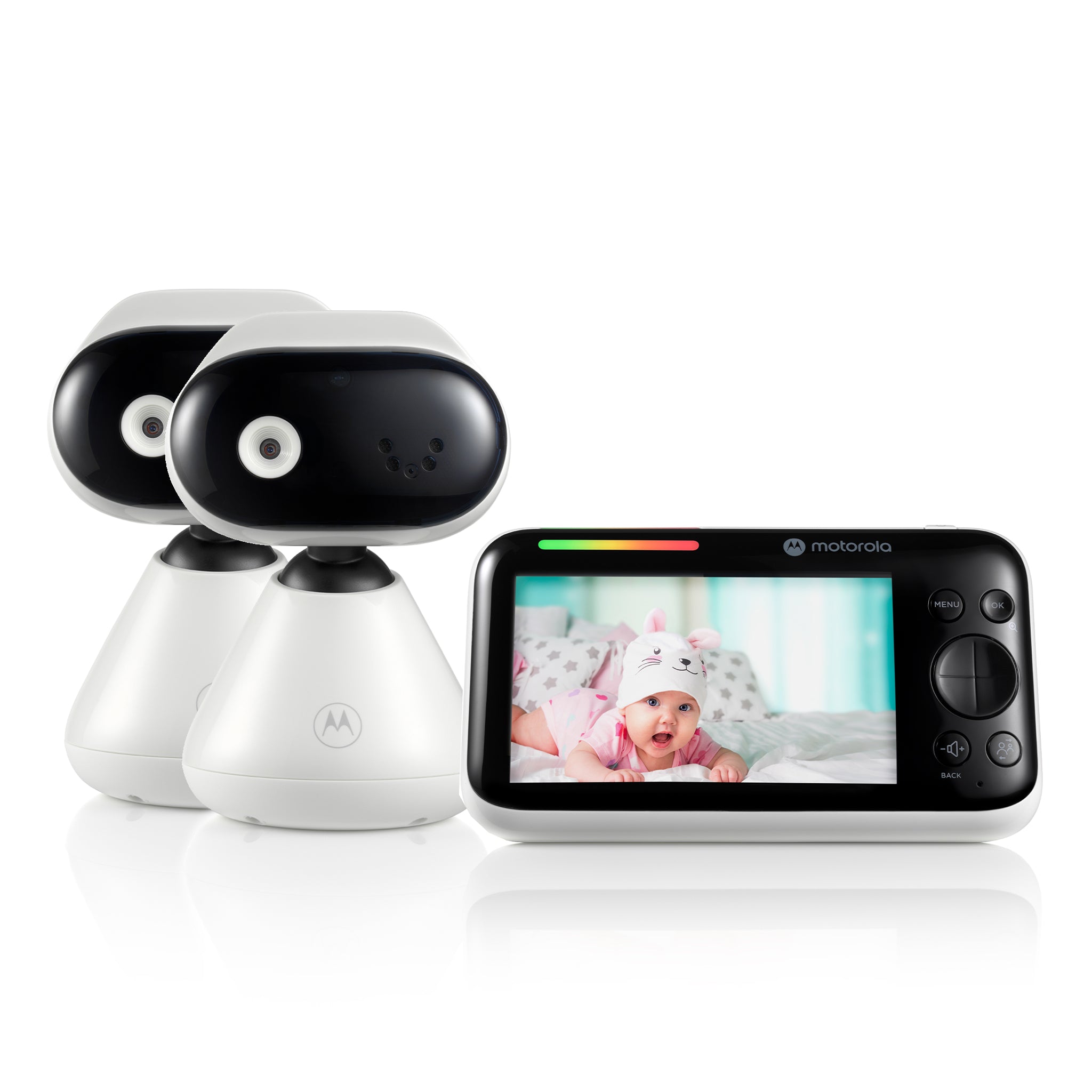
The Motorola PIP1500-2 Twin Pack is the two-camera package for households that need two nursery pictures available on one dedicated parent screen. Its exact U.S. listing is titled “PIP1500-2 TWIN PACK”; the product data identifies SKU 810036772815, and the listing showed Sold Out on 2026-10-23. That stock status may change, but the separate model is still useful to compare against the single-camera PIP1500. This review does not treat the second camera as a loose add-on or count it toward the standard PIP1500 package.
Both cameras connect directly to the parent unit through Motorola’s 2.4 GHz FHSS system. The U.S. listing says the pack does not need Wi-Fi or an app, so it is a local receiver setup rather than a phone feed that follows you away from home. The main payoff is the included second camera: Motorola advertises split-screen viewing for two rooms or babies side by side. The manual also allows viewing multiple registered cameras on screen, with a separate camera-cycling mode that changes the pictured room about every 12 seconds. Split-screen and cycling are not the same choice; use split when both pictures matter at once, and expect cycling to show one camera at a time.
Two pictures are verified; two simultaneous audio feeds are not
The exact two-camera listing and the shared PIP1500-family manual agree that multiple cameras can be displayed together. The manual’s split-screen section explains the multiple-picture view, while its camera-selection section separately explains selecting a camera. It does not say that sound from both rooms is audible simultaneously in split-screen mode. The product has a speaker and talk-back, and a single-camera view carries nursery sound, but that is not enough evidence to promise both room sounds at once. If simultaneous dual-room audio is essential, do not count PIP1500-2 as a confirmed match on that point. Motorola’s PIP15-2 MULTI is audio-only but has a manual-documented mode for hearing both rooms at the same time; the Infant Optics DXR-8 PRO SS has a manual-documented split view and dual-audio arrangement.
For a finder questionnaire, choose “two rooms visible at once” if split pictures are the requirement. A separate “two rooms audible at once” requirement should remove this model because that exact mode is undocumented. This is precisely where a two-camera kit label can mislead: two cameras establish the equipment count, not every way the receiver combines their audio.
Same receiver details, with a resolution mismatch to keep visible
The receiver is a five-inch color screen with two LED sound-level indicators, zoom, adjustable display brightness, volume control, talk-back, and room-temperature information. Infrared night vision turns the image black and white in low light. The camera aims by hand and has a manual-described 1×/2× display zoom; there is no documented remote pan-and-tilt motor. The temperature reading changes red below 57°F or above 84°F and changes to LL or HH outside the manual’s extreme limits. It is a basic room reading, not a calibrated health or sleep-safety sensor. Five lullabies or soothing sounds are available from a camera unit.
There is a genuine published-resolution conflict: the U.S. shop page says 480 × 272 pixels, while Motorola Nursery’s global PIP1500 page calls the display 720p. The English model-family guide gives a 0.3-megapixel camera sensor but no numeric screen resolution. The more specific U.S. listing is the value shown in this assessment, with the discrepancy stated rather than silently upgraded to 720p. If image detail or low-light performance is a hard requirement, compare the exact display and camera evidence, not only the headline.
Plan for three powered units and a portable—but finite—receiver
Each baby camera needs its supplied AC adapter and remains plugged in for use. The parent display has a built-in rechargeable 3.8 V, 2,800 mAh lithium-ion battery. The manual estimates up to seven hours of usage in ideal conditions, but does not specify a screen-on runtime condition. It offers 5-, 30- and 60-minute screen-off settings; audio continues after the display goes dark. Treat that setting as a screen-saving option, not proof of full-time video duration. Charge the receiver continuously for at least 16 hours before first use. The guide says the battery loses capacity over time and advises contacting support rather than attempting a replacement.
Motorola’s U.S. page states up to 1,000 feet, but the manual provides no numerical open-space test protocol and warns that walls, metal and other 2.4 GHz devices can weaken the radio link. Test the system at the planned receiver position, especially between floors or around dense walls. A quoted maximum is not a guarantee for a specific house.
Is split-screen the right way to follow two rooms?
Choose this twin pack if the dedicated receiver must show both camera images at once, and you can accept the local-only link and the manual’s silence about simultaneous two-room audio. Select the two-camera exact package rather than the single PIP1500 if both cameras need to be present from the start. If one room is enough, the single PIP1500 is the less elaborate package. If a phone must receive video away from home, choose an exact app-connected model. If sound from two rooms must stay open together, compare Motorola PIP15-2 MULTI; if the must-have is both split pictures and dual audio, check the exact Infant Optics DXR-8 PRO SS manual instead.
Keep both camera bodies and cords outside the crib and more than one metre (about three feet) from the child. Position the parent unit at least three to six feet from a baby unit to reduce feedback, and use the supplied power adapters. The monitor is an aid and does not replace adult supervision.
Sources: Motorola PIP1500-2 U.S. listing, PIP1500 support page, English User Guide V1, and North American Quick Start Guide V5.
Key details at a glance
| Parent-unit screen | 5 in |
|---|---|
| Published display resolution | 480 x 272 pixels in the U.S. shop specification; the global product page says 720p, while the shared guide omits display resolution |
| Camera-to-parent-unit connection | Direct local 2.4 GHz FHSS camera-to-parent connection; no Wi-Fi or app needed; no remote phone viewing documented |
| Advertised maximum range claim | 1000 ft |
| Cameras in the reviewed kit | 2 |
| Maximum camera units supported | 4 |
| Video rooms visible at once | 2 |
| Phone viewing away from home | No |
| User-replaceable parent-unit battery | No |
| Supplied camera lens setup | Fixed camera positions adjusted by hand; parent screen offers 1x/2x digital zoom, not documented remote pan or tilt |
| Recommended stable operation uses home Wi-Fi | No |
| Audio-only system | No |
| Parent talk-back | Yes |
| Room-temperature readout | Yes |
| Parent-unit batteries included | Yes |
| Preloaded lullaby count | 5 |
| Parent receivers included | 1 |
Use the exact model’s instructions for operating limits, supplied equipment and version differences.
Sources for this assessment
- Motorola Nursery U.S. listing, PIP1500-2 Twin Pack
- Motorola Nursery product support, PIP1500 model family, support productId 8615
- Motorola 5.0-inch Video Baby Monitor User Guide V1, includes PIP1500-2
- Motorola PIP1500 North American Quick Start Guide V5
- Motorola Nursery PIP1500 video baby monitor product page
- Motorola Nursery exact PIP1500-2 TWIN PACK image from U.S. product page
- CPSC SaferProducts exact-name response for Motorola PIP1500-2

Check the room and the receiving setup.
Read the exact model's constraints, camera count and supervision limits before choosing a package.