
Your needs, this model
Does it fit your priorities?
Do you need to hear two nursery rooms at the same time without needing a camera picture?
Yes. The exact two-baby-unit kit and manual support hearing both connected rooms together when you select all units. It can also focus on one unit or cycle between them, but cycling is one feed at a time and there is no video image.
Explore this need in the finder →Would one parent unit with talk-back and a temperature readout for two audio rooms fit your routine?
Yes. The parent menu supports talk-back and temperature display for the selected PIP15 MULTI units. High/low thresholds apply across all units rather than being set separately for each room; none of these readings is medical monitoring.
Explore this need in the finder →Does its manual-stated clear-line-of-sight maximum meet a 1,500-foot outdoor threshold?
The English North American guide states up to 1,500 feet outdoors in clear line of sight, but Motorola's U.S. page has a conflicting 1,000-foot specification block. Treat 1,500 feet as a stated maximum, not a household guarantee; the listing inconsistency is important if this numeric threshold is essential.
Explore this need in the finder →A two-room audio kit, not a video monitor
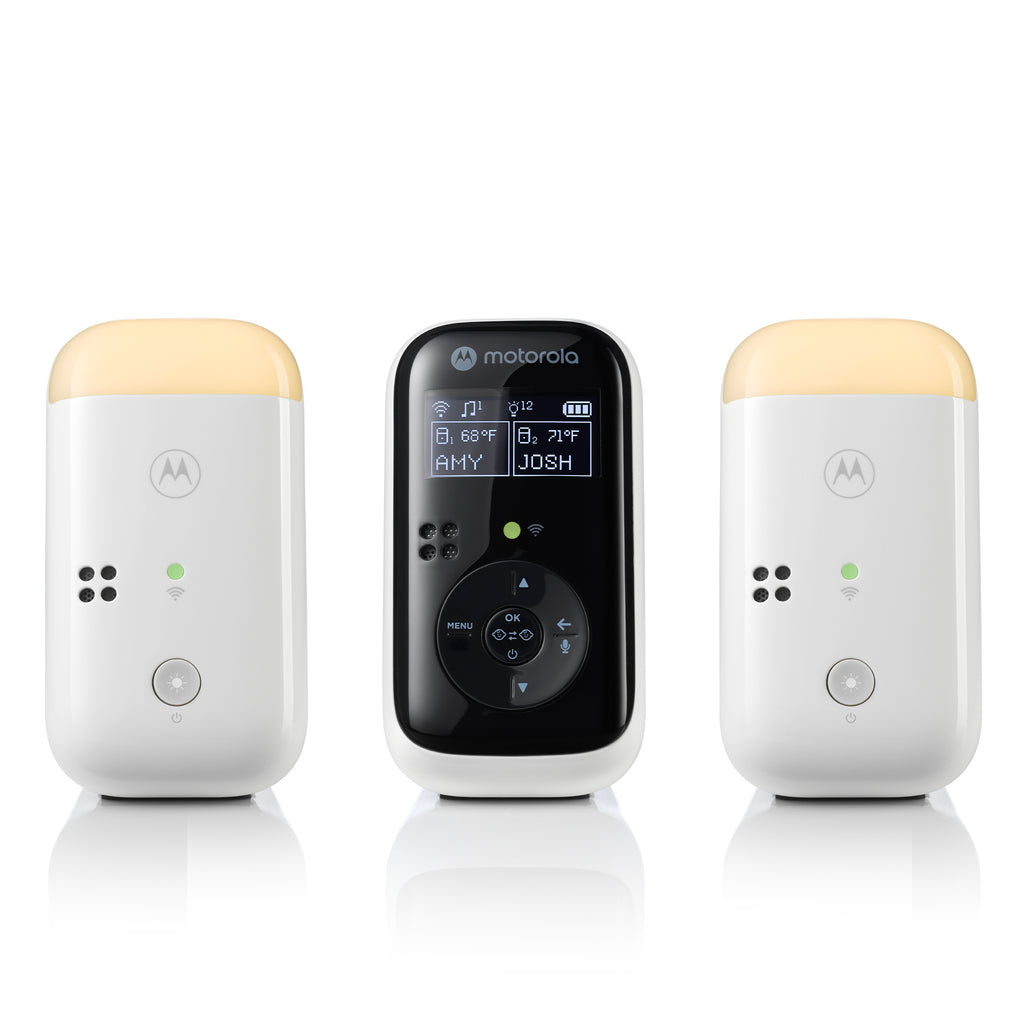
The Motorola PIP15-2 MULTI suits a household that wants one parent receiver to keep two nurseries audible at once, without a camera picture or Wi-Fi. The U.S. listing specifies two baby units and one parent unit; the manuals describe hearing both rooms, selecting one, or cycling between connected units. Its LCD shows status and temperature information, not either room.
That distinction matters when filling out a finder. Choose audio-only if sound meets the need. Requiring a picture should remove this model even though its parent unit has an LCD. If two separate room feeds must remain audible together, PIP15-2 has a documented operating mode for that. Cycling instead gives the receiver a 15-second turn on each selected unit, so it is not equivalent to simultaneous sound.
One receiver can listen to both rooms or focus on one
The exact PIP15-2 MULTI support listing connects to the PIP15 MULTI English V6 User Guide and North American V1 Quick Start Guide. Those guides describe selecting an individual baby unit, all connected units, or a cycling mode that changes the selected feed every 15 seconds. The current U.S. product page says its package has two baby units and one parent unit. The manuals say the PIP15 family can register up to four baby units, but that expandable ceiling should not be mistaken for four units in this kit; extra units require their own purchase and setup.
For two-room use, put the parent unit in the area where a caregiver can hear it, then explicitly select both baby units before relying on simultaneous sound. The receiver can also target one unit for parent talk-back, then return to listening. The manuals describe the 1.5-inch LCD, but not a camera feed, video alert or phone view. Motorola identifies the wireless link as DECT and says this arrangement does not require Wi-Fi or an app. It is a local receiver system rather than a way to check a room from outside the home.
Useful controls, with limits to the temperature and sound prompts
The unit controls include parent-to-baby talk-back, a five-level volume setting, mute, a room-temperature reading for each connected baby unit, and a high- or low-temperature beep option. The temperature warning limits are 57°F to 102°F (14°C to 39°C); the selected high and low thresholds apply across all baby units instead of being tuned separately room by room. A consumer monitor's temperature display is a convenience reading, not a calibrated medical measurement.
The parent menu can start one of five lullabies on a selected baby unit and set its volume and play duration. The baby unit's light has off, low, medium and high settings. Voice activation has four sensitivity levels or can be turned off; with sound alert enabled and the speaker muted, the parent can beep for detected sounds. These are convenience controls, not a judgement about a child's condition. Holding talk-back replaces listening; it is not a simultaneous two-way conversation.
Portable batteries do not remove the charging routine
Each unit takes rechargeable AAA NiMH cells, and the North American guide shows USB-C power adapters and cables for the parent and baby units. On the two-baby-unit setup, the guide's technical table estimates about nine hours of parent-unit battery use, versus twelve hours when a single baby unit is connected. A nursery unit is listed at nine to fourteen hours depending on whether its night light and lullaby are running. Those are manufacturer conditions, not a measured guarantee for an aging battery, chosen volume or particular listening pattern. Motorola asks for a continuous 16-hour first charge and about eight to ten hours for later charging.
That makes this more flexible to carry from room to room than a monitor that must always stay on its adapter, but three portable units mean three batteries to charge and keep in service. If the monitor will spend most of its life beside outlets, portable cells may be less important than keeping the adapters accessible. The manuals warn to use the supplied adapters and keep cords more than one metre (about three feet) from a child and out of the cot.
Range claims need a floor-plan check
The North American User Guide specifies up to 1,500 feet outdoors with a clear line of sight and warns that obstructions reduce the range significantly. Motorola's U.S. listing repeats 1,500 feet in its feature copy, while its product-specification block says up to 1,000 feet. Because that same listing gives two figures, treat neither as a prediction for an indoor nursery; the manuals do not promise how the radio will behave through a particular set of walls or floors. Check the link from the place where the parent unit will actually be used.
The manual recommends at least two metres (about six feet) between parent and baby units to reduce feedback, and more than one metre between a baby unit and a child. Keep cords out of reach and follow the setup directions. A monitor is an aid, not a substitute for responsible adult supervision.
When to choose a simpler audio pair—or a camera kit
Among Motorola's reviewed audio products, PIP15-2 is the one for the specific two-room simultaneous-audio requirement. The PIP12 TRAVEL is a smaller one-baby-unit travel set with a pouch and magnetic design; it adds portability but does not document a second nursery feed. PIP11 also handles one included baby unit and adds a temperature display, talk-back, lullabies and night light, so it is a more appropriate fit if only one room needs listening. If a caregiver needs to see both rooms, an audio-only PIP15-2 is the wrong format; compare a video kit such as Infant Optics DXR-8 PRO SS instead, then check the exact picture and audio modes.
For the model and connection details, consult the Motorola PIP15-2 U.S. listing, the PIP15-2 MULTI support page, the English User Guide V6, and the North American Quick Start Guide V1.
Key details at a glance
| Camera-to-parent-unit connection | Local DECT radio connection; no Wi-Fi or app required and no camera picture or remote phone view documented |
|---|---|
| Manufacturer-stated open-space range | 1500 ft |
| Advertised maximum range claim | 1500 ft |
| Cameras in the reviewed kit | 0 |
| Maximum camera units supported | 0 |
| Video rooms visible at once | 0 |
| Phone viewing away from home | No |
| User-replaceable parent-unit battery | Yes |
| Recommended stable operation uses home Wi-Fi | No |
| Audio-only system | Yes |
| Parent talk-back | Yes |
| Room-temperature readout | Yes |
| Parent-unit batteries included | Yes |
| Preloaded lullaby count | 5 |
| Parent receivers included | 1 |
Use the exact model’s instructions for operating limits, supplied equipment and version differences.
Sources for this assessment
- Motorola Nursery U.S. shop listing, PIP15-2 Audio Baby Monitor, 2 Baby Units for Two Rooms
- Motorola Nursery Product Support, PIP15-2 MULTI, support productId 12654
- Motorola PIP15 User Guide English V6, shared manual family PIP15/PIP15-2 MULTI/PIP15-3 MULTI/PIP15-4 MULTI
- Motorola PIP15 MULTI North American Quick Start Guide English V1
- Motorola Nursery PIP15-2 MULTI product page
- Motorola Nursery official exact PIP15-2 MULTI image from current U.S. listing
- CPSC SaferProducts recall API exact-name response for Motorola PIP15-2 MULTI

Check the room and the receiving setup.
Read the exact model's constraints, camera count and supervision limits before choosing a package.