
Your needs, this model
Does it fit your priorities?
Is a portable sound-only link enough when you also want a parent talk-back button?
Yes. The PIP12 TRAVEL sends one local audio feed to its parent receiver and documents two-way talk. It cannot provide a camera picture or remote phone view.
Explore this need in the finder →Would its published clear-line-of-sight range meet your open-space minimum?
Motorola's English guide specifies up to 450 metres (1,500 feet) outdoors in clear line of sight. Walls and other obstructions reduce range, so this does not promise 1,500 feet inside a home.
Explore this need in the finder →Can one PIP12 TRAVEL package cover two rooms that must be audible at the same time?
No. The reviewed North American package includes one baby unit and one parent receiver, and the exact manuals document a one-link arrangement rather than simultaneous sound from two nurseries.
Explore this need in the finder →A small local audio pair, packed for trips
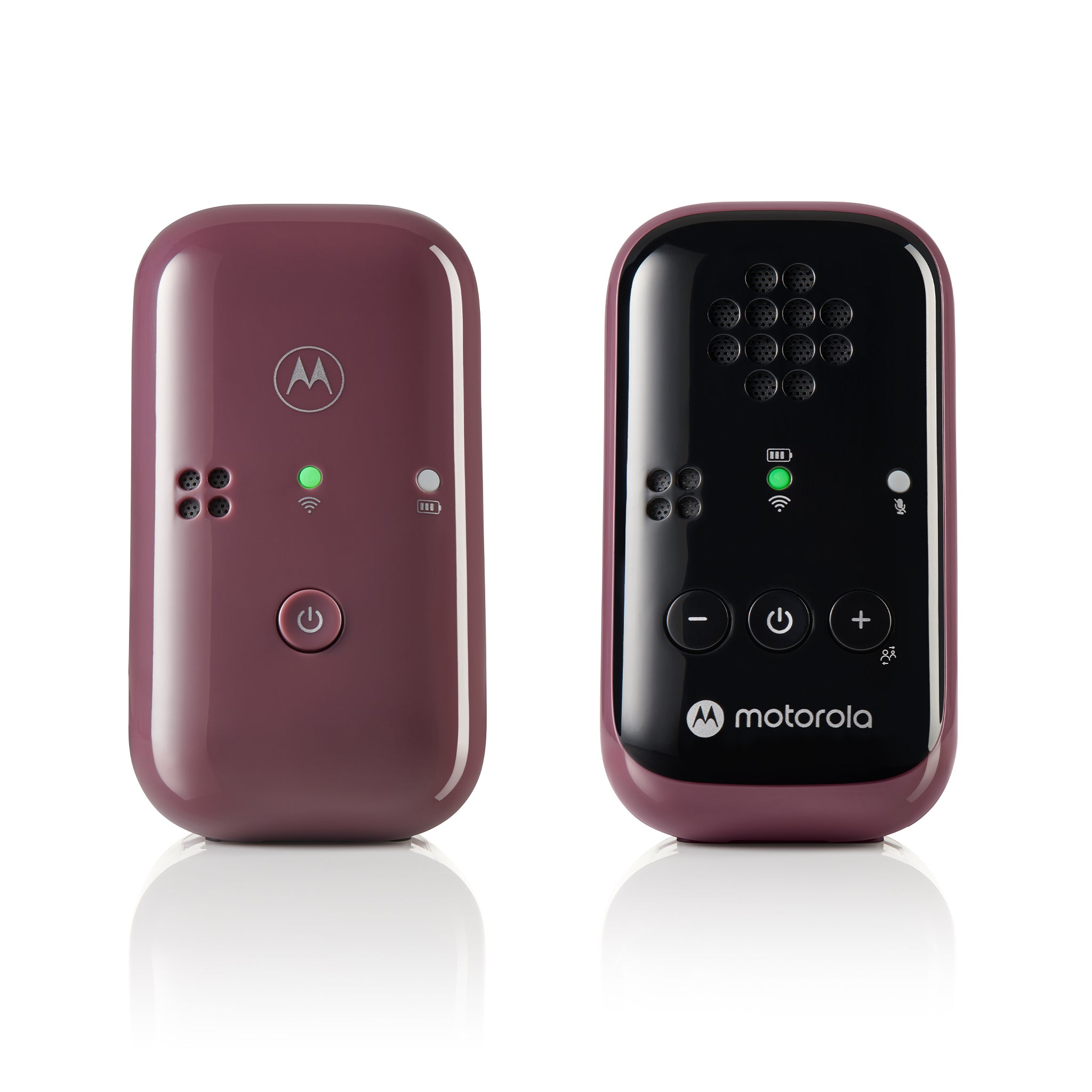
The Motorola PIP12 TRAVEL is an audio-only monitor for a household that wants a baby-unit sound feed on a dedicated, battery-powered parent receiver without setting up an app or joining home Wi-Fi. The current U.S. listing describes two-way talk and a water-resistant travel pouch; the manufacturer’s support page identifies the exact model as PIP12 TRAVEL, reference 810036773676. It is a compact travel-oriented sibling to Motorola’s PIP10 and PIP11, not a camera system. There is no picture to check, parent video screen, or phone view away from the receiver.
The matching baby and parent units attach magnetically for carrying and are designed to switch off when brought together, according to Motorola’s product support description. They must be detached before operation. This neat packing arrangement makes the pair easier to put away than two loose boxes, but the magnet is not a charging dock: the user guide warns that the units will not charge while magnetically attached. The pouch is for storing the equipment; Motorola describes it as water-resistant, not the monitor itself as safe to operate in wet conditions.
What the parent unit can and cannot do
The receiver has five volume levels and a mute control. If you mute it, the parent-unit indicator flashes red when the baby unit detects a loud sound. That gives you a visual prompt while listening is muted, not a video view or a separate phone notification. The two-way talk control works by holding the plus button while speaking through the parent microphone, then releasing it. That can make a quick voice response possible from the next room, but it is still a simple one-to-one radio monitor rather than a phone intercom or a continuous conversation system.
The manufacturer states up to 1,500 feet (450 metres) outdoors with clear line of sight. The same guide warns that obstructions reduce range significantly. Treat that number as an ideal open-space maximum, not a promise across walls, floors, or a hotel corridor. The meaningful test is whether the parent receiver keeps its link from the place where an adult will actually use it. The PIP12 also has an out-of-range indicator and a low-battery warning, but neither changes the fact that a lost radio link is possible.
If your questionnaire says sound alone is enough, the PIP12 can remain a candidate; if a camera image is essential, it should disappear rather than count as a weaker video choice. A requirement for two rooms to be audible simultaneously also rules it out: the reviewed package has one baby unit and one parent receiver, and its manual documents one linked audio feed. It should not be mistaken for a two-room kit because the units can be separated or because a different monitor in the Motorola range has a multi-room name.
Battery preparation is part of travel preparation
The North American quick-start guide lists a baby unit, parent unit, drawstring pouch, two USB-C power adapters with cables, four rechargeable NiMH AAA cells, and the guide. The cells are split between the two units, two per unit. Both units can run from their rechargeable cells or the supplied adapters, but the manufacturer says the batteries must remain installed even when an adapter is connected. Charge the separated units for 16 hours before first use; Motorola’s battery guidance says later charging takes about eight to ten hours and a full charge should provide up to ten hours of use under normal conditions. Cell age and use affect that estimate, so it is not a fixed overnight-runtime guarantee.
This arrangement is convenient if you want a portable parent receiver and a baby unit that can be used away from a fixed nursery setup. It also asks for more preparation than a one-cable audio monitor: both devices need charged cells, the first charge is lengthy, and the magnetic pair must be separated during charging. Keep the supplied cords more than one metre (about 3.3 feet) from the child and never place the unit or cord in a cot. Check the link and controls before relying on them in a new room.
Choose it over a simpler or more feature-rich audio set
Compared with the PIP10, the PIP12 adds documented talk-back and a travel-oriented rechargeable pair with a pouch; the PIP10 is the simpler sound receiver and its guide gives more explicit indoor and line-of-sight range figures. The PIP11 also adds talk-back, but its extra appeal is a parent LCD with room-temperature information, five lullabies and a night light. The PIP12’s controls are more travel-focused, not more informative: there is no temperature readout or soothing-light feature confirmed for this model. The AM21 is another plain local audio alternative, with a different power arrangement and fewer documented feature claims. None of these audio-only systems satisfies a need to see the room.
For matching, PIP12 is a positive fit when the selected view is audio-only, one nursery feed is enough, and a parent talk-back control is wanted. Requiring talk-back should exclude the simpler PIP10 and AM21, while an essential temperature display points instead toward the PIP11. An open-space minimum up to the manual’s 1,500-foot figure can fit its published claim; a greater threshold should reject it, and no figure guarantees reception indoors. A need for remote phone access, a screen, two simultaneous audio rooms, or a numeric screen-on runtime is not met by this PIP12 package.
Finally, a monitor is only an aid. It does not replace responsible adult supervision or safe-sleep practice. The unit and its cord belong outside the cot and beyond a child’s reach; the travel pouch and compact size do not change those placement rules.
Key details at a glance
| Camera-to-parent-unit connection | Direct local radio connection; the exact U.S. guide specifies 1921.536–1928.448 MHz; no Wi-Fi, app or camera picture in the reviewed package |
|---|---|
| Manufacturer-stated open-space range | 1500 ft |
| Advertised maximum range claim | 1500 ft |
| Cameras in the reviewed kit | 0 |
| Maximum camera units supported | 0 |
| Video rooms visible at once | 0 |
| Phone viewing away from home | No |
| User-replaceable parent-unit battery | Yes |
| Recommended stable operation uses home Wi-Fi | No |
| Audio-only system | Yes |
| Parent talk-back | Yes |
| Parent-unit batteries included | Yes |
Use the exact model’s instructions for operating limits, supplied equipment and version differences.
Sources for this assessment
- Motorola Nursery U.S. shop listing, PIP12 Travel Portable Audio Baby Monitor with Travel Pouch
- Motorola Nursery Product Support, PIP12 TRAVEL, reference 810036773676
- Motorola PIP12 TRAVEL User Guide, English V4.1
- Motorola PIP12 TRAVEL Quick Start Guide, English North America V1.5
- Motorola Nursery official exact-model PIP12 TRAVEL image
- CPSC public recall API exact-name response for Motorola PIP12 TRAVEL

Check the room and the receiving setup.
Read the exact model's constraints, camera count and supervision limits before choosing a package.