
On this page
Your needs, this model
Does it fit your priorities?
Do you want a local picture on a dedicated screen without relying on home Wi-Fi?
The exact HB66pro product page describes a 2.4 GHz FHSS video monitor that does not need Wi-Fi for its parent-display view; it does not document an away-from-home phone path.
Explore this need in the finder →Is one camera in the box enough, and must two views stay live together?
The monitor-only HB66pro SKU has one included camera. The family manual describes sequential scanning of added cameras, not concurrent pictures.
Explore this need in the finder →Would a 3.2-inch screen with remote camera control and temperature alerts meet your room plan?
The product page lists a 3.2-inch display, remote pan/tilt, two-way talk, and a temperature sensor; FCC family instructions give temperature alerts. No pixel resolution or screen-on battery runtime is established.
Explore this need in the finder →A compact local-video system with one camera in the base kit
HelloBaby’s HB66pro is a dedicated-screen monitor for a parent who wants a camera picture without adding a router, app account or phone connection to the room setup. The exact U.S. listing identifies the selected monitor-only SKU as HB66pro and describes a 3.2-inch receiver, a direct 2.4 GHz FHSS link, night vision and remote camera movement. One camera is included in that base choice. A phone-away view is not described, so this is a poor match if checking in from work or another building is essential.
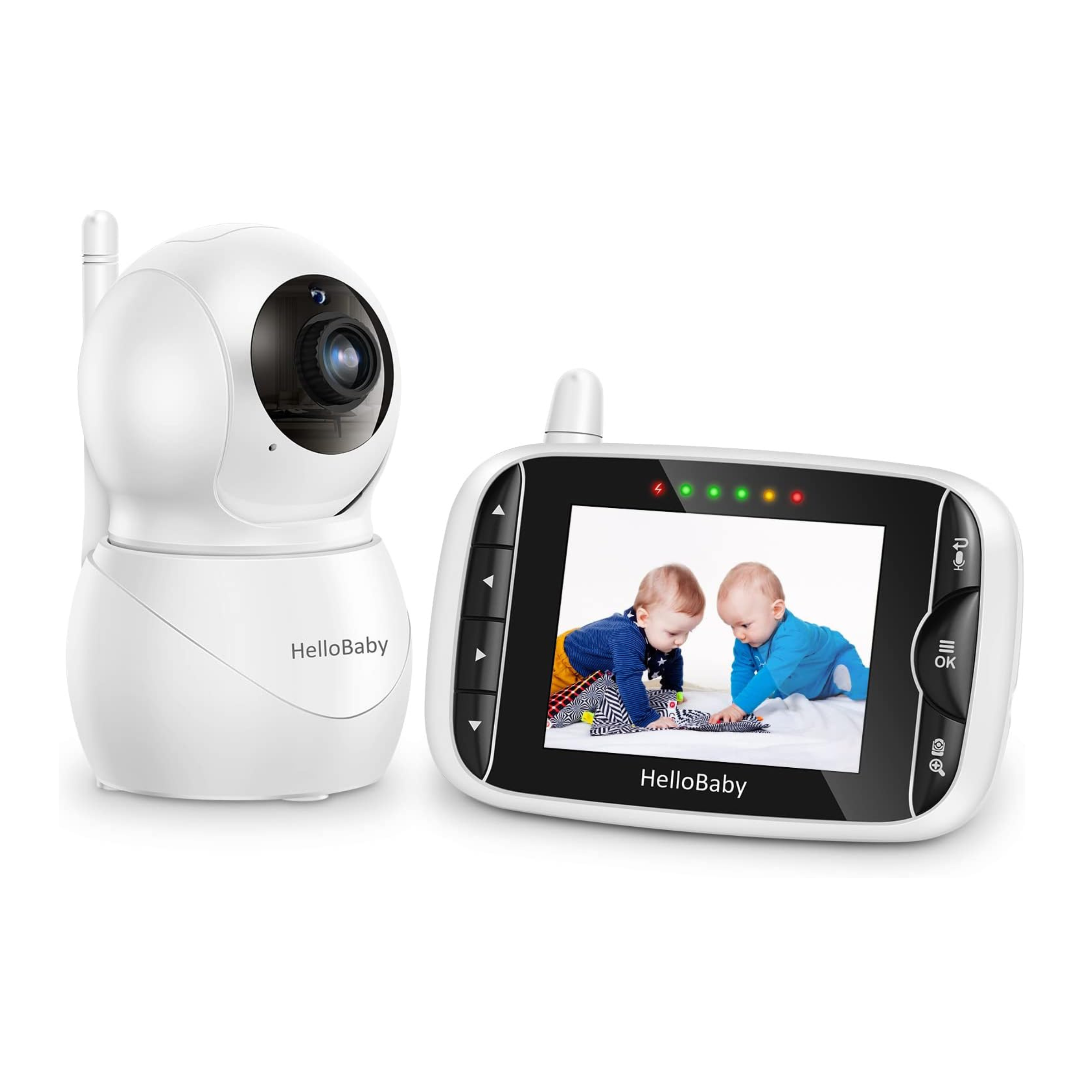
Image source and model notes
The screen is small compared with HelloBaby’s five- and six-inch local systems. That can suit a bedside table or a parent who carries a light receiver, but it is a real tradeoff if you want a room-wide picture at a glance. The model-family manual filed with the FCC lists a 3.2-inch IPS TFT display and directional camera controls. A manufacturer model-difference declaration names HB66Pro in the same electronics family as the manually documented HB6532. No numeric pixel resolution is given, and a larger screen elsewhere in the range does not prove that a different camera has higher resolution.
Remote framing is useful, but multiple cameras do not mean multiple live pictures
HelloBaby advertises pan, tilt and 2x zoom on the HB66pro page, with a 355-degree pan figure. Those are useful controls when a camera is fixed in a corner and the parent unit stays close by. The sibling HB66Pro-2 product page advertises 310 degrees instead; the family manual confirms remote directional control but gives no angle. I would not use that marketing-number difference alone to choose between these two listings. The manual describes scanning between camera units in sequence, around ten seconds per view, not a split-screen arrangement. The HB66pro page says the system supports up to four cameras, but the monitor-only kit still starts with one and the exact number of add-ons needed depends on how many rooms you want covered.
Local transmission helps keep the basic viewing plan independent of home Wi-Fi. It also means there is no documented phone notification or remote network view to fill in when you leave the house. Keep expectations tied to that plan: a 1,000-foot range is a manufacturer’s open-air ceiling, not a prediction for a home with walls. The FCC-filed family manual gives a more useful reference point—up to 165 feet indoors—and warns that construction and interference affect the radio link.
Helpful sound and temperature controls, with clear limits
The page lists two-way talk, eight lullabies, a sound-activated LED and VOX, which turns the screen back on when sound passes a sensitivity threshold. The manufacturer’s copy uses the phrase “crying recognition,” but the manual describes a sound threshold and selectable sensitivity levels. I treat this as sound-triggered screen behavior, not a verified cry classifier, breathing monitor or phone alert. The manual also notes that the parent speaker is muted while talk-back is held, a practical detail if you expect to hear the room continuously while speaking.
The camera’s temperature sensor and the parent unit’s high/low alert settings are useful for a quick room reference. The family manual gives adjustable alert ranges and describes a displayed temperature; that does not establish thermometer accuracy or make the unit a clinical device. The same manual says up to six hours for the parent battery, but it does not define screen brightness, VOX use or continuous screen-on runtime. The camera itself uses an adapter. Treat the battery figure as a manufacturer claim, not a guarantee of an overnight picture.
What the stand option changes
HelloBaby offers the HB66pro as monitor-only or with a camera stand, and a separate product page lists the stand package under its own product ID. That package keeps the same one-camera monitor identity; it does not turn the HB66pro into a different camera-count system. The listing image shows a flexible mount, but the page gives no dimensions or supported crib-rail range. Check the actual bundle contents and do not assume the mount is suitable for a particular rail or safe placement. The separate two-year warranty-service choice changes the service term, not the hardware.
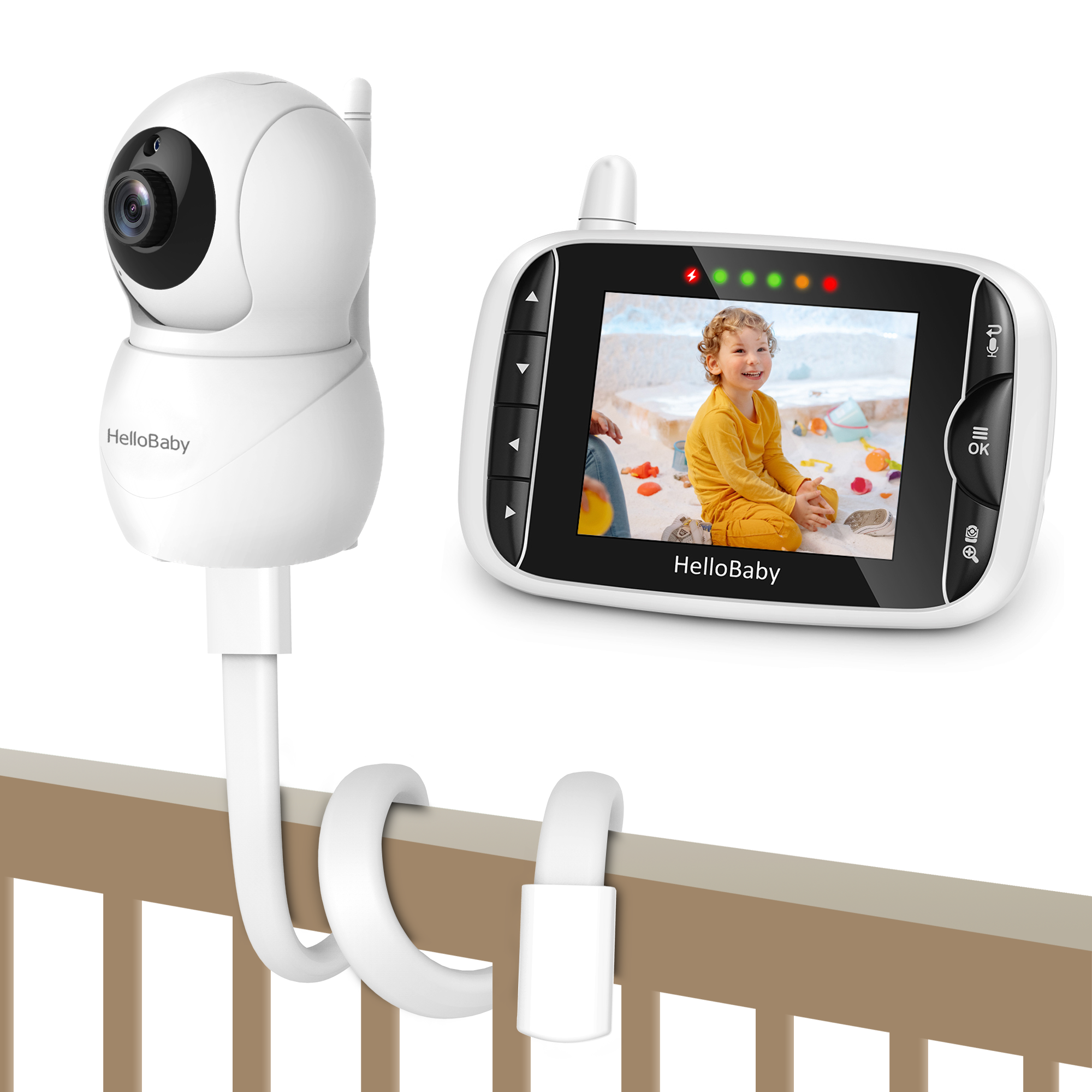
Image source and model notes
Who should choose a different setup?
HB66pro suits a household that values a nearby parent screen, one included camera, remote framing and offline local viewing more than a large display or remote phone access. Choose the HB66Pro-2 if you want two cameras included from the start, but that model scans one camera at a time rather than showing two rooms together. If you need both views simultaneously, choose a system whose exact configuration documents that operation. If the compact screen is the limiting factor, compare the six-inch HB6560; it is also a local-screen design, but its one-camera monitor-only package is a separate choice. A larger screen is not the same as an app connection.
Set up any camera outside the sleep space and route its power lead well away from the child. The manufacturer manual warns that the monitor cannot replace adult supervision and says cords should be kept more than three feet from a child. Those limits matter more than adding cameras to a system that cannot keep all rooms visible together.
Primary sources: HelloBaby HB66pro product page, separate +stand listing, FCC-filed family manual and manufacturer model-difference declaration.
Key details at a glance
| Parent-unit screen | 3.2 in |
|---|---|
| Camera-to-parent-unit connection | Direct local 2.4 GHz wireless from the camera(s) to the dedicated parent unit. Exact U.S. page states no Wi-Fi needed; a remote phone path is not documented. |
| Manufacturer-stated open-space range | 1000 ft |
| Advertised maximum range claim | 1000 ft |
| Cameras in the reviewed kit | 1 |
| Maximum camera units supported | 4 |
More specifications and setup details
| Video rooms visible at once | 1 |
|---|---|
| Recommended stable operation uses home Wi-Fi | No |
| Audio-only system | No |
| Parent talk-back | Yes |
| Room-temperature readout | Yes |
| Preloaded lullaby count | 8 |
| Parent receivers included | 1 |
Use the exact model’s instructions for operating limits, supplied equipment and version differences.
Sources for this assessment
- HelloBaby U.S. video-monitor collection page 3 (reused capture)
- HelloBaby U.S. all-products response (reused snapshot)
- HelloBaby exact U.S. HB66pro one-camera product page
- HelloBaby exact U.S. HB66 Pro with stand product page
- HelloBaby exact U.S. HB66Pro-2 two-camera product page
- Videotimes 32R user manual filed under FCC ID 2BDR5-32R
- Videotimes declaration of model difference for FCC ID 2BDR5-32R
Check the room and the receiving setup.
Read the exact model's constraints, camera count and supervision limits before choosing a package.