
On this page
Your needs, this model
Does it fit your priorities?
Do you need two cameras included in a local, no-Wi-Fi kit?
The exact U.S. HB66Pro-2 page and its monitor-only variant identify two cameras and one parent display; the page says Wi-Fi is not needed for the local connection.
Explore this need in the finder →Must two nursery pictures remain visible at the same moment?
The HB66Pro-2 kit includes two cameras but the applicable family manual describes sequential camera scanning, one feed after another.
Explore this need in the finder →Is a compact screen acceptable if remote framing and talk-back matter more?
The exact page lists a 3.2-inch IPS screen, remote movement, 2x zoom, talk-back and room-temperature monitoring. It does not establish pixel resolution or continuous screen-on battery time.
Explore this need in the finder →Two local cameras in the box, but one live view at a time
The HelloBaby HB66Pro-2 is the twin-camera version of a small dedicated-screen monitor, not a Wi-Fi camera bundle. Its exact U.S. page identifies model HB66Pro-2 and the base choice as “Baby Monitor Only”; that package contains two cameras and one parent display. The system uses a direct 2.4 GHz link and does not need home Wi-Fi for that local view. The manufacturer’s page does not document viewing from a phone away from home, so it is best for a parent who can carry the receiver between nearby rooms rather than someone who needs a remote app.
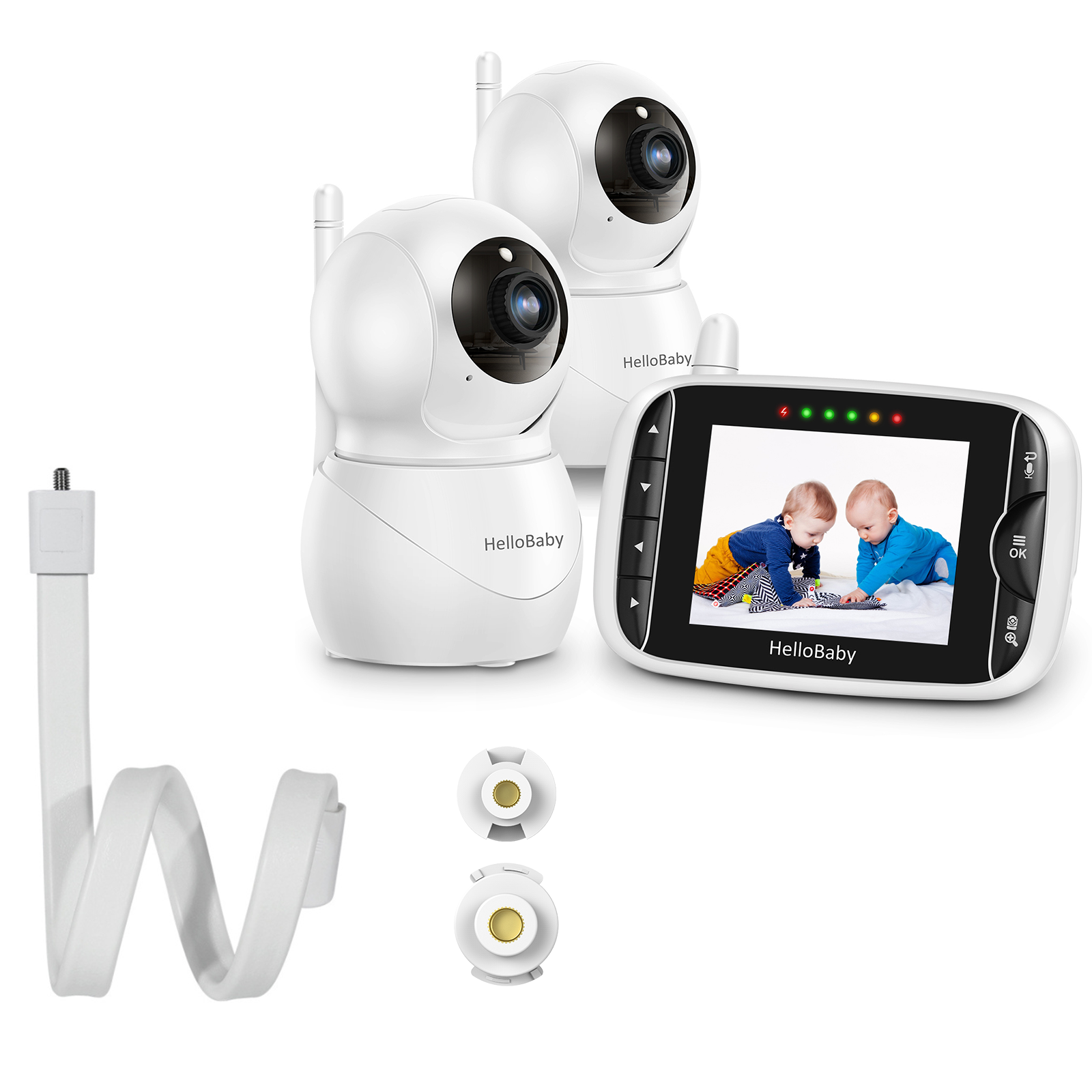
Image source and model notes
The distinction between “two cameras included” and “two rooms at once” is central. The family manual, filed for the HB6532 model, describes a scan mode that shows each camera in sequence for about ten seconds. The manufacturer’s model-difference filing names HB66Pro-2 in the same underlying electronics family. That supports using the shared operating instructions, but it does not change the two-camera kit into a split-screen display. If you need to keep both images visible together or hear two rooms simultaneously, this is not a documented solution.
A small parent display and basic camera control
The HB66Pro-2 page specifies a 3.2-inch IPS screen, remote pan and tilt, and 2x zoom. The product listing advertises 310 degrees of pan and 120 degrees of tilt. The single-camera HB66pro page advertises a different pan figure, even though the manufacturer’s FCC model-difference declaration groups the two model numbers as having the same internal structure. The manual confirms directional camera control but does not state an angle. That mismatch is a reason not to shop by the angle alone; the exact package count is the clearer documented difference.
Four cameras are supported according to the page, and the manual’s sequential scan is useful if you add compatible cameras for other spaces. The maximum is a pairing limit, not an included quantity. The screen changes between camera views instead of displaying a wall of simultaneous tiles. A household with just two separate nap areas may appreciate a second camera already in the box; someone trying to keep both rooms continuously visible should choose another system.
Local features without an app path
HelloBaby lists automatic infrared night vision, temperature monitoring, VOX, two-way talk, eight lullabies, a sound-level indicator and adjustable brightness and volume. The family manual adds more detail: it describes sound-sensitive ECO behavior, temperature alarms with adjustable limits and a parent-unit microphone button. When talk-back is held, the parent unit’s speaker is muted. VOX can be helpful when you prefer the display to wake on sound instead of staying lit, but that setting is not proof of a specialized cry-recognition or health-alert system. The temperature reading is a household reference, not a precision thermostat or medical measurement.
The manual lists a 1,000-foot outdoor line-of-sight maximum and up to 165 feet indoors. Those are manufacturer figures; walls, metal objects, interference and distance between units can reduce reception. It also lists a parent-unit battery claim of up to six hours, without an always-on screen test condition. The cameras require their supplied adapters, so the second camera brings another placement and power-cord decision. Plan cable routing before fixing either camera in place.
Package options and documented uncertainties
The HB66Pro-2 page offers both monitor-only and a separate “+ stand” variant. A plus-stand image shows a mounting accessory, but the listing does not document its dimensions, safe fit or compatibility with a specific crib rail. The stand is a package difference, not a third camera or a different parent receiver. A two-year warranty-service selection is also not a camera feature. Check the selected option and contents carefully because a product page may present hardware and service choices together.
The model is described as a video monitor in its name, handle, product page and video-monitor collection. One Shopify catalogue field labels its product type “Audio baby monitor”; I retain that as a source-data conflict rather than treating the device as audio-only. The direct product description and its two-camera image consistently identify video. The manual is not printed HB66Pro-2: it identifies HB6532, while the manufacturer filing explicitly places HB66Pro-2 in that device family. Use the shared setup and safety instructions with that boundary in mind; the manual’s one-camera package list does not override the exact two-camera retail listing.
Who should buy this configuration?
Choose HB66Pro-2 when you want two cameras in the box, a local parent screen and one-room-at-a-time viewing. The compact screen and camera scan are practical tradeoffs for a simple setup that does not depend on a household router. Consider the one-camera HB66pro if a single room is enough and you would rather start with one camera. Compare HelloBaby’s six-inch HB6560 if a larger dedicated screen matters more than an in-box second camera, and look elsewhere if your essential need is simultaneous two-room video or remote phone access.
As with any monitor, keep the camera and its cord outside the sleep space and out of reach. The family manual says the device does not replace responsible adult supervision and warns to keep cords more than three feet from a child. No camera-count option changes that boundary.
Primary sources: HelloBaby HB66Pro-2 product page, FCC-filed family manual and manufacturer model-difference declaration.
Key details at a glance
| Parent-unit screen | 3.2 in |
|---|---|
| Camera-to-parent-unit connection | Direct local 2.4 GHz wireless from the camera(s) to the dedicated parent unit. Exact U.S. page states no Wi-Fi needed; a remote phone path is not documented. |
| Manufacturer-stated open-space range | 1000 ft |
| Advertised maximum range claim | 1000 ft |
| Cameras in the reviewed kit | 2 |
| Maximum camera units supported | 4 |
More specifications and setup details
| Video rooms visible at once | 1 |
|---|---|
| Recommended stable operation uses home Wi-Fi | No |
| Audio-only system | No |
| Parent talk-back | Yes |
| Room-temperature readout | Yes |
| Preloaded lullaby count | 8 |
| Parent receivers included | 1 |
Use the exact model’s instructions for operating limits, supplied equipment and version differences.
Sources for this assessment
- HelloBaby U.S. video-monitor collection page 3 (reused capture)
- HelloBaby U.S. all-products response (reused snapshot)
- HelloBaby exact U.S. HB66pro one-camera product page
- HelloBaby exact U.S. HB66 Pro with stand product page
- HelloBaby exact U.S. HB66Pro-2 two-camera product page
- Videotimes 32R user manual filed under FCC ID 2BDR5-32R
- Videotimes declaration of model difference for FCC ID 2BDR5-32R
Check the room and the receiving setup.
Read the exact model's constraints, camera count and supervision limits before choosing a package.