
Your needs, this model
Does it fit your priorities?
Can the exact HB6560-2 show two camera pictures together on its dedicated screen when one selected room's audio is enough?
Yes. The exact SKU is the two-camera package; the manual describes split-screen for two picture feeds and audio from one selected camera only.
Explore this need in the finder →Does the HB6560-2 meet a requirement to hear two rooms simultaneously?
No. Split-screen uses the audio from one selected camera, and the manual says it cannot monitor both camera sounds simultaneously.
Explore this need in the finder →Can this exact two-camera kit operate without home Wi-Fi or internet?
Yes. The official package page and manual describe direct FHSS camera-to-parent-unit operation, not a router/app plan.
Explore this need in the finder →Can the two-camera HB6560-2 provide remote phone viewing away from home?
No. Neither the exact U.S. listing nor the inspected model guide documents a phone app or remote internet route.
Explore this need in the finder →Can a strict eight-hour continuous screen-on runtime be verified?
No. Accessible exact-model manual copies disagree on the battery-life number, and neither specifies continuous screen-on test conditions.
Explore this need in the finder →The two-camera package is about seeing two places together
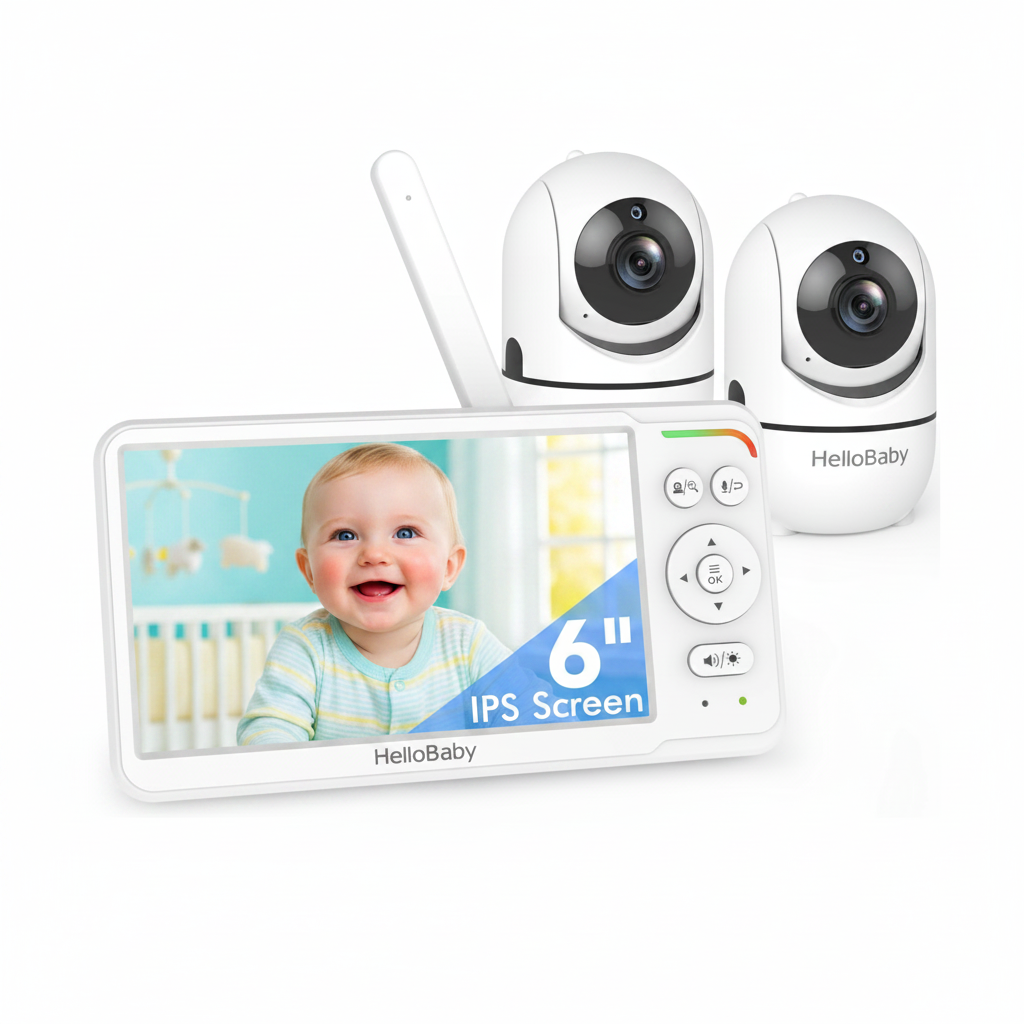
The HelloBaby HB6560-2 is the two-camera member of the six-inch HB6560 family. Its exact U.S. store page calls the package “6-inch Split Screen Video Baby Monitor with 2 Cameras,” and the matching product record identifies SKU HB6560-2. This review is for that two-camera monitor-only configuration. The separate listing that adds two camera stands is a different bundle and is not silently folded into the package assessed here.
Both cameras link to one dedicated 6-inch IPS parent screen over a direct 2.4 GHz FHSS connection. A home router, Wi-Fi account and phone app are not part of the listed operating plan. That makes the product a better fit than a Wi-Fi camera for a caregiver who wants a handheld receiver and wants to keep monitoring on the local system. It does not provide a documented away-from-home phone feed, so do not choose it if remote viewing while out is essential.
Split view is useful, but it does not create dual-room audio
The shared HB6560 manual describes a two-camera split-screen mode that shows both camera pictures side by side. It also offers a scan mode that cycles from one camera to the other for about ten seconds at a time. Those are meaningfully different ways to check two separate rooms: split screen gives both visual feeds together, while scan alternates the full-screen view. In split screen, sound still comes from one selected camera. The manual explicitly says the monitor cannot listen to both camera feeds at the same time.
For two-room video with one room's sound at a time, this exact package is the relevant family choice; a single HB6560 box contains one camera and does not meet the same two-camera-in-the-box requirement. If you need to hear both rooms simultaneously, the HB6560-2 is still a no, even though it can show two pictures. That distinction is more useful than the number of camera heads alone.
Each camera can be moved remotely by panning and tilting from the parent unit, and the product listing specifies up to 355 degrees of pan and 120 degrees of tilt. The monitor also supports digital zoom, infrared night vision, two-way talk and a temperature display with alerts. These features help a caregiver adjust a view from the receiver; they do not make the device a safety sensor or replace a safe sleep environment and adult supervision.
Power, placement and the limits behind the headline numbers
This is a powered camera setup rather than a portable battery camera. The manual's base-package contents list a parent unit, one camera, two power adapters, a manual and a wall-mounting kit; the exact HB6560-2 product page identifies the two-camera bundle. Each camera still needs a suitable powered location. The guide says to keep the camera near the monitored area, avoid soft bedding and blocked ventilation, and place cords more than 3 feet from a child. It describes desktop or wall mounting, not the separate crib-style stand shown in another bundle's promotional image. Treat the “+ stands” listings as their own unresolved configuration until exact instructions confirm the mounting use and safety conditions.
The manual gives up to 1,000 feet outdoors with line of sight and up to 165 feet indoors, while warning that walls, reinforced concrete, large metal objects and nearby 2.4 GHz devices can reduce reception. These are published limits, not a measured result for your floor plan. Test the signal from the places you plan to use the parent unit. A camera count does not tell you whether a particular house has a stable link to both rooms.
HelloBaby advertises 16–30 hours of parent-unit battery life on the product page. The accessible copies of the HB6560 family manual conflict on a single battery-life value, and do not define a screen-on test condition. The 4,000 mAh battery capacity is documented, but that alone cannot answer a strict runtime requirement. ECO mode can switch off the display and pause transmission during quiet periods, then wake on sound above the chosen sensitivity. If you require a minimum continuous screen-on duration, the published material does not confirm it.
Where the HB6560-2 fits, and what to verify
Choose this package when two camera pictures must be visible at once on one local parent display, a single selected audio channel is acceptable, and Wi-Fi independence matters more than phone access. Compare it with the one-camera HB6560 if you only need one view, or with a system whose manual confirms simultaneous audio when both rooms must be heard at once. The 6-inch screen is larger than many dedicated monitor displays, but the manufacturer does not publish a numeric pixel resolution for this model in the material reviewed; “HD” wording should not substitute for one.
The source records have an availability conflict: the product page displayed “Sold out,” while its U.S. product JSON marked the exact standard variant available. Check the seller's current listing rather than relying on either archived signal. The product photos are manufacturer renderings, not photographs of an independently tested setup. No claim is made here about measured image quality, tested range, battery performance or user experience. As with any monitor, the manufacturer's cord and placement instructions matter more than a promotional image. For the one-camera alternative, see the HB6560 review or the family comparison.
Key details at a glance
| Parent-unit screen | 6 in |
|---|---|
| Published display resolution | 6-inch IPS LCD; no numeric pixel resolution located in the inspected model material. |
| Camera-to-parent-unit connection | Direct local 2.4 GHz FHSS radio from two cameras to one parent unit; no phone-away viewing is documented. |
| Manufacturer-stated open-space range | 1000 ft |
| Advertised maximum range claim | 1000 ft |
| Cameras in the reviewed kit | 2 |
| Maximum camera units supported | 2 |
| Video rooms visible at once | 2 |
| Phone viewing away from home | No |
| Supplied camera lens setup | Two included powered motorized cameras; manufacturer page lists up to 355-degree pan and 120-degree tilt per view. Manual documents directional control and digital zoom. |
| Recommended stable operation uses home Wi-Fi | No |
| Audio-only system | No |
| Parent talk-back | Yes |
| Room-temperature readout | Yes |
| Preloaded lullaby count | 8 |
| Parent receivers included | 1 |
Use the exact model’s instructions for operating limits, supplied equipment and version differences.
Sources for this assessment

Check the room and the receiving setup.
Read the exact model's constraints, camera count and supervision limits before choosing a package.