
On this page
Your needs, this model
Does it fit your priorities?
Do you want a dedicated screen that works without home Wi-Fi?
The exact HB65 page describes encrypted 2.4GHz wireless and contrasts this model with Wi-Fi/app monitors. Local viewing uses its parent receiver; a remote phone route is not documented.
Explore this need in the finder →How much screen area and how many cameras must be in the selected kit?
The base HB65 SKU contains one camera and its receiver has a 3.2-inch TFT LCD. Compatible cameras may be scanned in sequence, but they are not two simultaneous views.
Explore this need in the finder →Is the documented temperature alarm useful if continuous screen-on runtime is not verified?
The exact product page lists a room-temperature monitor and the HB65 v1.3 manual describes adjustable high/low alarms. The same manual says up to eight hours of battery life without specifying screen-on duration.
Explore this need in the finder →A small local viewer with one camera in the base kit
The HelloBaby HB65 is a conventional parent-screen monitor rather than a camera built around an app. The exact U.S. listing describes a 3.2-inch LCD, direct 2.4GHz wireless, remote camera movement and a rechargeable parent unit. It positions the link as an alternative to Wi-Fi/app models, so the useful operating plan is simple: leave a camera powered in the nursery and carry the receiver around the home. A phone-away feature is not documented. If your routine depends on checking the room from work or another location, this is the wrong kind of system.
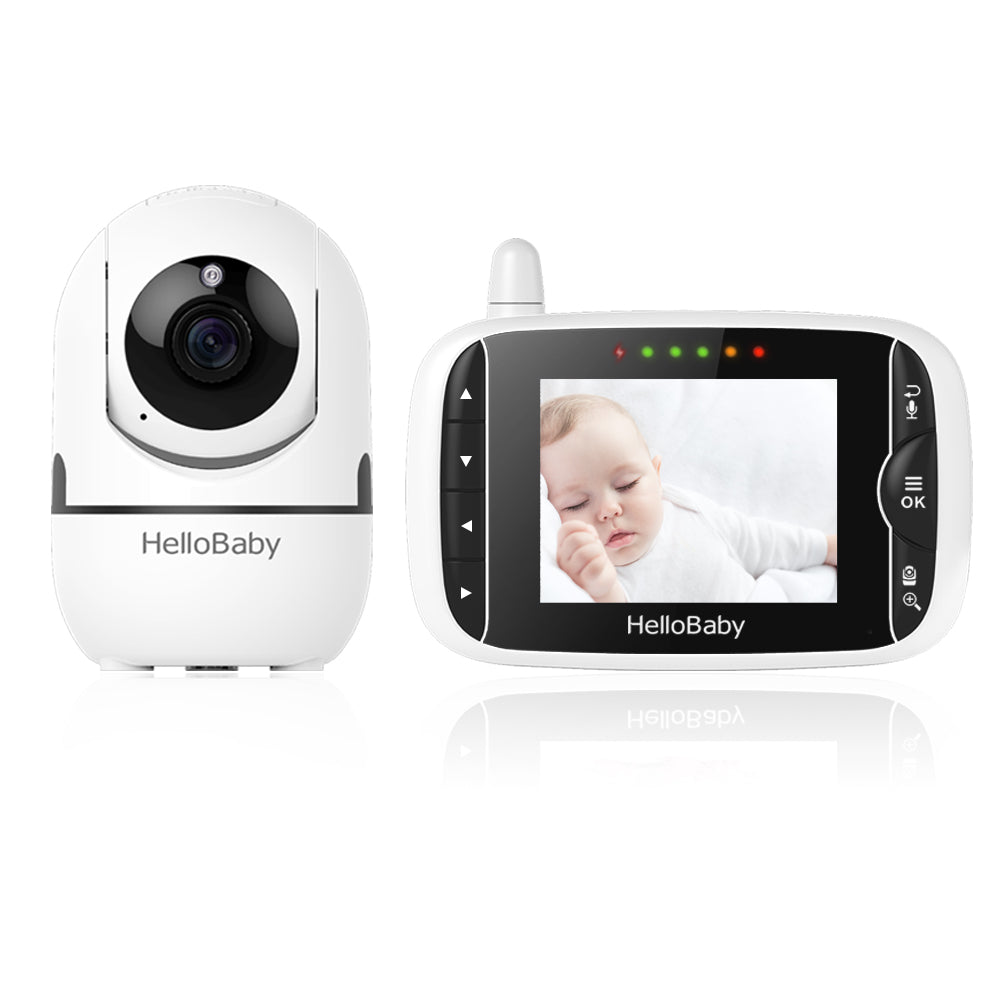
Image source and model notes
The manual identified as HB65 version 1.3 describes a 3.2-inch TFT LCD and the controls for pan, tilt, zoom, scan, sound level and two-way talk. The parent receiver can be used on its own battery, while the camera is powered by an adapter. That division is handy when you want to walk to another room with the screen, but it is not camera backup during an outage. The current listing also mentions digital encryption; that is a manufacturer claim, not an independent security audit.
One camera included; extra views rotate rather than stay together
The plain HB65 SKU contains one camera. HelloBaby’s separate add-on-camera page says its camera is compatible with HB65 and not with several other model families, including HB6550, HB66, HB50 and HB32. The same manufacturer material describes up to four paired cameras in alternate scan mode, with the screen switching about every ten seconds. That is useful for a parent who is content to glance at one room, then wait for the next camera in the cycle. It does not create four persistent pictures, and the model is not a fit when two rooms need to stay visible or audible together.
On the camera itself, the exact page lists remote pan and tilt, and the official HB65 add-on listing specifies 355 degrees of horizontal travel, 120 degrees of tilt and 2x zoom for the compatible camera. Those controls can reframe a selected nursery without a visit back to the room. They do not remove the need to place and power each camera thoughtfully. The manufacturer describes automatic infrared night vision, two-way talk, a sound-level indicator and lullabies. Its manual also documents a sound-activated screen/indicator when video is off. That is ordinary sound activation, not evidence of a phone notification or a specialized cry-recognition alert.
Temperature alarms are more specific than a simple readout
The HB65 manual v1.3 goes beyond the product page’s general temperature-monitoring description: it documents Fahrenheit/Celsius selection, an alarm toggle and adjustable high and low limits. The manual gives a 0–50°C detection range, high-alarm settings from 20–40°C and low-alarm settings from 0–19°C. That makes the HB65 more useful than a monitor that only displays temperature if you want an audible prompt when a selected threshold is crossed. It remains a room reading, not a precision thermostat or a substitute for checking conditions directly.
The manual’s technical section says the radio range can reach 1,000 feet outdoors with line of sight and up to 165 feet indoors. Treat those numbers as manufacturer limits: walls, metal, household electronics and the layout between camera and receiver matter more than the outdoor ceiling in most homes. The same manual lists a 950mAh rechargeable parent-unit battery and an “up to eight hours” battery-life claim. It does not say that eight hours is continuous screen-on runtime under a defined setting, so it should not meet an essential all-night display-duration requirement.
What changes with the stand and warranty choices
HelloBaby lists monitor-only and “+ stand” options on the HB65 page, plus a separate HB65 + stand product page. I treat the stand route as a package difference, not a different camera model. The bundle image is useful for identifying that accessory, but the page does not give dimensions or prove safe fit on a crib rail or any particular furniture. A two-year extended-warranty-service selection is also offered; it changes service coverage, not the camera count or monitor capabilities. Check the terms and the actual package list before ordering.
The HB65 listing was marked “Sold out” on the day checked, so availability may be intermittent. Verify that a seller is offering the HB65 model and whether the selected camera/stand package is included.
Who should compare another monitor?
HB65 suits someone who values a dedicated local screen, a one-camera starter kit, remote framing and the documented temperature alarm more than a large display or app access. For two cameras in the box, compare the HB65-2, but note that its listing also describes alternate scanning rather than simultaneous views. If two live rooms must remain on screen together, choose a model whose exact package and instructions substantiate that arrangement, such as the separately reviewed Infant Optics DXR-8 PRO SS. If the 3.2-inch picture is too small, compare a larger-screen local system such as HelloBaby’s five-inch HB6550; screen size alone does not establish higher camera resolution.
Do not treat the receiver as a safety guarantee: the manual says this monitor cannot replace responsible adult supervision and warns to keep cords more than three feet from a child. Place the powered camera outside the sleep space, follow the supplied instructions and keep electrical leads out of reach. Those practical limits matter more than adding another camera to a kit that you will not be able to see at the same time.
Key details at a glance
| Parent-unit screen | 3.2 in |
|---|---|
| Camera-to-parent-unit connection | Direct encrypted 2.4GHz radio between the camera and dedicated parent receiver. The exact U.S. page says this model does not require Wi-Fi or an app for its local view; a remote phone path is not documented. |
| Manufacturer-stated open-space range | 1000 ft |
| Advertised maximum range claim | 1000 ft |
| Cameras in the reviewed kit | 1 |
| Maximum camera units supported | 4 |
More specifications and setup details
| Video rooms visible at once | 1 |
|---|---|
| Recommended stable operation uses home Wi-Fi | No |
| Audio-only system | No |
| Parent talk-back | Yes |
| Room-temperature readout | Yes |
| Preloaded lullaby count | 8 |
| Parent receivers included | 1 |
Use the exact model’s instructions for operating limits, supplied equipment and version differences.
Sources for this assessment
Check the room and the receiving setup.
Read the exact model's constraints, camera count and supervision limits before choosing a package.