
Your needs, this model
Does it fit your priorities?
Does the exact HB50 fit a one-camera local-video plan without an app?
Yes, for one room: the selected HB50 monitor-only package is shown as a one-camera dedicated-screen system on a local 2.4 GHz link, with no phone-away route documented. It should not be chosen for remote phone viewing or simultaneous two-room video.
Explore this need in the finder →Can HB50 meet a required minimum parent-screen diagonal?
The HelloBaby HB50 page does not state the screen diagonal or pixel resolution. If a minimum size is essential, this source cannot confirm that it fits; choose a monitor with a published exact-model screen size instead.
Explore this need in the finder →Does HB50 provide the camera movement and temperature-alert behavior you need?
It lists a temperature readout, but exact alert thresholds are not published. The page does not document remote pan/tilt. Do not select it when either feature is an essential, specifically defined requirement.
Explore this need in the finder →A basic dedicated-screen monitor with useful sound cues
The HelloBaby HB50 is for a household that wants a camera picture on a separate parent unit, without making the monitor an app-and-router project. The exact U.S. listing identifies an HB50 monitor-only option, a direct 2.4 GHz connection, and a dedicated receiver. Its product page does not document viewing from a phone away from home. That makes the core choice fairly clear: if you want a local screen for one room, the HB50 is worth considering; if you need a remote app feed, choose a different kind of system.
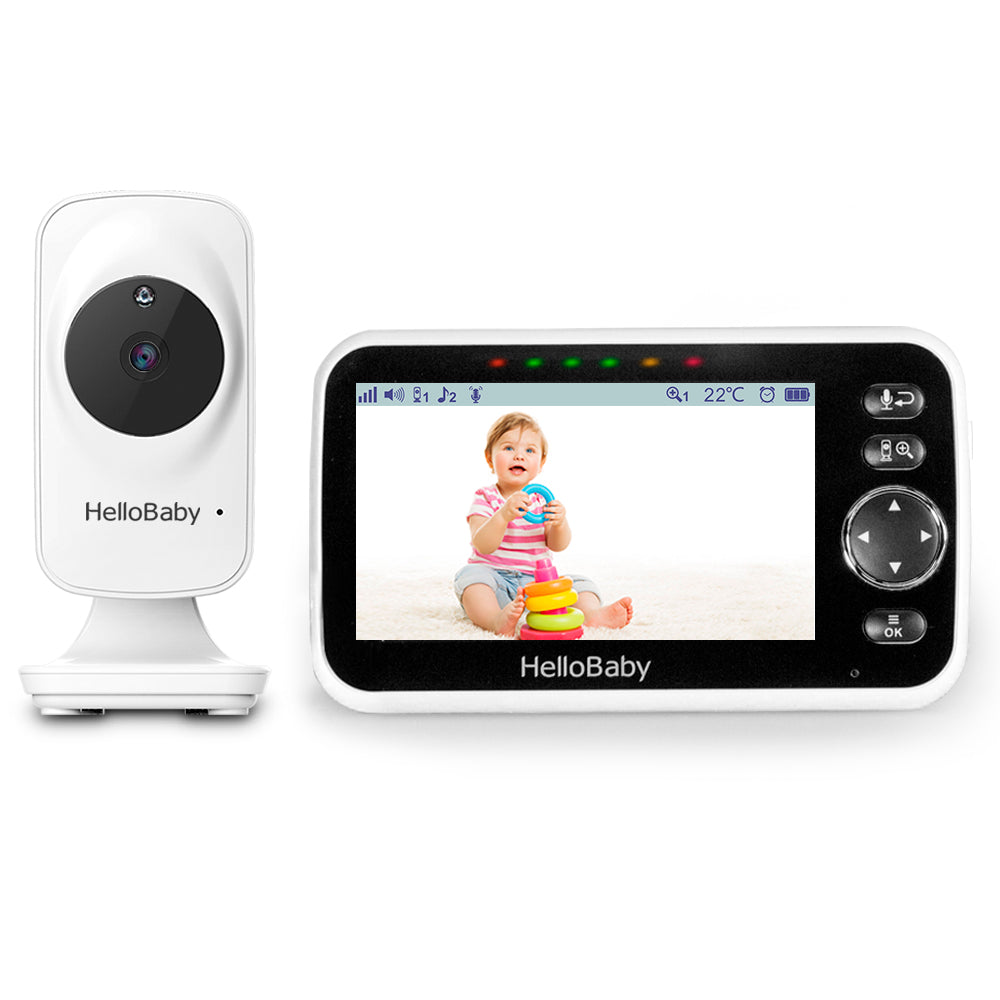
On the exact product page, HelloBaby lists two-way talk, automatic infrared night vision, a temperature readout, eight lullabies, a rechargeable parent unit and a sound-activated indicator and screen. Those are practical conveniences for a low-friction routine: a caregiver can keep the receiver nearby, answer the room through talk-back, or use the night-vision picture rather than opening a phone. The page says the screen and indicator can respond when crying is detected in screen-off mode. It does not spell out the detection sensitivity, a separate audible cry alarm, or what the speaker does while the screen is dark, so I would not buy the HB50 as a substitute for a specifically defined alert system.
What the listing does—and does not—settle
The published range is up to 900 feet, described by the manufacturer as tested in open air. Treat that as a manufacturer claim, not an indoor promise or a result measured in a home. Walls, floors, metal and other wireless equipment can change reception. More importantly, the official page leaves several buying-critical details unstated: the parent screen's diagonal and pixel resolution, continuous screen-on battery runtime, the camera's movement or zoom, maximum camera count, and temperature-alert thresholds. A buyer who has a hard screen-size minimum should use another exact model with a published diagonal rather than guessing from a product image. Likewise, the temperature indicator is a room readout, not medical monitoring or proof that a room is safe.
The standard HB50 kit is presented as a local camera-and-parent-screen monitor. It makes sense for a one-room video plan; it should not be treated as a multi-room system. The official FAQ says an HB50 monitor pairs only with an HB50 camera, but the material captured for this review does not establish the maximum supported cameras, split-screen viewing, or camera patrol behavior. Do not count on adding another room or seeing multiple feeds at once unless HelloBaby confirms that for the exact hardware revision you own. The same caution applies to compatibility: the manufacturer's add-on listings warn that upgraded versions can differ, so match model and serial details before buying a replacement camera.
How the choice changes with your answers
For the ordinary finder questions, HB50 fits a request for video on a dedicated screen, one room at a time, with an offline operating plan and talk-back. It does not fit a request for a phone view away from home. If you only need sound, an audio-only model may be simpler; if you expect to monitor two rooms together, look for a kit whose exact package and manual establish that function. An essential screen-size answer also changes the result: because the exact HB50 page does not publish its diagonal, a required 5.5-inch minimum should fail rather than be silently assumed from the image.
Camera movement is another useful filter. The HB50 page does not document remote pan or tilt. If adjusting the view from the parent unit matters, compare a model such as the HelloBaby HB6560, whose reviewed U.S. listing specifies remote pan and tilt and a 6-inch display. The smaller, published 3.2-inch screen on the HB39 is another reference point for readers who want to make a screen-size comparison using actual specifications. The HB50 sits between those choices only where its own details are confirmed; do not infer that it is larger or more capable than either model from the product art.
The stand package is a separate buying choice
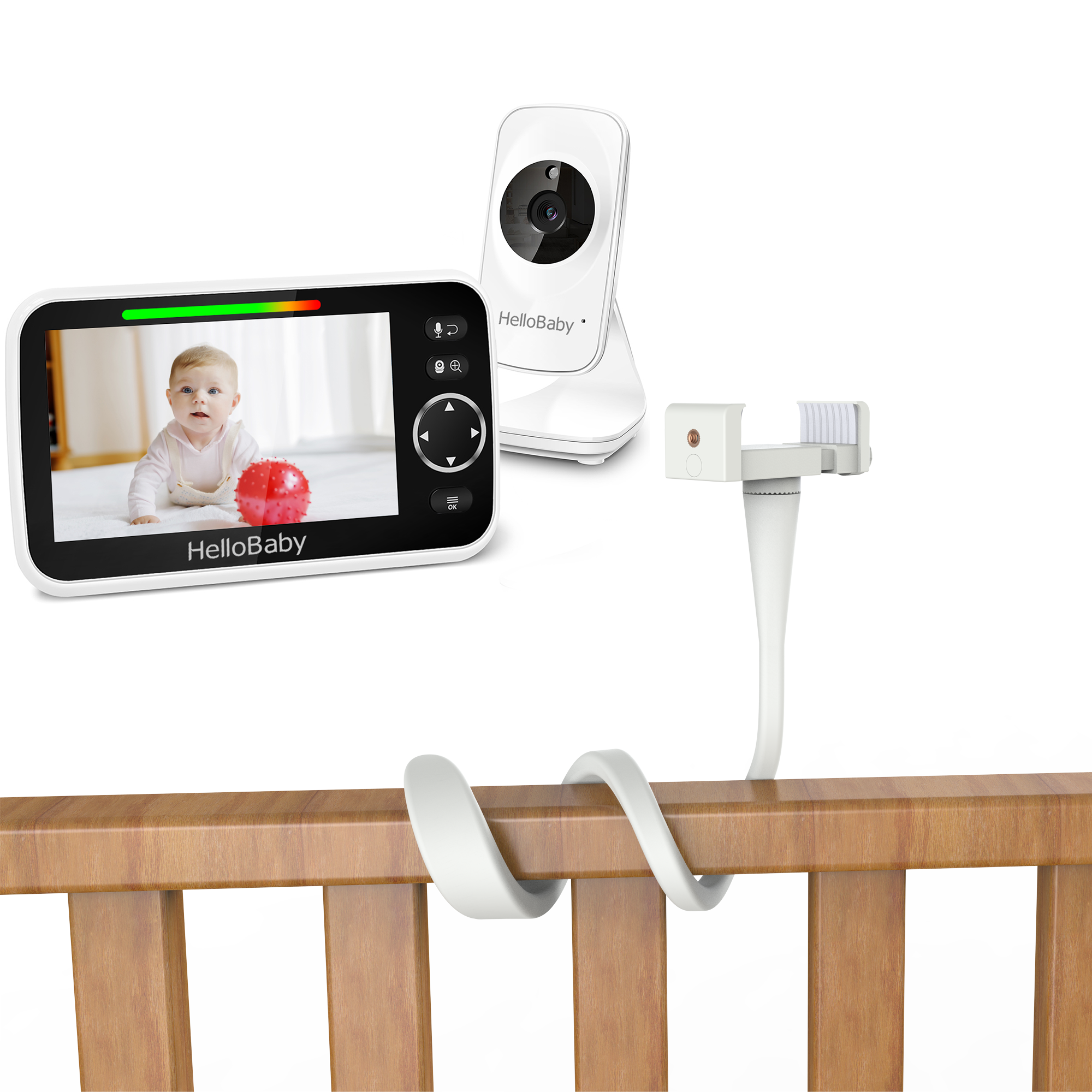
HelloBaby lists a separate “HB50 + stand” package as well as a stand option under the monitor listing. The stand changes the mounting accessory, not the documented monitor functions. The image below is the manufacturer's stand-package rendering. It depicts the camera positioned at a rail, but the product page captured here does not give rail-size limits, installation instructions, or approval for placement on a particular crib. Follow the instructions supplied with the exact stand and the applicable safe-sleep guidance; keep camera cords and the monitor mount completely outside the sleep space. If you cannot verify a secure location outside the crib, use another placement plan. The standard one-year and optional extended-warranty selections are service choices, not different camera systems.
Bottom line
Choose the HB50 when your priorities are a separate local screen, direct 2.4 GHz monitoring, two-way talk, infrared night vision, temperature readout and simple sound-responsive viewing. Pass if away-from-home phone access, documented remote camera movement, a specified display size, or simultaneous views from several rooms are essential. Its 900-foot figure is an open-air manufacturer claim, not a tested indoor result, and the page's official stock signals conflict: the captured product page said sold out while the all-products JSON marked the variant available. I cannot resolve stock from those sources. No model-specific downloadable manual was linked from the captured product page, so setup details beyond the stated features—including stand placement and battery behavior—remain unknown. That is a reason to verify before purchase, not to fill the gaps with assumptions.
Key details at a glance
| Camera-to-parent-unit connection | The exact U.S. product page specifies a 2.4 GHz monitor connection and the model is presented as a local dedicated-screen monitor; no app, router or away-from-home phone viewing is documented. |
|---|---|
| Manufacturer-stated open-space range | 900 ft |
| Advertised maximum range claim | 900 ft |
| Cameras in the reviewed kit | 1 |
| Video rooms visible at once | 1 |
| Phone viewing away from home | No |
| Supplied camera lens setup | The exact monitor-only page shows one fixed-looking camera, but the sources do not state whether it has remote movement or zoom. Do not count it as a documented remote-pan/tilt system. |
| Recommended stable operation uses home Wi-Fi | No |
| Audio-only system | No |
| Parent talk-back | Yes |
| Room-temperature readout | Yes |
| Preloaded lullaby count | 8 |
| Parent receivers included | 1 |
Use the exact model’s instructions for operating limits, supplied equipment and version differences.
Sources for this assessment
Check the room and the receiving setup.
Read the exact model's constraints, camera count and supervision limits before choosing a package.