
Your needs, this model
Does it fit your priorities?
Will a one-camera, local parent screen work without home Wi-Fi?
The exact HB26 package has one parent unit and one camera with a Wi-Fi-free 2.4 GHz local link; additional cameras scan one at a time.
Explore this need in the finder →Do you need remote camera aiming, two-way talk, and a room-temperature reading?
The HB26 manual documents pan/tilt from the parent controls, talk-back, and camera-room temperature display/limits.
Explore this need in the finder →Is an exact display-size minimum or continuous screen-on runtime essential?
Do not count the HB26 for either threshold: the manual contradicts itself on screen diagonal, and its six-hour battery claim differs from the page's eight-hour ECO claim without a stated continuous-screen test.
Explore this need in the finder →A local-screen monitor with useful camera controls
The HelloBaby HB26 is a straightforward, Wi-Fi-free video system: one camera sends a 2.4 GHz signal to a separate parent monitor. The product page calls out two-way talk, adjustable VOX sound activation, automatic infrared night vision, a feeding reminder, and support for up to four cameras. The model-specific manual adds practical detail: its standard package has one parent unit, one camera, two power adapters, a user manual, and a wall-mounting kit. That is a more helpful description than simply counting the extra cameras it can support.
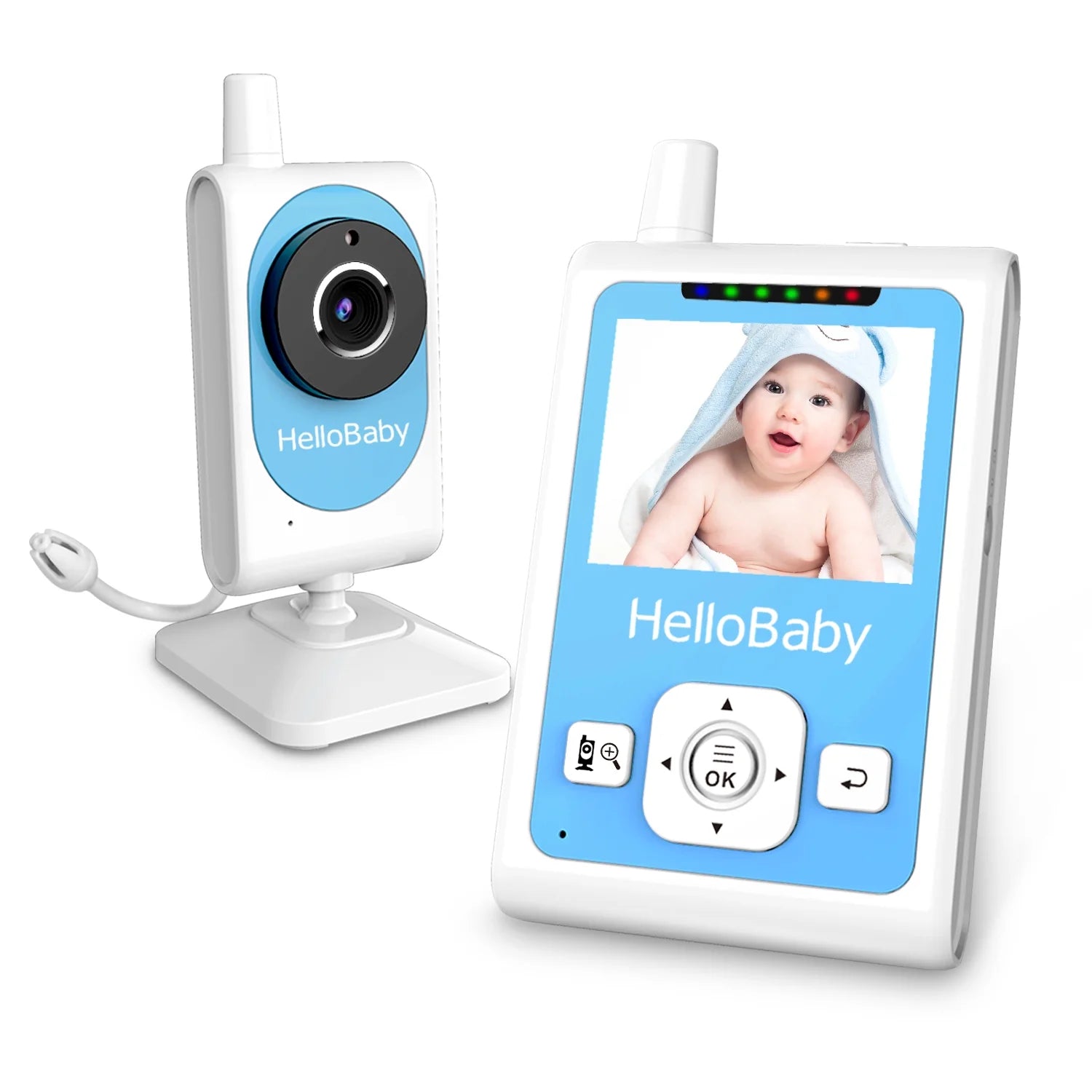
This setup fits caregivers who want a dedicated screen without home Wi-Fi or an away-from-home app connection. It does not offer the flexibility of a phone camera when you leave the house. The manual describes a direct radio link and warns that walls, metal, and nearby electronics can weaken reception; even a Wi-Fi-free monitor can experience interference from nearby 2.4 GHz equipment.
Remote aiming is different from seeing several rooms at once
The receiver’s arrow controls can pan and tilt the camera after entering the zoom mode, and the manual also describes digital zoom. That is a meaningful advantage over a camera that must be repositioned by hand: once you have mounted or placed the HB26, you can adjust the view from the parent unit. Zoom enlarges the image rather than adding detail, however, and the manufacturer does not publish video resolution.
The HB26 can register up to four cameras, but its scan mode shows each camera for about ten seconds and then advances to the next. That is a rotating check, not a split screen or two simultaneous views. The base package includes one camera. If you need several rooms visible continuously, select a system that specifically documents simultaneous video rather than treating “supports four cameras” as four live feeds. Confirm compatibility before adding another camera; model numbers from the same maker do not establish interchangeability.
Some headline specifications need a careful read
The screen diagonal is not dependable enough to use as a must-have threshold. In the filed HB26 manual, the parent-unit drawing labels the display 2.4 inches, while the technical-data table lists a 2.5-inch TFT LCD. The current product page does not resolve that internal discrepancy. If a minimum screen size matters, do not count the HB26 as meeting it from these sources; compare it with a model whose exact display measurement is consistent.
Battery claims also need context. The manual lists a 950 mAh parent-unit battery and “up to” six hours, while the product page advertises up to eight hours in ECO mode. Neither source establishes a continuous screen-on runtime under a stated test condition. Treat the battery as a convenience for moving around the home, not a promise of a full day away from an outlet. The camera itself is powered by its adapter, so choose a placement with a safe cable route.
HelloBaby’s manual gives a maximum open-area range of 1,000 feet line of sight and an indoor figure up to 165 feet. Those are manufacturer limits, not a measured guarantee through a particular house. The same guide says nearby walls, reinforced concrete, metal, and 2.4 GHz devices can affect the link. Place the camera close to the monitored area as directed, then test reception from the rooms where you will actually use the parent unit.
Convenience alerts are not supervision or medical monitoring
VOX can turn off the screen when the room is quiet and wake it when sound reaches the selected sensitivity. It is not a promise that every sound will be detected, and a quiet screen is not proof that everything is fine. The manual also describes a timer that can remind a caregiver about a feed or diaper change, plus a camera-side temperature reading and adjustable high/low alerts. These are practical prompts, not medical measurements or advice. Keep the monitor within a broader adult-supervision routine.
For safe setup, the manual says the camera may sit on a desktop or be wall mounted, but cords must be kept more than three feet from a child and the supplied adapters should be used. That placement caution matters more than the convenience of remote aiming: the camera and cable should remain outside the sleep space.
Who should choose the HB26?
Choose it when the priority is a no-Wi-Fi parent screen, one-room viewing, talk-back, sound activation, remote camera aiming, and a simple path to rotate among additional cameras. It is a poor match when remote phone access, simultaneous multi-room pictures, a verified screen-size minimum, or a specific continuous battery runtime is essential. Those unknown or unsupported conditions should not be waived just because the product has a long feature list.
Compare the HelloBaby HB32 if a larger documented display is the main difference you care about, or look at an app-connected system only if checking in from outside the home matters. The HB26 product page showed “Sold out” when checked, while the manufacturer’s product JSON marked its standard SKU available; stock is therefore unresolved. Check the exact HB26 option and package before purchase rather than relying on a neighboring model or a camera-only accessory.
Key details at a glance
| Camera-to-parent-unit connection | Local 2.4 GHz digital camera-to-parent-unit link; Wi-Fi-free according to the exact listing. |
|---|---|
| Manufacturer-stated open-space range | 1000 ft |
| Advertised maximum range claim | 1000 ft |
| Cameras in the reviewed kit | 1 |
| Maximum camera units supported | 4 |
| Video rooms visible at once | 1 |
| Phone viewing away from home | No |
| Recommended stable operation uses home Wi-Fi | No |
| Audio-only system | No |
| Parent talk-back | Yes |
| Room-temperature readout | Yes |
| Included crib-mount option | No |
| Supplied camera mount | Built-in camera stand and a listed wall-mounting kit; no crib mount is documented. |
| Portable Flex Stand included | No |
| Travel Case included | No |
| Parent receivers included | 1 |
Use the exact model’s instructions for operating limits, supplied equipment and version differences.
Sources for this assessment
Check the room and the receiving setup.
Read the exact model's constraints, camera count and supervision limits before choosing a package.