
Your needs, this model
Does it fit your priorities?
Do you want a separate under-mattress movement-monitor system as well as a video picture?
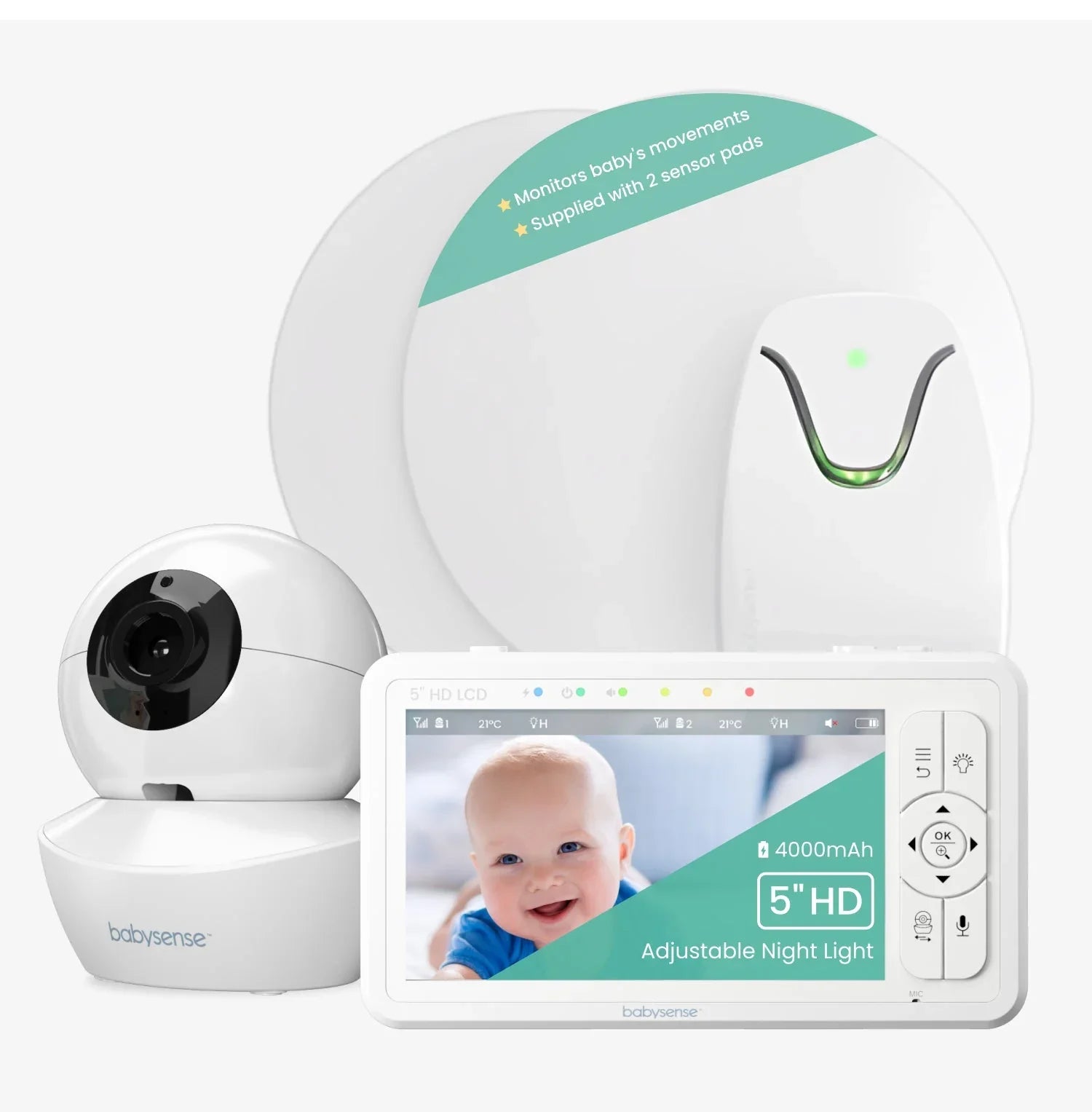
This bundle includes a Babysense 7 control unit with two under-mattress sensor pads, in addition to its HD S2 camera and screen. Keep the movement monitor's alarm path distinct; no relay to the video display is documented.
Explore this need in the finder →Must the same system send a live video feed to your phone when you are away?
No. The exact bundle page and HD S2 guide document a local camera-to-parent-display path, not remote app viewing; the separate BS7 sensor unit does not add a phone feed.
Explore this need in the finder →Does the included package show two rooms at once without buying another camera?
No. The exact SKU and lead package render identify one included HD S2 camera. The family can pair with additional cameras, but a second camera is additional equipment and the generic two-camera page tags/gallery do not change this 1CAM SKU.
Explore this need in the finder →A two-system bundle, not a single all-in-one sensor
The reviewed U.S. configuration is the Babysense True Sleep listing carrying SKU TRUESLEEP-1CAM-US. It combines the Babysense 7 under-mattress movement monitor with an HD S2 video monitor. The exact SKU says one camera, and the lead manufacturer rendering shows one; the storefront also contains two-camera gallery art and a generic two-camera tag. I therefore treat this as the one-camera package, not as a twin kit. Before ordering, check that the seller is supplying the 1CAM SKU if camera count matters.
That identity distinction matters because this bundle places two separate systems in the nursery. The HD S2 camera sends a picture and sound to its own handheld parent display. The Babysense 7's sensor pads send movement information to a separate control unit. The manufacturer describes two kinds of monitoring, but its product page and the two manuals do not document a connection that forwards the movement alarm to the HD S2 video receiver. Plan to position the two alert sources so you can hear or see each one; do not assume that the video screen repeats the movement alarm.
What the local video monitor does well
The video side uses a five-inch, 1280 × 720 TFT LCD parent display and a camera link described in the HD S2 guide as 2.4 GHz FHSS. The arrangement does not require home Wi-Fi or internet, and no away-from-home phone feed is documented. That makes this a fit for a household that wants a dedicated screen and local reception rather than app access from work or travel. It also means there is no phone route to fall back on if the receiver is elsewhere or its battery is depleted.
The camera can be remotely panned and tilted from the display, and the manual documents digital zoom. These controls can help adjust a view without entering a dim room, but zoom enlarges the image rather than adding optical detail. The HD S2 can pair with additional compatible cameras and show two feeds in split-screen mode; the one-camera True Sleep box cannot display two rooms simultaneously as supplied. Expansion capacity is not equipment included with this exact SKU.
Other documented video features include infrared night vision, two-way talk, sound activation, temperature readout and camera-side light and sounds. They make the parent unit more useful during a normal bedtime routine, but they do not replace the core question of where the one camera will be placed. The manufacturer’s large open-space range language should not be treated as an indoor-distance promise: the HD S2 manual and current storefront use inconsistent range figures. Check reception in the actual room and route before relying on a particular wall or floor.
The movement component has its own setup and limitations
Babysense 7 uses two non-contact sensor pads beneath the mattress and a separate bedside control unit. Its guide describes an audible and visual alarm if movement stops for 20 seconds or falls below the stated movement threshold. It does not attach anything to the baby, but it does need a correctly prepared sleeping surface, carefully routed pad wires, working batteries and daily checks. The U.S. user guide calls for four new 1.5-volt AA alkaline cells and specifically says not to use rechargeable batteries.
Sensor placement changes as the sleeping arrangement changes. The manual illustrates using one pad for an infant who is not yet crawling and both once the baby begins to crawl. It also warns that airflow, fans, air-conditioning and vibration can interfere with sensing or delay an alarm. Follow the guide’s empty-crib performance test every day and after moving the monitor, changing bedding or relocating the crib; test under the same room conditions in which it will be used. The test is not to be performed by lifting the baby out of the crib and waiting for an alarm.
The same guide says this movement monitor cannot prevent or reduce the risk of SIDS and that safe-sleep practices remain the caregiver’s responsibility. It is not a diagnosis or a substitute for an adult’s supervision, and the manual excludes infants requiring constant medical supervision. If you are looking for medical monitoring or have a clinician-directed need, ask the clinician rather than using this product’s marketing language as clinical advice.
Who should choose True Sleep?
This bundle suits a family that specifically wants both a local video display and an under-mattress movement alarm, is comfortable maintaining two devices, and does not need phone viewing away from home. It is less appealing if a parent expects a single screen to carry every alert, wants fewer setup steps, or only needs a camera. For a camera-only local setup, compare the separate HD S2 one-camera review; for a mandatory phone feed, choose a system with a documented remote-app operating plan instead. For two live rooms from the start, pick an exact two-camera kit rather than interpreting the True Sleep page’s mixed gallery labels as proof of a second camera in this SKU.
Babysense True Sleep listing · Babysense 7 product information · Babysense product manuals
Key details at a glance
| Parent-unit screen | 5 in |
|---|---|
| Published display resolution | 5-inch 1280 × 720 TFT LCD, per the HD S2 manual and exact bundle component specifications. |
| Camera-to-parent-unit connection | Local 2.4 GHz FHSS camera-to-HD-S2-parent-unit video link; separate BS7 under-mattress sensor pads and alert control unit; no Wi-Fi, internet, or phone-away mode documented. |
| Advertised maximum range claim | 1000 ft |
| Cameras in the reviewed kit | 1 |
| Maximum camera units supported | 4 |
| Video rooms visible at once | 1 |
| Phone viewing away from home | No |
| User-replaceable parent-unit battery | No |
| Supplied camera lens setup | HD S2 camera supports remote pan/tilt and digital zoom; the linked manual says split-screen needs multiple paired cameras and digital zoom is unavailable in split view. |
| Recommended stable operation uses home Wi-Fi | No |
| Audio-only system | No |
| Parent talk-back | Yes |
| Room-temperature readout | Yes |
| Camera-side mood light | Yes |
| Separate under-mattress movement-monitor system included | Yes |
| Parent receivers included | 1 |
Use the exact model’s instructions for operating limits, supplied equipment and version differences.
Sources for this assessment
- Babysense True Sleep current U.S. product listing and exact TRUESLEEP-1CAM-US variant
- Babysense HD S2 U.S. user manual; exact manual for bundled video component
- Babysense 7 movement monitor product page
- Babysense 7 U.S. user manual, V.BS7_New_UG_.04.US.05.23
- Babysense True Sleep official one-camera package image
- CPSC exact-string recall API query for Babysense True Sleep; empty response is not comprehensive clearance

Check the room and the receiving setup.
Read the exact model's constraints, camera count and supervision limits before choosing a package.