
Your needs, this model
Does it fit your priorities?
Does the one-camera Touch kit provide a seven-inch local parent screen for a one-room view?
Yes. The exact package includes the 7-inch parent display and one camera; its direct local view can be used without home Wi-Fi.
Explore this need in the finder →Can the one-camera package meet a two-room, two-picture requirement?
No. The exact one-camera box includes one physical camera. The product page uses split-screen/two-room wording, but the manual describes split-screen over multiple camera channels and the dual optical lenses are within one camera.
Explore this need in the finder →Can a caregiver view the nursery remotely on a phone while keeping the dedicated parent screen?
Yes. The app is a separate optional path; phone viewing away from home requires the 2.4 GHz Wi-Fi/app configuration and an internet connection. The kit still includes its parent monitor.
Explore this need in the finder →Can the listed cry-detection feature be required in the connected app plan?
The exact listing advertises cry alerts with the app, so it can be selected as a desired feature in the remote/app plan. It is not a guaranteed alarm and is not confirmed in the local-only plan.
Explore this need in the finder →Should the one-camera Touch be relied on for an eight-hour guaranteed screen-on minimum?
No. The manual gives an up-to screen-on estimate while the listing gives a different continuous-use estimate; neither is a tested or guaranteed minimum, so strict runtime matching remains unknown.
Explore this need in the finder →The one-camera Touch kit makes the most sense when you want a full-size dedicated screen at home and an optional app route for check-ins away. Its one included camera is the important boundary: the package is not a ready-made two-room system, even though the product page also uses broad split-screen language.
One monitor, two ways to receive its picture
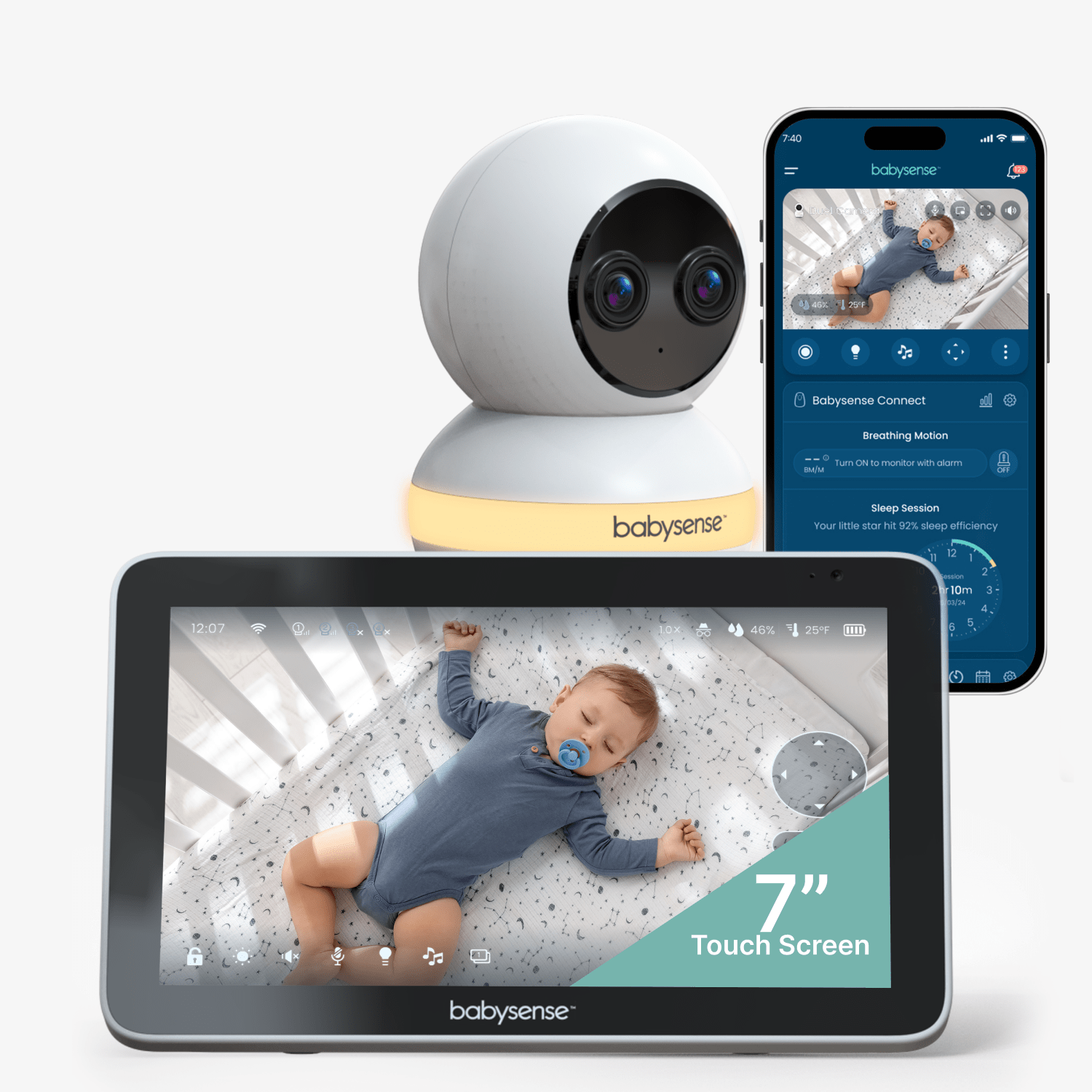
The exact U.S. package is listed as Touch™ Smart WiFi Baby Monitor, model BS-TOUCH-1CAM-US. The box list in the shared Touch guide names one 7-inch parent monitor, one camera and two power adapters, along with one wall-mount set. The parent display is not just a phone stand-in: the manual describes a direct local camera-to-parent-unit mode that works without Wi-Fi. In Dual mode, the camera connects to the parent unit and the Babysense app; remote phone viewing then needs the home network and internet path. That hybrid arrangement is more flexible than a phone-only camera, but it means remote access is not a property of the local radio link itself.
The 7-inch touchscreen, pan/tilt controls, two-way talk and temperature display are useful if you prefer to check the room on a bedside screen without picking up a phone. The listed 1,000-foot figure is an open-space maximum, not an indoor-distance promise. Walls, floors and nearby electronics can change reception, so the guide advises placing the equipment carefully and checking the signal in the intended location.
A dual-lens camera is still one camera unit
Babysense describes the camera as a 4MP dual-lens design, with wide-angle and telephoto optics, autofocus tracking, a focus area and up to 6× hybrid zoom. Those are two lens views on a camera that can pan and tilt; they are not two independently placed cameras. The manual's split-screen control is for multiple camera channels, and this exact package supplies only one camera. Although the single-camera listing uses “two rooms” and “true split-screen” language, its box list and package rendering show one camera, while the guide's split-screen control is described for multiple cameras. I would choose this package for one viewing point and not count it as two-room coverage. A second compatible camera would be an additional purchase, not part of this kit.
For a true side-by-side view of two separate camera locations from the start, compare the Touch two-camera kit. If you need a dependable two-room arrangement without home Wi-Fi, the Babysense PRO or Prisma twin packages are also worth comparing; their exact reviews explain that their two local pictures use one selected audio feed.
Alerts and comfort settings are prompts, not supervision
The manufacturer lists sound, motion and cry alerts in the app, while the Touch manual describes VOX sound activation, a no-face-detected alert, and automatic pan/tilt tracking. They are different features: tracking moves the camera, VOX wakes the screen after sound, and the page's cry-detection feature is a software alert. None establishes that every cry, movement or obscured face will be recognized promptly. Treat them as optional household prompts, not as safety alarms or health monitoring, and continue to check directly on a child.
Room temperature and humidity are displayed, with configurable temperature alerts; these are readings at the camera, not medical measurements. The camera has an adjustable night light, white noise and lullabies. The listing also describes optional microSD recording, but the card is not included. Storage capacity, retention duration and whether recording continues through a network interruption are not established by the package materials.
Battery and setup details worth knowing
The parent unit has a pre-installed 5,200mAh rechargeable battery. Runtime descriptions do not line up cleanly: the Touch guide says up to 30 hours standby or 10 hours with the screen on, while the product page says up to 20 hours in VOX mode or 12 hours of continuous screen time. These are manufacturer estimates rather than independent tests, and the different states are not directly comparable. Do not buy it to meet a strict battery-duration minimum without clarifying the intended use and current instructions.
The camera and parent unit use separate supplied power adapters. For installation, follow the exact guide: keep cords and the camera at least six feet from the crib, secure cables out of reach, and mount the camera where its view is useful without putting equipment in the sleep space. The dual-mode design is the main reason to choose this version; its main limit is that the one-camera box does not itself establish a two-room picture. Read the manufacturer listing and Touch user guide before choosing a placement or operating mode.
Key details at a glance
| Parent-unit screen | 7 in |
|---|---|
| Published display resolution | 7-inch IPS touchscreen; pixel matrix not stated in the manual. |
| Camera-to-parent-unit connection | Hybrid system: direct local camera-to-parent monitor operation without Wi-Fi; optional phone viewing uses the Babysense app and 2.4 GHz Wi-Fi. Remote access away from home needs an internet path. |
| Manufacturer-stated open-space range | 1000 ft |
| Advertised maximum range claim | 1000 ft |
| Cameras in the reviewed kit | 1 |
| Maximum camera units supported | 4 |
| Video rooms visible at once | 1 |
| Phone viewing away from home | Yes |
| User-replaceable parent-unit battery | No |
| Supplied camera lens setup | Each supplied PTZ camera has one wide-angle 3.0 mm lens and one telephoto 6.3 mm lens (4MP dual-lens system); the two lenses belong to a single camera unit and do not count as separate room cameras. |
| Recommended stable operation uses home Wi-Fi | No |
| Audio-only system | No |
| Parent talk-back | Yes |
| Room-temperature readout | Yes |
| Camera-side mood light | Yes |
| Parent receivers included | 1 |
Use the exact model’s instructions for operating limits, supplied equipment and version differences.
Sources for this assessment

Check the room and the receiving setup.
Read the exact model's constraints, camera count and supervision limits before choosing a package.